

Hycanthone |
Catalog No.GC32096
 One-Click Copy Product Info
|

Hycanthone is a thioxanthenone DNA intercalator and inhibits RNA synthesis as well as the DNA topoisomerases I and II.
Products are for research use only. Not for human use. We do not sell to patients.
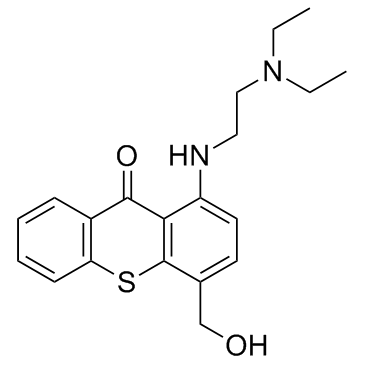
Cas No.: 3105-97-3
Sample solution is provided at 25 µL, 10mM.
_1-3.$$$39978408@51.jpg');)
_1-9.$$$38538795@65.jpg');)
_1-9.$$$39112701@51.jpg');)
_1-7.$$$37316672@70.jpg');)
_366-372.$$$36198801@70.jpg');)
.$$$38565142@65.jpg');)
_1867-1883.$$$33248023@67.jpg');)
_eads6055.$$$39977546@45.jpg');)
_eadm9805.$$$40080571@45.jpg');)
_eadj3020.$$$39666821@45.jpg');)
_1-20.$$$39757301@28.jpg');)
_1-24.$$$38898113@28.jpg');)
_273-287.$$$36806353@46.jpg');)
_1-16.$$$37156877@44.jpg');)
_1-19.$$$37460805@44.jpg');)
_1291-1307.$$$34518654@46.jpg');)
Hycanthone is an effective antischistosomai drug.
Hycanthone at 20 mg/mL or more is progressively more detrimental to cell viability. Results reveal that increased concentrations of Hycanthone, ranging from 0.1 to 10 μg/mL, progressively reduces viral interferon yields as much as 73% compare to that of controls[2].
Results show that the incorporation of tritiated thymidine into TCA-precipitable material of adult sensitive worms undergo a progressive decrease after treatment with Hycanthone. Immature worms are totally unaffected by Hycanthone at all times tested. Male worms treated with Hycanthone show signs of a possible partial recovery from the initial low levels of incorporation. The incorporation of tritiated leucine by drug-sensitive worms treated with Hycanthone is inhibited by 40 to 50% in the first four days after treatment. Results show that, 7 days after Hycanthone treatment, both ribosomal RNA species are reduced by at least 80% with respect to untreated worms, with some indication of a possible accumulation of heavier precursor molecules[1].
[1]. Pica Mattoccia L, et al. Effect of hycanthone administered in vivo upon the incorporation of radioactive precursors into macromolecules of Schistosoma mansoni. Mol Biochem Parasitol. 1983 Jun;8(2):99-107. [2]. Hahon N, et al. Action of antischistosomal drugs, hycanthone and its analog 1A-4 N-oxide, on viral interferon induction. J Toxicol Environ Health. 1980 Jul;6(4):705-12.
Cell experiment: | Appropriate quantities of Hycanthone (1 to 100 μg) in 10 mL maintenance medium are added to plastic flasks (75 cm2) containing approximately 3×10⁷ LLC-MK2 cells in monolayer, which are then incubated at 35°C for 24 h. Maintenance medium is decanted, and 2 mL influenza virus is added onto cell monolayers and incubated at 35°C for 2 h. The multiplicity of infection is approximately 1.0. Inoculum is removed and 10 mL maintenance medium is added to each flask, which is then incubated at 35°C for 24 h. Supernatant fluid is decanted, centrifuged at 100,000 g for 1 h, dialyzed against HCI-KCI buffer (pH 2.0) at 4°C for 24 h, and then dialyzed against two changes of phosphate-buffered saline (pH 7.1) at 4°C for 24 h. Fluids are passed through filters to obtain sterile preparations. Samples are stored at -80°C until assayed for interferon activity[2]. |
Animal experiment: | Female outbred Swiss albino mice used as definitive hosts weigh 18 to 20 g at the time of infection. Hycanthone is administered at 0.01 mL/g body weight intramuscularly by splitting the dose into the two hind legs, so that each mouse receives 80 mg/kg body weight of the free base. Treatments are usually performed during the 8th week after infection[1]. |
References: [1]. Pica Mattoccia L, et al. Effect of hycanthone administered in vivo upon the incorporation of radioactive precursors into macromolecules of Schistosoma mansoni. Mol Biochem Parasitol. 1983 Jun;8(2):99-107. | |
| Cas No. | 3105-97-3 | SDF | |
| Canonical SMILES | O=C1C2=C(SC3=C1C=CC=C3)C(CO)=CC=C2NCCN(CC)CC | ||
| Formula | C20H24N2O2S | M.Wt | 356.48 |
| Solubility | DMSO : 30 mg/mL (84.16 mM) | Storage | Store at -20°C |
| General tips | Please select the appropriate solvent to prepare the stock solution according to the
solubility of the product in different solvents; once the solution is prepared, please store it in
separate packages to avoid product failure caused by repeated freezing and thawing.Storage method
and period of the stock solution: When stored at -80°C, please use it within 6 months; when stored
at -20°C, please use it within 1 month. To increase solubility, heat the tube to 37°C and then oscillate in an ultrasonic bath for some time. |
||
| Shipping Condition | Evaluation sample solution: shipped with blue ice. All other sizes available: with RT, or with Blue Ice upon request. | ||
| Prepare stock solution | |||

|
1 mg | 5 mg | 10 mg |
| 1 mM | 2.8052 mL | 14.026 mL | 28.0521 mL |
| 5 mM | 561 μL | 2.8052 mL | 5.6104 mL |
| 10 mM | 280.5 μL | 1.4026 mL | 2.8052 mL |
Step 1: Enter information below (Recommended: An additional animal making an allowance for loss during the experiment)
 g
μL
g
μL
Step 2: Enter the in vivo formulation (This is only the calculator, not formulation. Please contact us first if there is no in vivo formulation at the solubility Section.)
Calculation results:
Working concentration: mg/ml;
Method for preparing DMSO master liquid: mg drug pre-dissolved in μL DMSO ( Master liquid concentration mg/mL, Please contact us first if the concentration exceeds the DMSO solubility of the batch of drug. )
Method for preparing in vivo formulation: Take μL DMSO master liquid, next addμL PEG300, mix and clarify, next addμL Tween 80, mix and clarify, next add μL saline, mix and clarify.
Method for preparing in vivo formulation: Take μL DMSO master liquid, next add μL Corn oil, mix and clarify.
Note: 1. Please make sure the liquid is clear before adding the next solvent.
2. Be sure to add the solvent(s) in order. You must ensure that the solution obtained, in the previous addition, is a clear solution before proceeding to add the next solvent. Physical methods such as vortex, ultrasound or hot water bath can be used to aid dissolving.
3. All of the above co-solvents are available for purchase on the GlpBio website.
Quality Control & SDS
- View current batch:
- Purity: >99.50% Appearance: A solid
- COA (Certificate of Analysis)
- SDS (Safety Data Sheet)
- Datasheet
Average Rating: 5 (Based on Reviews and 35 reference(s) in Google Scholar.)