

ISCK03 (Synonyms: c-Kit Inhibitor II,Stem-Cell Factor/c-Kit Inhibitor) |
Catalog No.GC13961
 One-Click Copy Product Info
|

inhibitor of SCF-mediated c-kit activation
Products are for research use only. Not for human use. We do not sell to patients.
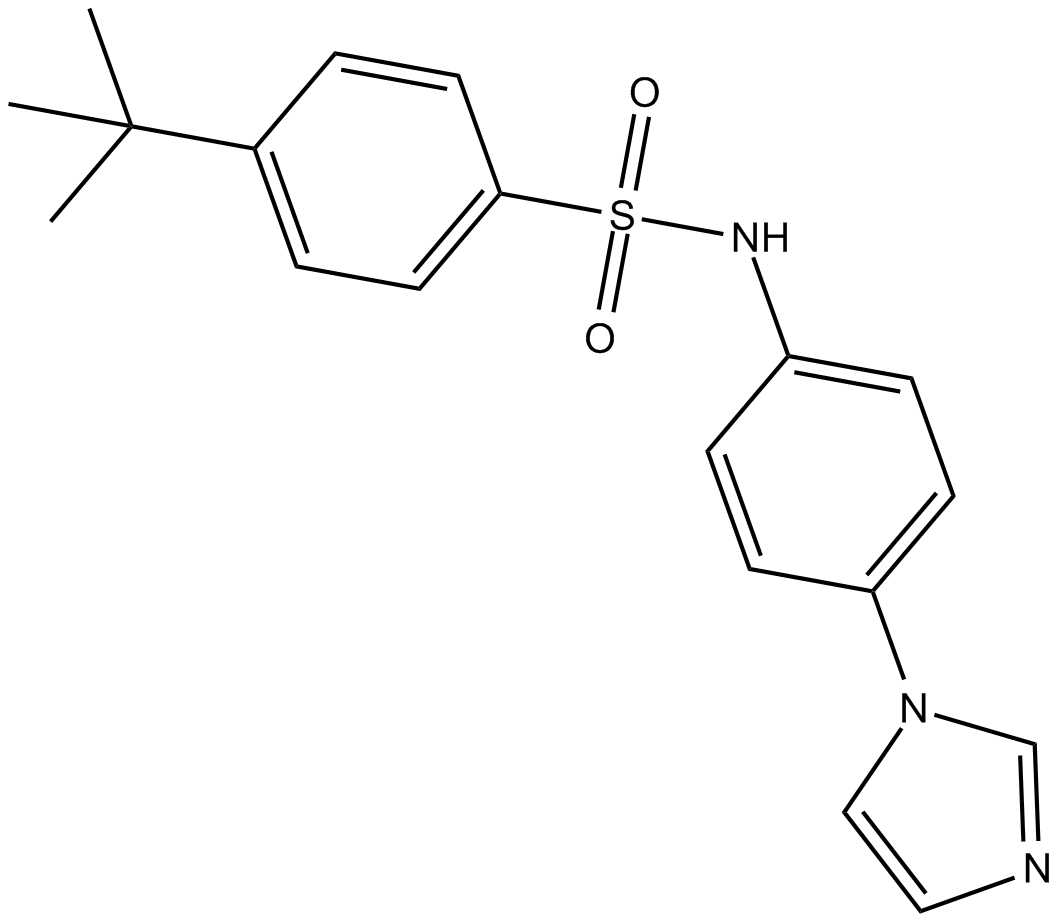
Cas No.: 945526-43-2
Sample solution is provided at 25 µL, 10mM.
_1-3.$$$39978408@51.jpg');)
_1-9.$$$38538795@65.jpg');)
_1-9.$$$39112701@51.jpg');)
_1-7.$$$37316672@70.jpg');)
_366-372.$$$36198801@70.jpg');)
.$$$38565142@65.jpg');)
_1867-1883.$$$33248023@67.jpg');)
_eads6055.$$$39977546@45.jpg');)
_eadm9805.$$$40080571@45.jpg');)
_eadj3020.$$$39666821@45.jpg');)
_1-20.$$$39757301@28.jpg');)
_1-24.$$$38898113@28.jpg');)
_273-287.$$$36806353@46.jpg');)
_1-16.$$$37156877@44.jpg');)
_1-19.$$$37460805@44.jpg');)
_1291-1307.$$$34518654@46.jpg');)
ISCK03 is an inhibitor of SCF-mediated c-kit activation.
The signaling downstream of SCF/c-kit plays a key role in the development of various mammalian cells, such as mast cells, melanocytes, primordial germ cells, and hematopoietic progenitor cells.
In vitro: Previous study showed that the pretreatment of 501mel cells with ISCK03 could dose-dependently inhibit SCF-induced c-kit phosphorylation. ISCK03 could also inhibit the phosphorylation of p44/42 ERK mitogen-activated protein kinase that was known to be involved in SCF/c-kit downstream signaling. However, ISCK03 was not able to inhibit hepatocyte growth factor-induced phosphorylation of p44/42 ERK proteins [1].
In vivo: To determine the in vivo efficacy, ISCK03was orally administered to depilated C57BL/6 mice. Results showed that the oral administration of ISCK03 could induce the dose-dependent depigmentation of newly regrown hair, and this was reversed with cessation of ISCK03 treatment. In addition, the topical application of ISCK03 could promote the depigmentation of UV-induced hyperpigmented spots on n brownish guinea pig skin. Moreover, the Fontana–Masson staining analyses showed epidermal melanin was diminished in spots treated with ISCK03 [1].
Clinical trial: Up to now, ISCK03 is still in the preclinical development stage.
References:
[1] Y. J. Na, H. S. Baek, S. M. Ahn, et al. [4-t-Butylphenyl]-N-(4-imidazol-1-yl phenyl)sulfonamide (ISCK03) inhibits SCF/c-kit signaling in 501mel human melanoma cells and abolishes melanin production in mice and brownish guinea pigs. Biochemical Pharmacology 74(5), 780-786 (2007).
|
Kinase experiment: |
ATP is dispensed into 384-well plates, chemical compounds (ISCK03: 2.5, 5, 10, 100 μM) are added by replicative plate, and recombinant human c-kit protein is added for the kinase reaction. Following a 45-min incubation at 37°C, the development reaction is carried out for 40 min at room temperature. After the reaction is stopped, the coumrain and fluorescein fluorescence-emission signals are detected[1]. |
|
Cell experiment: |
To determine any cytotoxic effects of ISCK03 on 501mel cells, MTT assays are performed with various doses of ISCK03 (1, 5, 10 μM). 501mel cells are cultured with SCF alone (50 ng/mL) or SCF with ISCK03 for 48 h[1]. |
|
Animal experiment: |
Mice: To induce the hair cycle, depilation of skin on the back of the female C57BL/6 mice is performed. Briefly, the hair is removed from anesthetized mice. The rat antimouse c-kit-neutralizing monoclonal antibody ACK2 is administered intraperitoneally (50 mg) every day. ISCK03 is administered orally once a day. On days 21–28, animals are sacrificed or analyzed for repigmentation of the newly regrown hair shaft. Skin is harvested and fixed in paraffin or frozen for immunohistochemical analyses[1]. |
|
References: [1]. Na YJ, et al. [4-t-butylphenyl]-N-(4-imidazol-1-yl phenyl)sulfonamide (ISCK03) inhibits SCF/c-kit signaling in 501mel human melanoma cells and abolishes melanin production in mice and brownish guinea pigs. Biochem Pharmacol. 2007 Sep 1;74(5):780-6. |
|
| Cas No. | 945526-43-2 | SDF | |
| Synonyms | c-Kit Inhibitor II,Stem-Cell Factor/c-Kit Inhibitor | ||
| Chemical Name | 4-(1,1-dimethylethyl)-N-[4-(1H-imidazol-1-yl)phenyl]-benzenesulfonamide | ||
| Canonical SMILES | O=S(NC1=CC=C(N2C=NC=C2)C=C1)(C3=CC=C(C(C)(C)C)C=C3)=O | ||
| Formula | C19H21N3O2S | M.Wt | 355.5 |
| Solubility | ≤2mg/ml in ethanol;25mg/ml in DMSO;30mg/ml in dimethyl formamide | Storage | Store at -20°C |
| General tips | Please select the appropriate solvent to prepare the stock solution according to the
solubility of the product in different solvents; once the solution is prepared, please store it in
separate packages to avoid product failure caused by repeated freezing and thawing.Storage method
and period of the stock solution: When stored at -80°C, please use it within 6 months; when stored
at -20°C, please use it within 1 month. To increase solubility, heat the tube to 37°C and then oscillate in an ultrasonic bath for some time. |
||
| Shipping Condition | Evaluation sample solution: shipped with blue ice. All other sizes available: with RT, or with Blue Ice upon request. | ||
| Prepare stock solution | |||

|
1 mg | 5 mg | 10 mg |
| 1 mM | 2.8129 mL | 14.0647 mL | 28.1294 mL |
| 5 mM | 562.6 μL | 2.8129 mL | 5.6259 mL |
| 10 mM | 281.3 μL | 1.4065 mL | 2.8129 mL |
Step 1: Enter information below (Recommended: An additional animal making an allowance for loss during the experiment)
 g
μL
g
μL
Step 2: Enter the in vivo formulation (This is only the calculator, not formulation. Please contact us first if there is no in vivo formulation at the solubility Section.)
Calculation results:
Working concentration: mg/ml;
Method for preparing DMSO master liquid: mg drug pre-dissolved in μL DMSO ( Master liquid concentration mg/mL, Please contact us first if the concentration exceeds the DMSO solubility of the batch of drug. )
Method for preparing in vivo formulation: Take μL DMSO master liquid, next addμL PEG300, mix and clarify, next addμL Tween 80, mix and clarify, next add μL saline, mix and clarify.
Method for preparing in vivo formulation: Take μL DMSO master liquid, next add μL Corn oil, mix and clarify.
Note: 1. Please make sure the liquid is clear before adding the next solvent.
2. Be sure to add the solvent(s) in order. You must ensure that the solution obtained, in the previous addition, is a clear solution before proceeding to add the next solvent. Physical methods such as vortex, ultrasound or hot water bath can be used to aid dissolving.
3. All of the above co-solvents are available for purchase on the GlpBio website.
Quality Control & SDS
- View current batch:
- Purity: >98.00% Appearance: A solid
- COA (Certificate of Analysis)
- SDS (Safety Data Sheet)
- Datasheet
Average Rating: 5 (Based on Reviews and 3 reference(s) in Google Scholar.)