

Isoshaftoside |
Catalog No.GN10438
 One-Click Copy Product Info
|

Isoshaftoside is a C-glycosylflavonoid and can be isolated from plants like Passiflora incarnata L., Viola yedoensis Makino, and Abrus cantoniensis, and it can inhibit the growth of germinating S. hermonthica radicles.
Products are for research use only. Not for human use. We do not sell to patients.
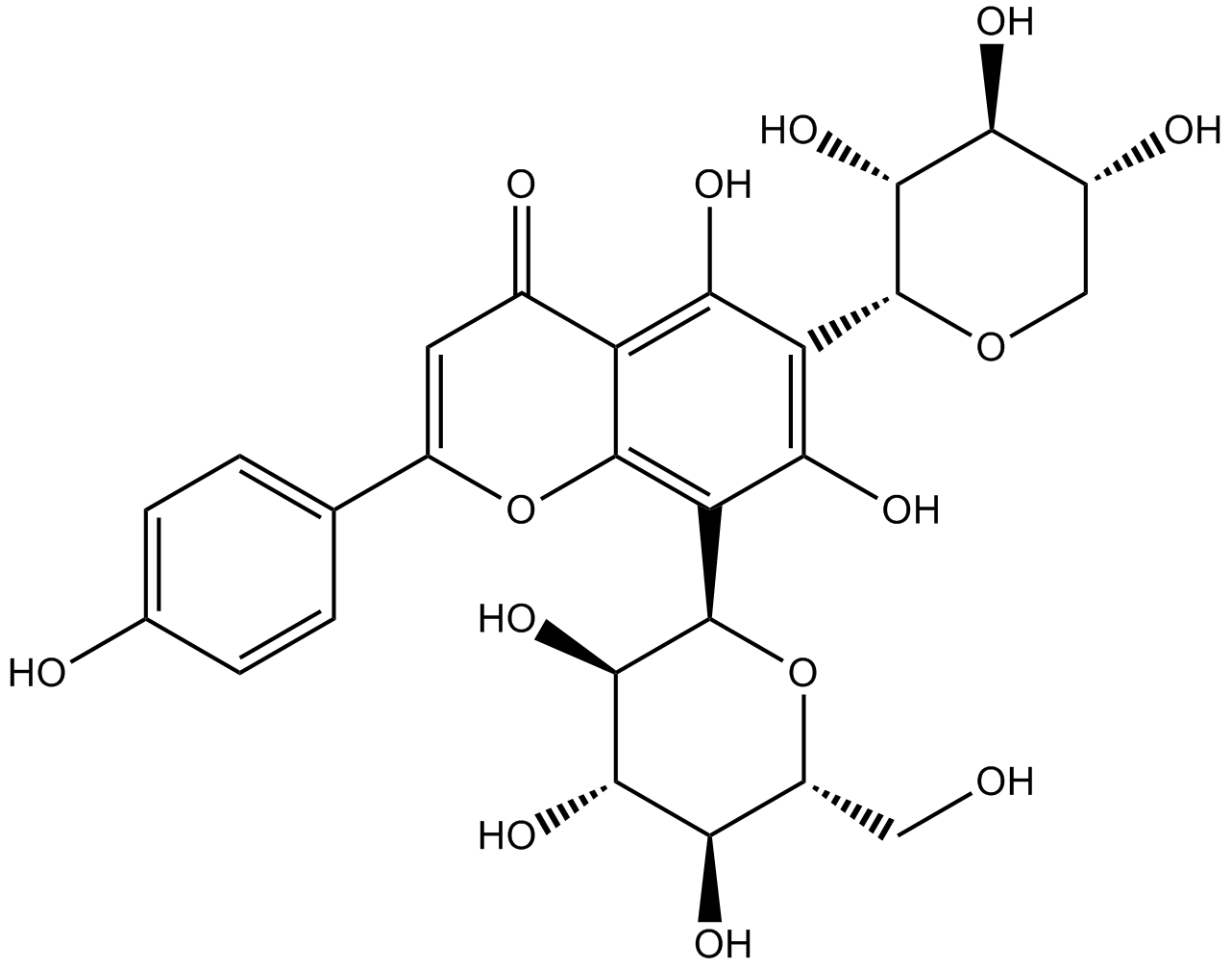
Cas No.: 52012-29-0
Sample solution is provided at 25 µL, 10mM.
_1-3.$$$39978408@51.jpg');)
_1-9.$$$38538795@65.jpg');)
_1-9.$$$39112701@51.jpg');)
_1-7.$$$37316672@70.jpg');)
_366-372.$$$36198801@70.jpg');)
.$$$38565142@65.jpg');)
_1867-1883.$$$33248023@67.jpg');)
_eads6055.$$$39977546@45.jpg');)
_eadm9805.$$$40080571@45.jpg');)
_eadj3020.$$$39666821@45.jpg');)
_1-20.$$$39757301@28.jpg');)
_1-24.$$$38898113@28.jpg');)
_273-287.$$$36806353@46.jpg');)
_1-16.$$$37156877@44.jpg');)
_1-19.$$$37460805@44.jpg');)
_1291-1307.$$$34518654@46.jpg');)
Isoshaftoside is a C-glycosylflavonoid and can be isolated from plants like Passiflora incarnata L., Viola yedoensis Makino, and Abrus cantoniensis, and it can inhibit the growth of germinating S. hermonthica radicles[1][2][3]. Isoshaftoside exert several pharmacological effects, such as anti inflammatory[4] and antioxidant effects[5].
Isoshaftoside (1µM; 12d) treatment can restore mitochondrial function and reduce glycolysis dependence in human dermal fibroblasts[6]. In HepG2 cells, treatment with Isoshaftoside at 300µM for 24 hours reduced the expression levels of LC3-II and p62[7].
Isoshaftoside (20mg/kg/day; 4 weeks; ip) treatment can reduce the body weight of high-fat diet mice and alleviate hepatic steatosis in nonalcoholic fatty liver disease(NAFLD)[7]. Isoshaftoside (50µM; 12 weeks; oral) treatment significantly decreased lobular inflammation fibrosis induced by a high-fat diet[8].
References:
[1]. Toda K, Hitoe S, Takeda S, et al. Passionflower Extract Induces High-amplitude Rhythms without Phase Shifts in the Expression of Several Circadian Clock Genes in Vitro and in Vivo. Int J Biomed Sci. 2017 Jun;13(2):84-92. PMID: 28824345; PMCID: PMC5542920.
[2]. Hu XL, Niu YJ, Chen M, et al. Preventive Effects of Total Flavonoid C-Glycosides from Abrus mollis on Nonalcoholic Fatty Liver Disease through Activating the PPARα Signaling Pathway. Planta Med. 2019 May;85(8):678-688. doi: 10.1055/a-0895-5838. Epub 2019 Apr 26. PMID: 31026873.
[3]. Hooper AM, Tsanuo MK, Chamberlain K, et al. Isoschaftoside, a C-glycosylflavonoid from Desmodium uncinatum root exudate, is an allelochemical against the development of Striga. Phytochemistry. 2010 Jun;71(8-9):904-8. doi: 10.1016/j.phytochem.2010.02.015. Epub 2010 Mar 6. PMID: 20211477.
[4]. Guan S, Sun L, Wang X, et al. Isoschaftoside Inhibits Lipopolysaccharide-Induced Inflammation in Microglia through Regulation of HIF-1α-Mediated Metabolic Reprogramming. Evid Based Complement Alternat Med. 2022 Nov 23;2022:5227335. doi: 10.1155/2022/5227335. PMID: 36467557; PMCID: PMC9711954.
[5]. Congyou DENG, Xinhe LEI, Minyou HE, et al. Identifying the active antioxidant ingredients in Arisaema Cum Bile aqueous extract on the basis of spectrum-effect relationships. Chinese Journal of Analytical Chemistry,Volume 52, Issue 12,2024,100453,ISSN 1872-2040.https://doi.org/10.1016/j.cjac.2024.100453.
[6]. Lee YH, So BH, Lee KS, et al. Identification of Cellular Isoschaftoside-Mediated Anti-Senescence Mechanism in RAC2 and LINC00294. Molecules. 2024 Sep 4;29(17):4182. doi: 10.3390/molecules29174182. PMID: 39275030; PMCID: PMC11397025.
[7]. Su Y, Kang Y, Yi J, et al. Isoschaftoside Reverses Nonalcoholic Fatty Liver Disease via Activating Autophagy In Vivo and In Vitro. Evid Based Complement Alternat Med. 2022 Jun 27;2022:2122563. doi: 10.1155/2022/2122563. PMID: 35795282; PMCID: PMC9252632.
[8]. Abe T. Isoschaftoside in Fig Leaf Tea Alleviates Nonalcoholic Fatty Liver Disease in Mice via the Regulation of Macrophage Polarity. Nutrients. 2025 Feb 21;17(5):757. doi: 10.3390/nu17050757. PMID: 40077628; PMCID: PMC11902273.
| Cell experiment [1]: | |
|
Cell lines |
Human dermal fibroblasts |
|
Preparation Method |
Senescent human dermal fibroblasts were treated with 4µM Isoshaftoside for 12 days. Then cells were stained with 10μg/mL DHR123 and ROS was measured by FACS. |
|
Reaction Conditions |
4µM; 12 days |
|
Applications |
Isoshaftoside treatment significantly reduces reactive oxygen species (ROS) levels in senescent cells. |
| Animal experiment [2]: | |
|
Animal models |
Nonalcoholic fatty liver disease (NAFLD) model mice |
|
Preparation Method |
NAFLD animal model was conducted using C57 mice fed with a high-fat diet. NAFLD model mice were treated with Isoshaftoside (20mg/kg/day) for 4 weeks. Blood samples were collected and serum levels of alanine transaminase (ALT), aspartate transaminase (AST), fasting blood glucose (GLU), total cholesterol (TC), and triglyceride (TG) were examined with blood index kits. |
|
Dosage form |
20mg/kg/day; 4 weeks; ip. |
|
Applications |
Isoshaftosidee reversed the damage to liver function and the elevation of blood glucose caused by a high-fat diet. |
|
References: |
|
| Cas No. | 52012-29-0 | SDF | |
| Chemical Name | 5,7-dihydroxy-2-(4-hydroxyphenyl)-8-[(2S,3R,4R,5S,6R)-3,4,5-trihydroxy-6-(hydroxymethyl)oxan-2-yl]-6-[(2S,3R,4S,5S)-3,4,5-trihydroxyoxan-2-yl]chromen-4-one | ||
| Canonical SMILES | C1C(C(C(C(O1)C2=C(C3=C(C(=C2O)C4C(C(C(C(O4)CO)O)O)O)OC(=CC3=O)C5=CC=C(C=C5)O)O)O)O)O | ||
| Formula | C26H28O14 | M.Wt | 564.49 |
| Solubility | ≥ 56.4mg/mL in DMSO | Storage | 4°C, protect from light |
| General tips | Please select the appropriate solvent to prepare the stock solution according to the
solubility of the product in different solvents; once the solution is prepared, please store it in
separate packages to avoid product failure caused by repeated freezing and thawing.Storage method
and period of the stock solution: When stored at -80°C, please use it within 6 months; when stored
at -20°C, please use it within 1 month. To increase solubility, heat the tube to 37°C and then oscillate in an ultrasonic bath for some time. |
||
| Shipping Condition | Evaluation sample solution: shipped with blue ice. All other sizes available: with RT, or with Blue Ice upon request. | ||
| Prepare stock solution | |||

|
1 mg | 5 mg | 10 mg |
| 1 mM | 1.7715 mL | 8.8576 mL | 17.7151 mL |
| 5 mM | 354.3 μL | 1.7715 mL | 3.543 mL |
| 10 mM | 177.2 μL | 885.8 μL | 1.7715 mL |
Step 1: Enter information below (Recommended: An additional animal making an allowance for loss during the experiment)
 g
μL
g
μL
Step 2: Enter the in vivo formulation (This is only the calculator, not formulation. Please contact us first if there is no in vivo formulation at the solubility Section.)
Calculation results:
Working concentration: mg/ml;
Method for preparing DMSO master liquid: mg drug pre-dissolved in μL DMSO ( Master liquid concentration mg/mL, Please contact us first if the concentration exceeds the DMSO solubility of the batch of drug. )
Method for preparing in vivo formulation: Take μL DMSO master liquid, next addμL PEG300, mix and clarify, next addμL Tween 80, mix and clarify, next add μL saline, mix and clarify.
Method for preparing in vivo formulation: Take μL DMSO master liquid, next add μL Corn oil, mix and clarify.
Note: 1. Please make sure the liquid is clear before adding the next solvent.
2. Be sure to add the solvent(s) in order. You must ensure that the solution obtained, in the previous addition, is a clear solution before proceeding to add the next solvent. Physical methods such as vortex, ultrasound or hot water bath can be used to aid dissolving.
3. All of the above co-solvents are available for purchase on the GlpBio website.
Quality Control & SDS
- View current batch:
- Purity: >98.00% Appearance: A solid
- COA (Certificate of Analysis)
- SDS (Safety Data Sheet)
- Datasheet
Average Rating: 5 (Based on Reviews and 30 reference(s) in Google Scholar.)