

Kanamycin A |
Catalog No.GC16515
 One-Click Copy Product Info
|

A broad spectrum antibiotic
Products are for research use only. Not for human use. We do not sell to patients.
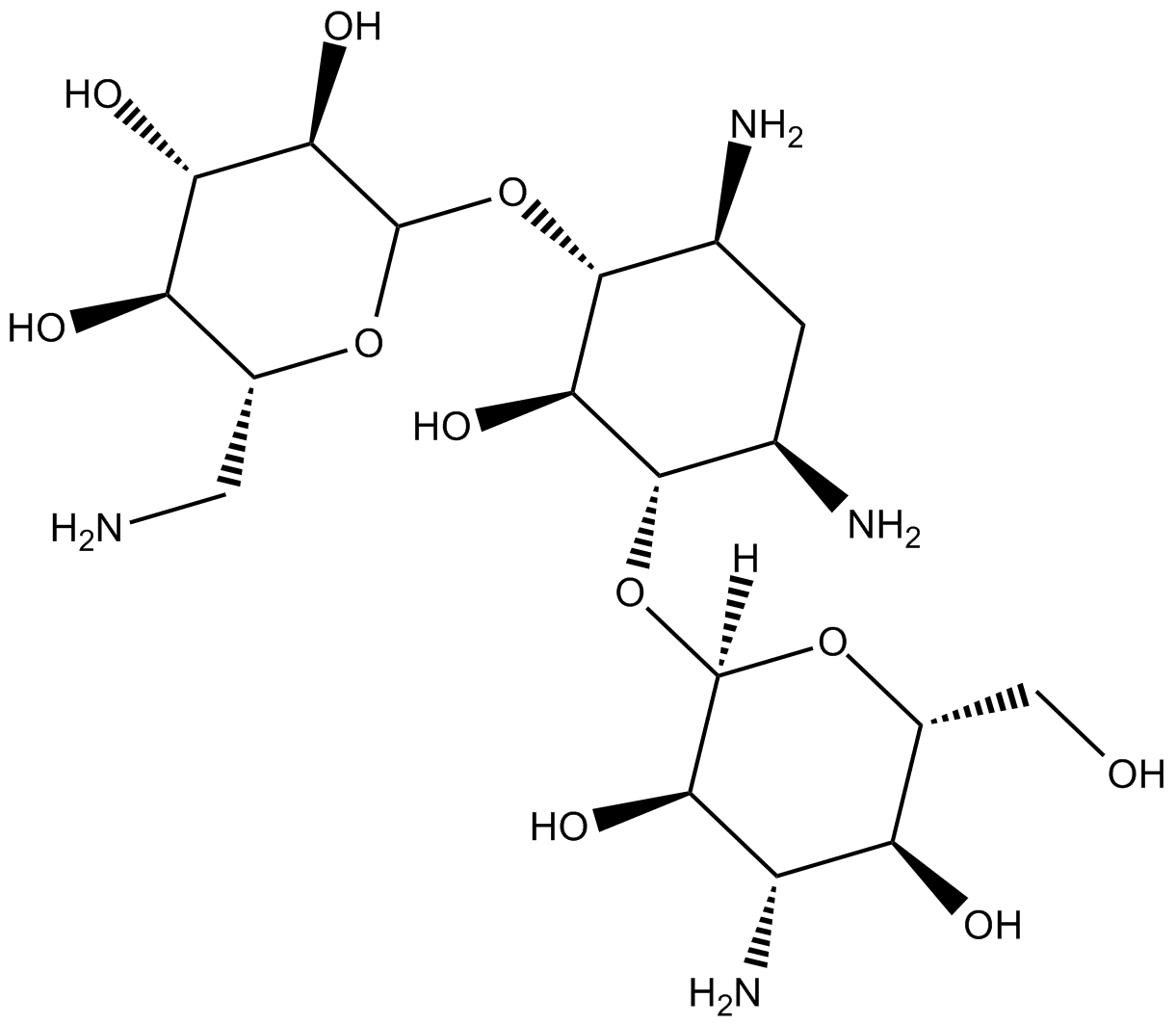
Cas No.: 59-01-8
Sample solution is provided at 25 µL, 10mM.
_1-3.$$$39978408@51.jpg');)
_1-9.$$$38538795@65.jpg');)
_1-9.$$$39112701@51.jpg');)
_1-7.$$$37316672@70.jpg');)
_366-372.$$$36198801@70.jpg');)
.$$$38565142@65.jpg');)
_1867-1883.$$$33248023@67.jpg');)
_eads6055.$$$39977546@45.jpg');)
_eadm9805.$$$40080571@45.jpg');)
_eadj3020.$$$39666821@45.jpg');)
_1-20.$$$39757301@28.jpg');)
_1-24.$$$38898113@28.jpg');)
_273-287.$$$36806353@46.jpg');)
_1-16.$$$37156877@44.jpg');)
_1-19.$$$37460805@44.jpg');)
_1291-1307.$$$34518654@46.jpg');)
Kanamycin A is a broad spectrum antibiotic.
Kanamycin A was first isolated in 1957 by Hamao Umezawa from the bacterium Streptomyces kanamyceticus.
In vitro: In previous study, kanamycin A was found to block a single cycle of translocation on the poly[U]-ribosome, carrying N-acetyl-diPhe-tRNA on the acceptor site and deacylated tRNA at the donor site. The GTPase reaction, catalyzed by EF-G and ribosomes, was not significantly affected by kanamycin A. The results with kanamycin A differed from those obtained with fusidic acid, suggesting that the mechanism of translocation inhibition might be differen [1].
In vivo: Twelve male Lister hooded rats were conditioned to discriminate an 8 kHz tone and were subsequently injected subcutaneously with kanamycin A for 28 days. Results showed that only one rat was unaffected by the kanamycin A. The onset of hearing impairment generally occurred during the fourth week of kanamycin dosage although the earliest onset was towards the end of the second week. In most animals the hearing impairment progressed after kanamycin A was stopped and in one rat there was a latency between the end of drug dosage and onset of hearing impairment [2].
Clinical trial: Kanamycin A is an antibiotic used to treat severe bacterial infections and tuberculosis. It is not a first line treatment. Kanamycin A is recommended for short-term use only [3].
References:
[1] Misumi, M. and Tanaka, N. Mechanism of inhibition of translocation by kanamycin and viomycin: A comparative study with fusidic acid. Biochemical and Biophysical Research Communications 92(2), 647-654 (1980).
[2] Harpur ES, D'Arcy PF. The quantification of kanamycin ototoxicity in the rat using conditioned tone discrimination. J Pharm Pharmacol. 1975 Dec;27(12):907-13.
[3] https://en. wikipedia.org/wiki/Kanamycin_A
| Cas No. | 59-01-8 | SDF | |
| Chemical Name | O-3-amino-3-deoxy-α-D-glucopyranosyl-(1→6)-O-[6-amino-6-deoxy-α-D-glucopyranosyl-(1→4)]-2-deoxy-D-streptamine | ||
| Canonical SMILES | N[C@H]([C@H]1O)[C@H](O)[C@@H](CO)O[C@]1([H])O[C@H]([C@H]2O)[C@H](N)C[C@H](N)[C@H]2OC3O[C@H](CN)[C@@H](O)[C@H](O)[C@H]3O | ||
| Formula | C18H36N4O11 | M.Wt | 484.5 |
| Solubility | insoluble in DMSO | Storage | Store at -20°C |
| General tips | Please select the appropriate solvent to prepare the stock solution according to the
solubility of the product in different solvents; once the solution is prepared, please store it in
separate packages to avoid product failure caused by repeated freezing and thawing.Storage method
and period of the stock solution: When stored at -80°C, please use it within 6 months; when stored
at -20°C, please use it within 1 month. To increase solubility, heat the tube to 37°C and then oscillate in an ultrasonic bath for some time. |
||
| Shipping Condition | Evaluation sample solution: shipped with blue ice. All other sizes available: with RT, or with Blue Ice upon request. | ||
| Prepare stock solution | |||

|
1 mg | 5 mg | 10 mg |
| 1 mM | 2.064 mL | 10.3199 mL | 20.6398 mL |
| 5 mM | 412.8 μL | 2.064 mL | 4.128 mL |
| 10 mM | 206.4 μL | 1.032 mL | 2.064 mL |
Step 1: Enter information below (Recommended: An additional animal making an allowance for loss during the experiment)
 g
μL
g
μL
Step 2: Enter the in vivo formulation (This is only the calculator, not formulation. Please contact us first if there is no in vivo formulation at the solubility Section.)
Calculation results:
Working concentration: mg/ml;
Method for preparing DMSO master liquid: mg drug pre-dissolved in μL DMSO ( Master liquid concentration mg/mL, Please contact us first if the concentration exceeds the DMSO solubility of the batch of drug. )
Method for preparing in vivo formulation: Take μL DMSO master liquid, next addμL PEG300, mix and clarify, next addμL Tween 80, mix and clarify, next add μL saline, mix and clarify.
Method for preparing in vivo formulation: Take μL DMSO master liquid, next add μL Corn oil, mix and clarify.
Note: 1. Please make sure the liquid is clear before adding the next solvent.
2. Be sure to add the solvent(s) in order. You must ensure that the solution obtained, in the previous addition, is a clear solution before proceeding to add the next solvent. Physical methods such as vortex, ultrasound or hot water bath can be used to aid dissolving.
3. All of the above co-solvents are available for purchase on the GlpBio website.
Quality Control & SDS
- View current batch:
- Appearance: A solid
- COA (Certificate of Analysis)
- SDS (Safety Data Sheet)
- Datasheet
Average Rating: 5 (Based on Reviews and 26 reference(s) in Google Scholar.)