

KRN 633 |
Catalog No.GC12590
 One-Click Copy Product Info
|

VEGFR inhibitor,ATP-competitive
Products are for research use only. Not for human use. We do not sell to patients.
Cas No.: 286370-15-8
Sample solution is provided at 25 µL, 10mM.
_1-3.$$$39978408@51.jpg');)
_1-9.$$$38538795@65.jpg');)
_1-9.$$$39112701@51.jpg');)
_1-7.$$$37316672@70.jpg');)
_366-372.$$$36198801@70.jpg');)
.$$$38565142@65.jpg');)
_1867-1883.$$$33248023@67.jpg');)
_eads6055.$$$39977546@45.jpg');)
_eadm9805.$$$40080571@45.jpg');)
_eadj3020.$$$39666821@45.jpg');)
_1-20.$$$39757301@28.jpg');)
_1-24.$$$38898113@28.jpg');)
_273-287.$$$36806353@46.jpg');)
_1-16.$$$37156877@44.jpg');)
_1-19.$$$37460805@44.jpg');)
_1291-1307.$$$34518654@46.jpg');)
KRN 633 is a selective inhibitor of VEGFR-1, VEGFR-2 and VEGFR-3 with IC50 value of 170 nM, 160 nM and 125 nM [1].
Vascular endothelial growth factor receptor (VEGFR) is a protein and plays an important role in tumor angiogenesis by cooperating with its ligand VEGF [1].
KRN 633 is a potent VEGFR inhibitor. When tested with HUVECs, KRN 633 inhibited the cell proliferation that mediated by VEGF with the IC50 value of 14.9 nmol/L and suppressed the capillary tube formation by ~50% at the dose of 10 nmol/L [1].
In mid-pregnant mice model, KRN633 was used at the dose of 5 mg/kg once daily from embryonic day 13.5 until the day of delivery and the effect on vascular growth was slightly delayed on postnatal day 4 (P4) and on P8 it was observed that KRN633 resulted in the decreased numbers of central arteries and veins and abnormal branching of the central arteries [2]. When tested with athymic mouse xenograft HT29 cells model, administration of KRN633 inhibited tumor growth as ~90% from the initial tumor volume rangs from 500-667 mm3, while had less effect Du145 xenograft mouse models by inhibiting tumor angiogenesis and vascular permeability [1].
References:
[1]. Nakamura, K., et al., KRN633: A selective inhibitor of vascular endothelial growth factor receptor-2 tyrosine kinase that suppresses tumor angiogenesis and growth. Mol Cancer Ther, 2004. 3(12): p. 1639-49.
[2]. Morita, A., et al., Treatment of mid-pregnant mice with KRN633, an inhibitor of vascular endothelial growth factor receptor tyrosine kinase, induces abnormal retinal vascular patterning in their newborn pups. Birth Defects Res B Dev Reprod Toxicol, 2014. 101(4): p. 293-9.
Kinase experiment: | Cell-free kinase assays are done to obtain IC50 values against a variety of recombinant receptor and non-RTKs. KRN-633 is tested from 0.3 nM to 10 μM. All assays are done in quadruplicate with 1 μM ATP[1]. |
Cell experiment: | A549, Ls174T, HT29, DU145, LNCap, and PC-3 cells cancer cells are cultured for 24 hours before adding KRN-633 (0.01 to 10 μM) or vehicle (0.1% DMSO in medium) and then grow for a further 96 hours. Cell viability is measured using WST-1 reagent. The percentage viability is determined relative to the untreated control[1]. |
Animal experiment: | Rats: Human tumor xenografts are established in the hind flank of athymic rats (BALB/cA, Jcl-nu). Rats are randomized into groups of five at the point when the tumors reach the average size indicated (162 to 657 mm3) and are then treated with KRN-633 or vehicle, either once (qd) or twice (bid) per day, at the dosages shown. The percentage of tumor growth inhibition compared with the vehicle-treated group is calculated on the day after the last treatment (day 14)[1]. Mice: The mice are randomized into groups of five at the point when the tumors reached the average sizes: 103 to 260 mm3 or 500 to 667 mm3. They are then treated with KRN-633 or vehicle, either once (qd) or twice (bid) per day, at the dosages of 10-100 mg/kg. The percentage of tumor growth inhibition (TGI) compared with the vehicle-treated group is calculated on the day after the last treatment[1]. |
References: [1]. Nakamura K, et al. KRN633: A selective inhibitor of vascular endothelial growth factor receptor-2 tyrosine kinase that suppresses tumor angiogenesis and growth. Mol Cancer Ther. 2004 Dec;3(12):1639-49. | |
| Cas No. | 286370-15-8 | SDF | |
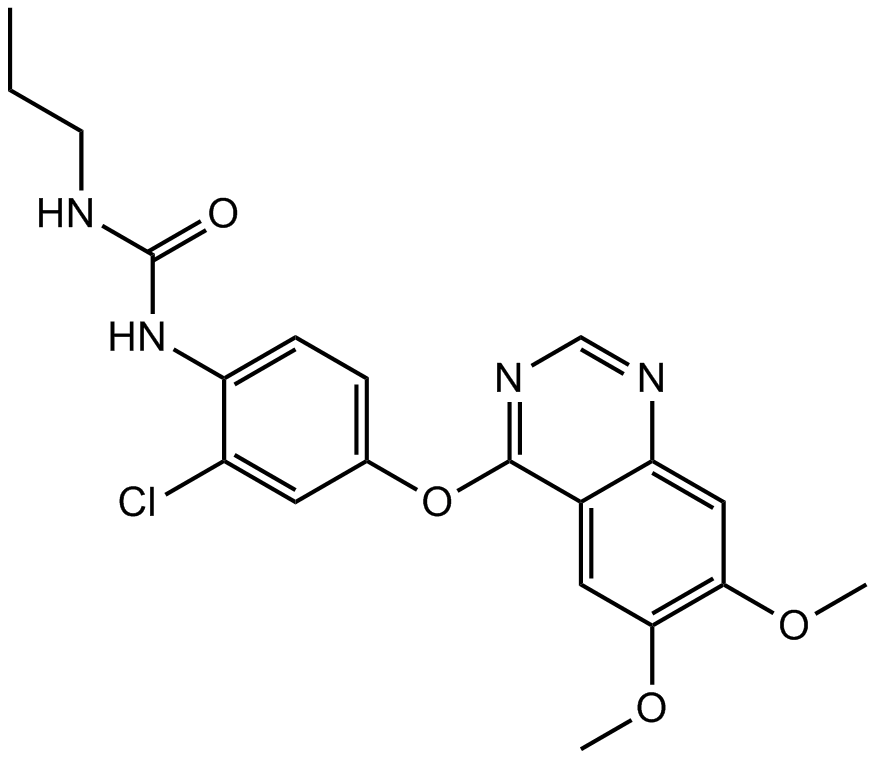
| Chemical Name | 1-[2-chloro-4-(6,7-dimethoxyquinazolin-4-yl)oxyphenyl]-3-propylurea | ||
| Canonical SMILES | CCCNC(=O)NC1=C(C=C(C=C1)OC2=NC=NC3=CC(=C(C=C32)OC)OC)Cl | ||
| Formula | C20H21ClN4O4 | M.Wt | 416.86 |
| Solubility | ≥ 13.75mg/mL in DMSO with gentle warming | Storage | Store at -20°C |
| General tips | Please select the appropriate solvent to prepare the stock solution according to the
solubility of the product in different solvents; once the solution is prepared, please store it in
separate packages to avoid product failure caused by repeated freezing and thawing.Storage method
and period of the stock solution: When stored at -80°C, please use it within 6 months; when stored
at -20°C, please use it within 1 month. To increase solubility, heat the tube to 37°C and then oscillate in an ultrasonic bath for some time. |
||
| Shipping Condition | Evaluation sample solution: shipped with blue ice. All other sizes available: with RT, or with Blue Ice upon request. | ||
| Prepare stock solution | |||

|
1 mg | 5 mg | 10 mg |
| 1 mM | 2.3989 mL | 11.9944 mL | 23.9889 mL |
| 5 mM | 479.8 μL | 2.3989 mL | 4.7978 mL |
| 10 mM | 239.9 μL | 1.1994 mL | 2.3989 mL |
Step 1: Enter information below (Recommended: An additional animal making an allowance for loss during the experiment)
 g
μL
g
μL
Step 2: Enter the in vivo formulation (This is only the calculator, not formulation. Please contact us first if there is no in vivo formulation at the solubility Section.)
Calculation results:
Working concentration: mg/ml;
Method for preparing DMSO master liquid: mg drug pre-dissolved in μL DMSO ( Master liquid concentration mg/mL, Please contact us first if the concentration exceeds the DMSO solubility of the batch of drug. )
Method for preparing in vivo formulation: Take μL DMSO master liquid, next addμL PEG300, mix and clarify, next addμL Tween 80, mix and clarify, next add μL saline, mix and clarify.
Method for preparing in vivo formulation: Take μL DMSO master liquid, next add μL Corn oil, mix and clarify.
Note: 1. Please make sure the liquid is clear before adding the next solvent.
2. Be sure to add the solvent(s) in order. You must ensure that the solution obtained, in the previous addition, is a clear solution before proceeding to add the next solvent. Physical methods such as vortex, ultrasound or hot water bath can be used to aid dissolving.
3. All of the above co-solvents are available for purchase on the GlpBio website.
Quality Control & SDS
- View current batch:
- Purity: >99.00% Appearance: A solid
- COA (Certificate of Analysis)
- SDS (Safety Data Sheet)
- Datasheet
Average Rating: 5 (Based on Reviews and 39 reference(s) in Google Scholar.)