

Pim1/AKK1-IN-1 (Synonyms: LKB1/AAK1 dual inhibitor) |
Catalog No.GC13154
 One-Click Copy Product Info
|

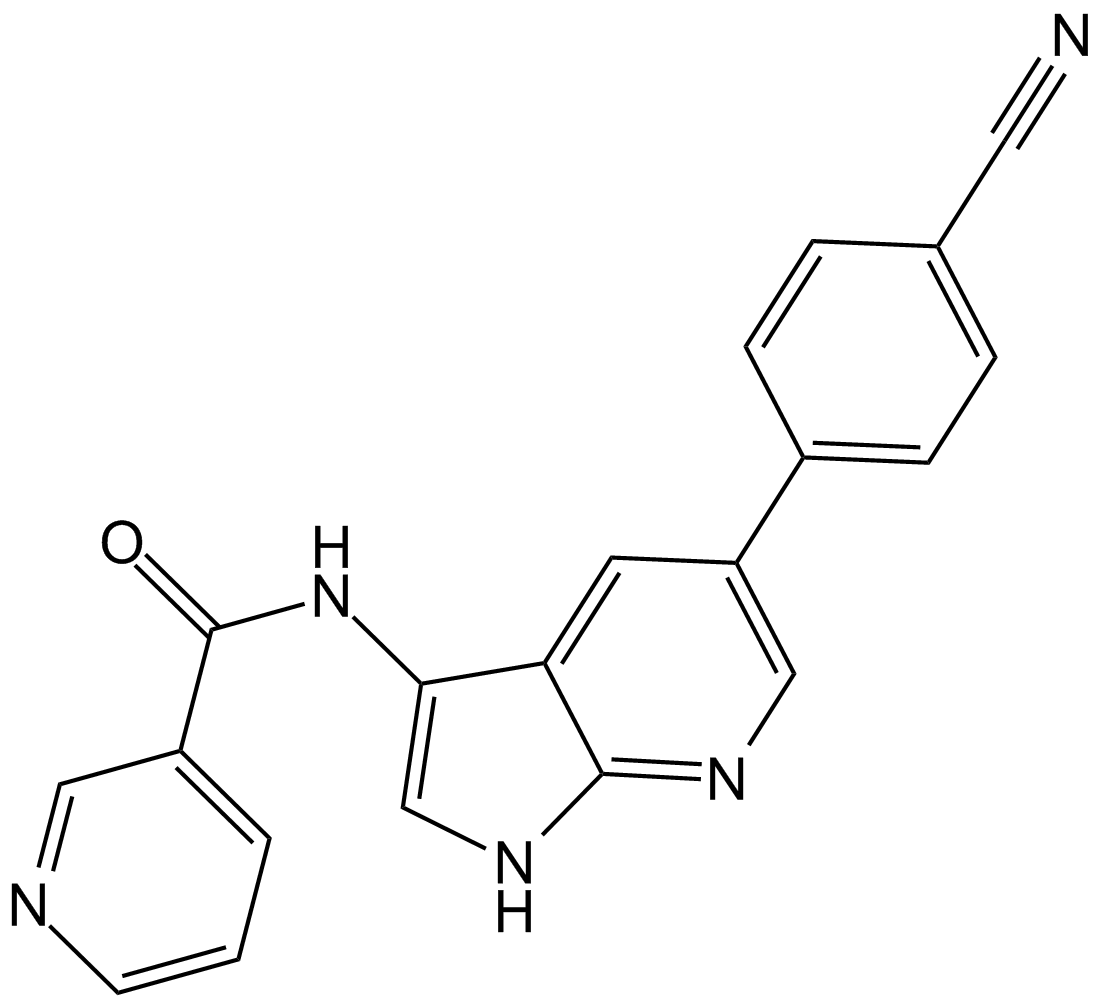
Pim1/AKK1-IN-1 is a potent multi-kinase inhibitor that exerts inhibitory effects on kinases including Pim1, AKK1 (AAK1), LKB1 and MST2.
Products are for research use only. Not for human use. We do not sell to patients.
Cas No.: 1093222-27-5
Sample solution is provided at 25 µL, 10mM.
_1-3.$$$39978408@51.jpg');)
_1-9.$$$38538795@65.jpg');)
_1-9.$$$39112701@51.jpg');)
_1-7.$$$37316672@70.jpg');)
_366-372.$$$36198801@70.jpg');)
.$$$38565142@65.jpg');)
_1867-1883.$$$33248023@67.jpg');)
_eads6055.$$$39977546@45.jpg');)
_eadm9805.$$$40080571@45.jpg');)
_eadj3020.$$$39666821@45.jpg');)
_1-20.$$$39757301@28.jpg');)
_1-24.$$$38898113@28.jpg');)
_273-287.$$$36806353@46.jpg');)
_1-16.$$$37156877@44.jpg');)
_1-19.$$$37460805@44.jpg');)
_1291-1307.$$$34518654@46.jpg');)
Pim1/AKK1-IN-1 is a potent multi-kinase inhibitor that exerts inhibitory effects on kinases including Pim1, AKK1 (AAK1), LKB1 and MST2[1]. These kinases play key roles in regulating cell proliferation-apoptosis balance, endocytic transport, and energy metabolism[2][3]. Pim1/AKK1-IN-1 is usually used in metabolic and viral infection-related research[4][5].
In vitro, Pim1/AKK1-IN-1 (10-1000nM; 48h) dose-dependently reversed NaB-induced suppression of STAT6 phosphorylation, nuclear translocation, and IL-4R recruitment in bone marrow-derived macrophages[6].
In vivo, Pim1/AKK1-IN-1 (40mg/kg; single intraperitoneal injection) exacerbated DSS-induced colitis in mice, increased colonic UGT1A4 levels and bile acid accumulation, caused greater weight loss compared to DSS treatment alone[7].
References:
[1] Bamborough P, Drewry D, Harper G, Smith GK, Schneider K. Assessment of chemical coverage of kinome space and its implications for kinase drug discovery. J Med Chem. 2008;51(24):7898-7914.
[2] Trelford CB, Shepherd TG. LKB1 biology: assessing the therapeutic relevancy of LKB1 inhibitors. Cell Commun Signal. 2024;22(1):310.
[3] Xin X, Wang Y, Zhang L, et al. Development and therapeutic potential of adaptor-associated kinase 1 inhibitors in human multifaceted diseases. Eur J Med Chem. 2023;248:115102.
[4] Zhou B, Luo Y, Ji N, Hu C, Lu Y. Orosomucoid 2 maintains hepatic lipid homeostasis through suppression of de novo lipogenesis. Nat Metab. 2022;4(9):1185-1201.
[5] Garcia-Carceles J, Caballero E, Gil C, Martinez A. Kinase Inhibitors as Underexplored Antiviral Agents. J Med Chem. 2022;65(2):935-954.
[6] Liang W, Wu H, Long Q, et al. LKB1 activated by NaB inhibits the IL-4/STAT6 axis and ameliorates renal fibrosis through the suppression of M2 macrophage polarization. Life Sci. 2025;370:123564.
[7] Lin Z, Feng Y, Wang J, Men Z, Ma X. Microbiota governs host chenodeoxycholic acid glucuronidation to ameliorate bile acid disorder induced diarrhea. Microbiome. 2025;13(1):36.
| Cell experiment [1]: | |
Cell lines | bone marrow-derived macrophages |
Preparation Method | Mononuclear cells were isolated from the femurs of 6-8 week-old C57BL/6J mice. The cells were plated in 10cm culture dishes and maintained in a medium containing 20ng/ml mouse macrophage colony-stimulating factor (M-CSF) for 5-7 days to generate bone marrow-derived macrophages (BMDM). Subsequently, BMDMs were stimulated 20ng/ml mouse IL-4 for 2h followed by treatment with NaB and/or Pim1/AKK1-IN-1 (10-1000nM) for 48h. STAT6 phosphorylation were analyzed by Western blot using anti-STAT6 antibody. |
Reaction Conditions | 10-1000nM; 48h |
Applications | Pim1/AKK1-IN-1 dose-dependently reversed NaB-induced suppression of STAT6 phosphorylation in bone marrow-derived macrophages. |
| Animal experiment [2]: | |
Animal models | male C57BL/6 mice |
Preparation Method | 5-week-old male C57BL/6 mice gained daily care with a 12h light/12h dark cycle. Mice were randomly divided into three groups (n=8 per group): Control (drinking water), DSS (saline by oral gavage), and DSS+LKB1 inhibitor (40mg/kg Pim1/AKK1-IN-1 by single intraperitoneal injection) . Subsequently these mice received 3% DSS daily drink for 7 days. Body weight was recorded, besides colonic tissue samples, colonic fixed samples, and colonic chyme samples were collected during sampling, liver and spleen were weighed, and colonic length was measured. |
Dosage form | 40mg/kg; single intraperitoneal injection |
Applications | Pim1/AKK1-IN-1 exacerbated DSS-induced colitis in mice model, caused greater weight loss compared to DSS treatment alone. |
References: | |
| Cas No. | 1093222-27-5 | SDF | |
| Synonyms | LKB1/AAK1 dual inhibitor | ||
| Chemical Name | N-[5-(4-cyanophenyl)-1H-pyrrolo[2,3-b]pyridin-3-yl]pyridine-3-carboxamide | ||
| Canonical SMILES | C1=CC(=CN=C1)C(=O)NC2=CNC3=NC=C(C=C23)C4=CC=C(C=C4)C#N | ||
| Formula | C20H13N5O | M.Wt | 339.36 |
| Solubility | ≥ 34.8 mg/mL in DMSO | Storage | Store at -20°C |
| General tips | Please select the appropriate solvent to prepare the stock solution according to the
solubility of the product in different solvents; once the solution is prepared, please store it in
separate packages to avoid product failure caused by repeated freezing and thawing.Storage method
and period of the stock solution: When stored at -80°C, please use it within 6 months; when stored
at -20°C, please use it within 1 month. To increase solubility, heat the tube to 37°C and then oscillate in an ultrasonic bath for some time. |
||
| Shipping Condition | Evaluation sample solution: shipped with blue ice. All other sizes available: with RT, or with Blue Ice upon request. | ||
| Prepare stock solution | |||

|
1 mg | 5 mg | 10 mg |
| 1 mM | 2.9467 mL | 14.7336 mL | 29.4672 mL |
| 5 mM | 589.3 μL | 2.9467 mL | 5.8934 mL |
| 10 mM | 294.7 μL | 1.4734 mL | 2.9467 mL |
Step 1: Enter information below (Recommended: An additional animal making an allowance for loss during the experiment)
 g
μL
g
μL
Step 2: Enter the in vivo formulation (This is only the calculator, not formulation. Please contact us first if there is no in vivo formulation at the solubility Section.)
Calculation results:
Working concentration: mg/ml;
Method for preparing DMSO master liquid: mg drug pre-dissolved in μL DMSO ( Master liquid concentration mg/mL, Please contact us first if the concentration exceeds the DMSO solubility of the batch of drug. )
Method for preparing in vivo formulation: Take μL DMSO master liquid, next addμL PEG300, mix and clarify, next addμL Tween 80, mix and clarify, next add μL saline, mix and clarify.
Method for preparing in vivo formulation: Take μL DMSO master liquid, next add μL Corn oil, mix and clarify.
Note: 1. Please make sure the liquid is clear before adding the next solvent.
2. Be sure to add the solvent(s) in order. You must ensure that the solution obtained, in the previous addition, is a clear solution before proceeding to add the next solvent. Physical methods such as vortex, ultrasound or hot water bath can be used to aid dissolving.
3. All of the above co-solvents are available for purchase on the GlpBio website.
Quality Control & SDS
- View current batch:
- Purity: >98.00% Appearance: A solid
- COA (Certificate of Analysis)
- SDS (Safety Data Sheet)
- Datasheet
Average Rating: 5 (Based on Reviews and 30 reference(s) in Google Scholar.)