

Lucidin |
Catalog No.GC14424
 One-Click Copy Product Info
|

Products are for research use only. Not for human use. We do not sell to patients.
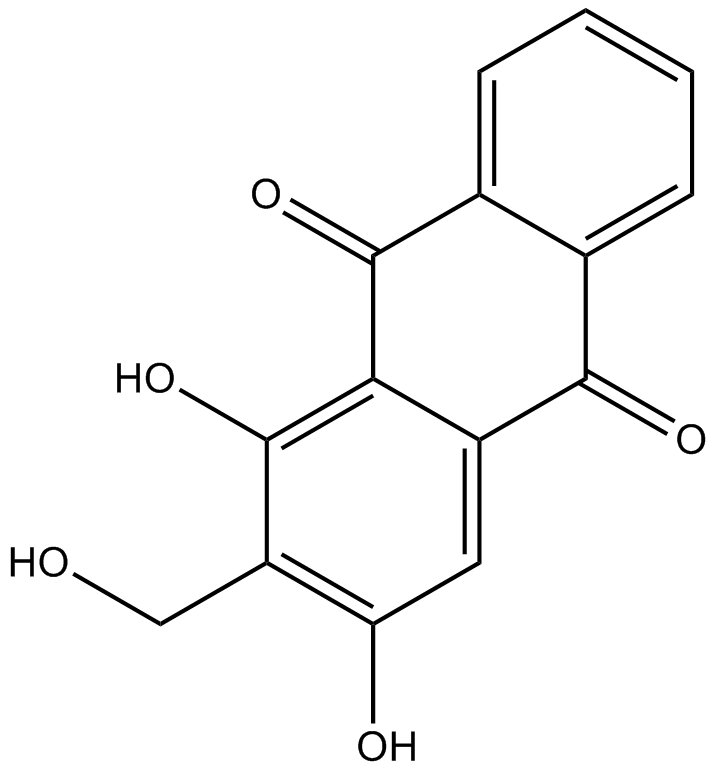
Cas No.: 478-08-0
Sample solution is provided at 25 µL, 10mM.
_1-3.$$$39978408@51.jpg');)
_1-9.$$$38538795@65.jpg');)
_1-9.$$$39112701@51.jpg');)
_1-7.$$$37316672@70.jpg');)
_366-372.$$$36198801@70.jpg');)
.$$$38565142@65.jpg');)
_1867-1883.$$$33248023@67.jpg');)
_eads6055.$$$39977546@45.jpg');)
_eadm9805.$$$40080571@45.jpg');)
_eadj3020.$$$39666821@45.jpg');)
_1-20.$$$39757301@28.jpg');)
_1-24.$$$38898113@28.jpg');)
_273-287.$$$36806353@46.jpg');)
_1-16.$$$37156877@44.jpg');)
_1-19.$$$37460805@44.jpg');)
_1291-1307.$$$34518654@46.jpg');)
Lucidin (NSC 30546) is a natural component of Rubia tinctorum L., which is mutagenic in bacteria and mammalian cells [1].
Hydroxyanthraquinones (HAs) are special organic compounds widely distributed in the plant kingdom. The HA plants have been used as laxatives and colorant for thousands of years. In the last century, HAs were also employed as medicine for the treatment of kidney stone. Lucidin is a HA extracted from the root of Rubia tinctorum L. that also known as madder. It was thought to be genotoxic in bacteria and mammalian cells [1].
Lucidin was found to be mutagenic in five Salmonella typhimurium strains without metabolic activation. Additionally, in Chinese hamster fibroblast V79 cells, lucidin was found to be mutagenic at the hypoxanthine-guanine phosphoribosyl transferase gene locus, which induced DNA single-strand breaks and DNA-protein cross-link. In primary rat hepatocytes and transformed C3H/ M2-mouse fibroblasts, it was observed lucidin might induce DNA repair synthesis [1].
In mouse model, when ACI rats were treated with 1-10% madder roots in the diet and control group without madder roots for 780 days, the dose-dependent increase of benign and malignant tumors were observed in liver and kidney. Additionally, DNA adducts were observed in liver, kidney and colon when treated with 10% madder root for two weeks. The formation of DNA adducts and mutagenicity was thought to be associated with lucidin which was contained in the madder roots [2].
References:
[1] Westendorf J et al. , The genotoxicity of lucidin, a natural component of Rubia tinctorum L., and lucidinethylether, a component of ethanolic Rubia extracts. Cell Biol Toxicol. 1988, 4(2):225-239.
[2] Westendorf J et al. , Carcinogenicity and DNA adduct formation observed in ACI rats after long-term treatment with madder root, Rubia tinctorum L. Carcinogenesis. 1998, 19(12):2163-2168.
| Cell experiment: [1] | |
|
Cell lines |
PANC-1 cells |
|
Preparation method |
The solubility of this compound in DMSO is >10 mM. General tips for obtaining a higher concentration: Please warm the tube at 37 °C for 10 minutes and/or shake it in the ultrasonic bath for a while.Stock solution can be stored below -20°C for several months. |
|
Reaction Conditions |
PC50: 54.7 μM, 24 hours |
|
Applications |
After 24 h of incubation, the cells were washed with PBS, and 100 μL of DMEM containing 10% WST-8 cell counting kit solution was added to the wells. After 3 h of incubation, the absorbance was measured at 450 nm. The preferential cytotoxicity was expressed as the concentration at which 50% of cells died preferentially. The PC50 value of lucidin was 54.7 μM in this experiment. |
| Animal experiment: [2] | |
|
Animal models |
Male Parkes mice |
|
Dosage form |
Oral administration, 2 mg/day |
|
Applications |
Mice were treated orally with lucidin for 4 days. 32P-Postlabelling analysis of hepatic DNA from mice treated with lucidin showed three lucidin-caused radioactive spots not present in the chromatograms of DNA from the control animals. The adduct levels calculated from individual animals were 1.16 ± 0.2 total adducts/108 nucleotides. |
|
Other notes |
Please test the solubility of all compounds indoor, and the actual solubility may slightly differ with the theoretical value. This is caused by an experimental system error and it is normal. |
|
References: [1] Dibwe D F, Awale S, Kadota S, et al. Damnacanthal from the Congolese Medicinal Plant Garcinia huillensis has a Potent Preferential Cytotoxicity against Human Pancreatic Cancer PANC-1 Cells. Phytotherapy Research, 2012, 26(12): 1920-1926. [2] Poginsky B, Westendorf J, Blömeke B, et al. Evaluation of DNA-binding activity of hydroxyanthraquinones occurring in Rubia tinctorum L. Carcinogenesis, 1991, 12(7): 1265-1271. | |
| Cas No. | 478-08-0 | SDF | |
| Chemical Name | 1,3-dihydroxy-2-(hydroxymethyl)anthracene-9,10-dione | ||
| Canonical SMILES | C1=CC=C2C(=C1)C(=O)C3=CC(=C(C(=C3C2=O)O)CO)O | ||
| Formula | C15H10O5 | M.Wt | 270.24 |
| Solubility | Soluble in DMSO | Storage | Store at -20°C |
| General tips | Please select the appropriate solvent to prepare the stock solution according to the
solubility of the product in different solvents; once the solution is prepared, please store it in
separate packages to avoid product failure caused by repeated freezing and thawing.Storage method
and period of the stock solution: When stored at -80°C, please use it within 6 months; when stored
at -20°C, please use it within 1 month. To increase solubility, heat the tube to 37°C and then oscillate in an ultrasonic bath for some time. |
||
| Shipping Condition | Evaluation sample solution: shipped with blue ice. All other sizes available: with RT, or with Blue Ice upon request. | ||
| Prepare stock solution | |||

|
1 mg | 5 mg | 10 mg |
| 1 mM | 3.7004 mL | 18.5021 mL | 37.0041 mL |
| 5 mM | 740.1 μL | 3.7004 mL | 7.4008 mL |
| 10 mM | 370 μL | 1.8502 mL | 3.7004 mL |
Step 1: Enter information below (Recommended: An additional animal making an allowance for loss during the experiment)
 g
μL
g
μL
Step 2: Enter the in vivo formulation (This is only the calculator, not formulation. Please contact us first if there is no in vivo formulation at the solubility Section.)
Calculation results:
Working concentration: mg/ml;
Method for preparing DMSO master liquid: mg drug pre-dissolved in μL DMSO ( Master liquid concentration mg/mL, Please contact us first if the concentration exceeds the DMSO solubility of the batch of drug. )
Method for preparing in vivo formulation: Take μL DMSO master liquid, next addμL PEG300, mix and clarify, next addμL Tween 80, mix and clarify, next add μL saline, mix and clarify.
Method for preparing in vivo formulation: Take μL DMSO master liquid, next add μL Corn oil, mix and clarify.
Note: 1. Please make sure the liquid is clear before adding the next solvent.
2. Be sure to add the solvent(s) in order. You must ensure that the solution obtained, in the previous addition, is a clear solution before proceeding to add the next solvent. Physical methods such as vortex, ultrasound or hot water bath can be used to aid dissolving.
3. All of the above co-solvents are available for purchase on the GlpBio website.
Quality Control & SDS
- View current batch:
- Purity: >98.00% Appearance: A solid
- COA (Certificate of Analysis)
- SDS (Safety Data Sheet)
- Datasheet
Average Rating: 5 (Based on Reviews and 30 reference(s) in Google Scholar.)