

Paeoniflorin (Synonyms: NSC 178886) |
Catalog No.GN10452
 One-Click Copy Product Info
|

Paeoniflorin is a pinane monoterpene glycoside extracted from the roots of Paeonia plants of the Ranunculaceae family, possessing multiple biological activities.
Products are for research use only. Not for human use. We do not sell to patients.
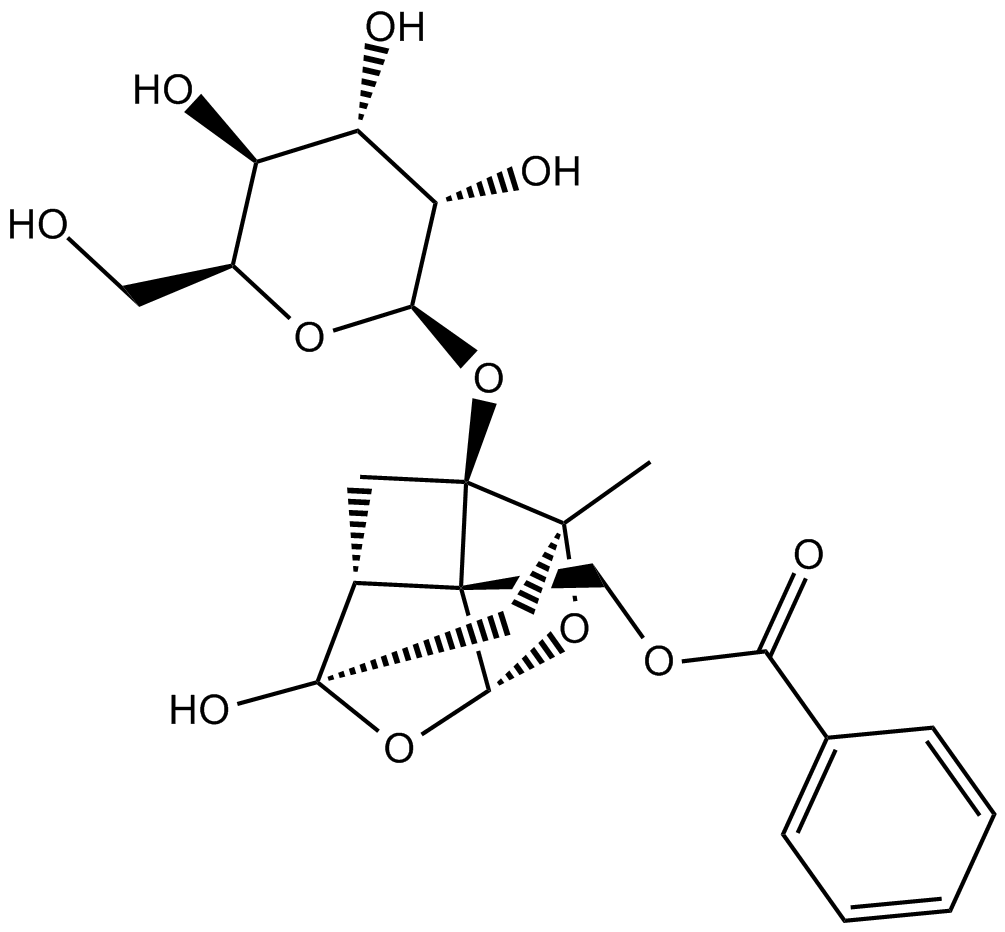
Cas No.: 23180-57-6
Sample solution is provided at 25 µL, 10mM.
Paeoniflorin is a pinane monoterpene glycoside extracted from the roots of Paeonia plants of the Ranunculaceae family, possessing multiple biological activities[1-2]. Through mechanisms such as activating adenosine A1 receptors, inhibiting COX-2 expression, and downregulating HIF-1α, Paeoniflorin exerts anti-inflammatory, immunomodulatory, analgesic, anti-tumor, antioxidant stress, and anti-platelet aggregation effects. Paeoniflorin can be used in research related to rheumatoid arthritis, cardiovascular diseases, neurological disorders, and tumors[3-4].
In vitro, Paeoniflorin (60μM) pretreatment of ER-positive breast cancer cell lines T47D and MCF-7 for 48 hours, followed by combination treatment with Tamoxifen (8μM for T47D, 16μM for MCF-7), Paeoniflorin significantly enhanced Tamoxifen-induced apoptosis, upregulated the Bax/Bcl-2 protein expression ratio and Caspase 3 activity, while inhibiting STAT3 phosphorylation and its downstream target gene c-Myc expression by promoting SIRT4 expression[5]. Paeoniflorin (1-30μM) co-treatment with TGF-β1 (2ng/mL) in human alveolar epithelial cells A549 for 48 hours, Paeoniflorin significantly inhibited TGF-β1-induced epithelial-mesenchymal transition (EMT), reduced cell migration ability and Vimentin and α-SMA expression, while downregulating the transcription factor Snail expression through the Smad-dependent pathway and reducing type I and III collagen secretion[6].
In vivo, Paeoniflorin (50, 100, 200mg/kg/day) intraperitoneal injection in acetaminophen (APAP; 300mg/kg)-induced drug-induced liver injury C57BL/6J male mice (preventive administration starting 5 days before modeling, for 5 consecutive days), Paeoniflorin significantly reduced serum ALT, AST, ALP, γ-GT, and TBIL levels, alleviated liver tissue inflammation and edema, and protected hepatocytes from APAP damage by activating autophagy through inhibiting the MAPK/mTOR signaling pathway, reducing oxidative stress and apoptosis[7]. Paeoniflorin (5, 10mg/kg/day) intraperitoneal injection in LPS-induced cognitive dysfunction ICR male mice (starting after LPS injection, for 3 consecutive weeks), Paeoniflorin significantly improved spatial memory, recognition memory, and long-term learning ability in mice, and alleviated LPS-induced cognitive deficits by inhibiting the expression of APP, BACE, PS1, and PS2 proteins in the brain and reducing β-amyloid production[8].
References:
[1] Zhang L, Wei W. Anti-inflammatory and immunoregulatory effects of paeoniflorin and total glucosides of paeony. Pharmacol Ther. 2020 Mar;207:107452.
[2] Zhang XX, Zuo JQ, Wang YT, et al. Paeoniflorin in Paeoniaceae: Distribution, influencing factors, and biosynthesis. Front Plant Sci. 2022 Sep 2;13:980854.
[3] Ma Y, Lang X, Yang Q, et al. Paeoniflorin promotes intestinal stem cell-mediated epithelial regeneration and repair via PI3K-AKT-mTOR signalling in ulcerative colitis. Int Immunopharmacol. 2023 Jun;119:110247.
[4] Wang XL, Feng ST, Wang YT, et al. Paeoniflorin: A neuroprotective monoterpenoid glycoside with promising anti-depressive properties. Phytomedicine. 2021 Sep;90:153669.
[5] Zhang P, Wu N, Song ZJ, et al. Paeoniflorin Enhances the Sensitivity of ER-Positive Breast Cancer Cells to Tamoxifen through Promoting Sirtuin 4. Evid Based Complement Alternat Med. 2022 Jan 15;2022:6730559.
[6] Ji Y, Dou YN, Zhao QW, et al. Paeoniflorin suppresses TGF-β mediated epithelial-mesenchymal transition in pulmonary fibrosis through a Smad-dependent pathway. Acta Pharmacol Sin. 2016 Jun;37(6):794-804.
[7] Deng X, Li Y, Chen Y, et al. Paeoniflorin protects hepatocytes from APAP-induced damage through launching autophagy via the MAPK/mTOR signaling pathway. Cell Mol Biol Lett. 2024 Sep 7;29(1):119.
[8] Meng HW, Kim JH, Kim HY, et al. Paeoniflorin Attenuates Lipopolysaccharide-Induced Cognitive Dysfunction by Inhibition of Amyloidogenesis in Mice. Int J Mol Sci. 2023 Mar 2;24(5):4838.
| Cell experiment [1]: | |
|
Cell lines |
A549 cells (human type II alveolar epithelial cell line) |
|
Preparation Method |
A549 cells were maintained in RPMI-1640 medium supplemented with 10% fetal bovine serum (FBS) at 37°C, 5% CO₂. For EMT induction, cells were incubated with TGF-β1 (2ng/mL). Paeoniflorin was co-incubated with TGF-β1 at 1-30μM. |
|
Reaction Conditions |
1-30μM; 48h |
|
Applications |
Paeoniflorin significantly inhibited TGF-β1-induced epithelial-mesenchymal transition (EMT) in A549 cells, as evidenced by the reversal of morphological changes to a mesenchymal phenotype, reduction of cell migration, up-regulation of epithelial marker E-cadherin, and down-regulation of mesenchymal markers Vimentin and α-SMA. |
| Animal experiment [2]: | |
|
Animal models |
C57BL/6J mice |
|
Preparation Method |
Mice were intraperitoneally Administered acetaminophen (APAP; 300mg/kg) to induce acute liver injury. Paeoniflorin (50, 100, 200mg/kg) was administered intraperitoneally once daily for 5 consecutive days before APAP injection. Mice were sacrificed 24 hours after APAP administration for serum and liver tissue collection. |
|
Dosage form |
50, 100, 200mg/kg; i.p.; Once daily for 5 days. |
|
Applications |
Paeoniflorin pretreatment significantly attenuated APAP-induced acute liver injury, as evidenced by reduced serum levels of ALT, AST, ALP, γ-GT, and TBIL, and ameliorated liver histopathological changes including hepatocyte necrosis, inflammatory cell infiltration, and congestion. Paeoniflorin also suppressed oxidative stress by decreasing MDA levels and increasing SOD and GSH activities, and inhibited apoptosis by regulating the Bax/Bcl-2 ratio and cleaved caspase-3 expression. Mechanistically, Paeoniflorin activated autophagy through the MAPK/mTOR signaling pathway, which contributed to its hepatoprotective effects against APAP-induced liver damage. |
|
References: |
|
| Cas No. | 23180-57-6 | SDF | |
| Synonyms | NSC 178886 | ||
| Chemical Name | ((2S,2aR,2a1S,3aR,4R,5aR)-4-hydroxy-2-methyl-2a-(((2S,3R,4S,5S,6R)-3,4,5-trihydroxy-6-(hydroxymethyl)tetrahydro-2H-pyran-2-yl)oxy)hexahydro-2H-1,5-dioxa-2,4-methanocyclobuta[cd]pentalen-2a1-yl)methyl benzoate | ||
| Canonical SMILES | O=C(C1=C([H])C([H])=C([H])C([H])=C1[H])OC([H])([H])[C@@]2([C@@]3([H])C4([H])[H])[C@]4([C@@](C5([H])[H])(C([H])([H])[H])O[C@]2([H])O[C@@]35O[H])O[C@]([C@]([C@@]6([H])O[H])([H])O[H])([H])O[C@@](C([H])([H])O[H])([H])[C@@]6([H])O[H] | ||
| Formula | C23H28O11 | M.Wt | 480.47 |
| Solubility | DMF: 30 mg/mL,DMSO: 30 mg/mL,Ethanol: 30 mg/mL,PBS (pH 7.2): 10 mg/mL | Storage | Store at -20°C |
| General tips | Please select the appropriate solvent to prepare the stock solution according to the
solubility of the product in different solvents; once the solution is prepared, please store it in
separate packages to avoid product failure caused by repeated freezing and thawing.Storage method
and period of the stock solution: When stored at -80°C, please use it within 6 months; when stored
at -20°C, please use it within 1 month. To increase solubility, heat the tube to 37°C and then oscillate in an ultrasonic bath for some time. |
||
| Shipping Condition | Evaluation sample solution: shipped with blue ice. All other sizes available: with RT, or with Blue Ice upon request. | ||
| Prepare stock solution | |||

|
1 mg | 5 mg | 10 mg |
| 1 mM | 2.0813 mL | 10.4065 mL | 20.813 mL |
| 5 mM | 416.3 μL | 2.0813 mL | 4.1626 mL |
| 10 mM | 208.1 μL | 1.0406 mL | 2.0813 mL |
Step 1: Enter information below (Recommended: An additional animal making an allowance for loss during the experiment)
 g
μL
g
μL
Step 2: Enter the in vivo formulation (This is only the calculator, not formulation. Please contact us first if there is no in vivo formulation at the solubility Section.)
Calculation results:
Working concentration: mg/ml;
Method for preparing DMSO master liquid: mg drug pre-dissolved in μL DMSO ( Master liquid concentration mg/mL, Please contact us first if the concentration exceeds the DMSO solubility of the batch of drug. )
Method for preparing in vivo formulation: Take μL DMSO master liquid, next addμL PEG300, mix and clarify, next addμL Tween 80, mix and clarify, next add μL saline, mix and clarify.
Method for preparing in vivo formulation: Take μL DMSO master liquid, next add μL Corn oil, mix and clarify.
Note: 1. Please make sure the liquid is clear before adding the next solvent.
2. Be sure to add the solvent(s) in order. You must ensure that the solution obtained, in the previous addition, is a clear solution before proceeding to add the next solvent. Physical methods such as vortex, ultrasound or hot water bath can be used to aid dissolving.
3. All of the above co-solvents are available for purchase on the GlpBio website.
Quality Control & SDS
- View current batch:
- Purity: >98.00% Appearance: A solid
- COA (Certificate of Analysis)
- SDS (Safety Data Sheet)
- Datasheet
Average Rating: 5 (Based on Reviews and 30 reference(s) in Google Scholar.)