

PBP10 TFA |
Catalog No.GC63726
 One-Click Copy Product Info
|

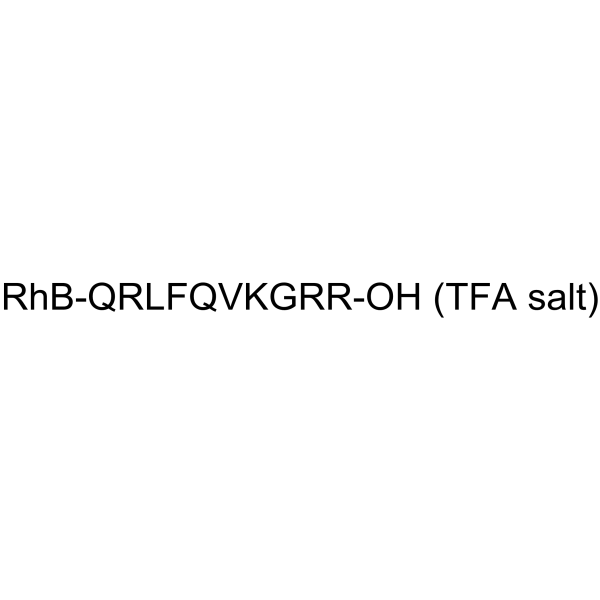
PBP10 TFA is a cell-permeable formyl peptide receptor 2 (FPR2) antagonist.
Products are for research use only. Not for human use. We do not sell to patients.
Sample solution is provided at 25 µL, 10mM.
_1-3.$$$39978408@51.jpg');)
_1-9.$$$38538795@65.jpg');)
_1-9.$$$39112701@51.jpg');)
_1-7.$$$37316672@70.jpg');)
_366-372.$$$36198801@70.jpg');)
.$$$38565142@65.jpg');)
_1867-1883.$$$33248023@67.jpg');)
_eads6055.$$$39977546@45.jpg');)
_eadm9805.$$$40080571@45.jpg');)
_eadj3020.$$$39666821@45.jpg');)
_1-20.$$$39757301@28.jpg');)
_1-24.$$$38898113@28.jpg');)
_273-287.$$$36806353@46.jpg');)
_1-16.$$$37156877@44.jpg');)
_1-19.$$$37460805@44.jpg');)
_1291-1307.$$$34518654@46.jpg');)
PBP10 TFA is a cell-permeable formyl peptide receptor 2 (FPR2) antagonist[1-2]. PBP10 TFA exhibits multiple biological activities, including antibacterial, antiviral, and cancer-inhibitory effects[3-4].
In vitro, pretreatment of human keratinocytes (HaCaT) with PBP10 TFA (2-10μg/mL) for 20 minutes significantly suppresses the release of pro-inflammatory mediators such as nitric oxide (NO), reactive oxygen species (ROS), and interleukin-8 (IL-8) induced by stimulation with lipopolysaccharide (LPS; 1μg/mL) or lipoteichoic acid (LTA; 1μg/mL), while also reversing inflammation-related nanomechanical changes, such as the reduction in cell stiffness caused by LPS[5]. Pretreatment of RT4 Schwann cells with PBP10 TFA (1 μM) for 20 minutes, followed by stimulation with fMLF (10nM–100nM) for 6 hours, significantly inhibits fMLF-induced upregulation of Fpr2 protein expression and the decrease in p-NFκB levels, while also reversing changes in the expression of CCR2, CXCR4, and PKCβ[6].
References:
[1] Forsman H, Andréasson E, Karlsson J, et al. Structural characterization and inhibitory profile of formyl peptide receptor 2 selective peptides descending from a PIP2-binding domain of gelsolin. J Immunol. 2012 Jul 15;189(2):629-37.
[2] Holdfeldt A, Winther M, Gabl M, et al. Data on human neutrophil activation induced by pepducins with amino acid sequences derived from β2AR and CXCR4. Data Brief. 2016 Jun 1;8:411-4.
[3] Courtin N, Fotso AF, Fautrad P, et al. Antiviral activity of formyl peptide receptor 2 antagonists against influenza viruses. Antiviral Res. 2017 Jul;143:252-261.
[4] Jia G, Wang X, Wu W, et al. LXA4 enhances prostate cancer progression by facilitating M2 macrophage polarization via inhibition of METTL3. Int Immunopharmacol. 2022 Jun;107:108586.
[5] Korimová A, Dubový P. N-Formylated Peptide Induces Increased Expression of Both Formyl Peptide Receptor 2 (Fpr2) and Toll-Like Receptor 9 (TLR9) in Schwannoma Cells-An In Vitro Model for Early Inflammatory Profiling of Schwann Cells. Cells. 2020 Dec 11;9(12):2661.
[6] Xu J, Su Z, Cheng X, et al. High PPT1 expression predicts poor clinical outcome and PPT1 inhibitor DC661 enhances sorafenib sensitivity in hepatocellular carcinoma. Cancer Cell Int. 2022 Mar 11;22(1):115.
| Cell experiment [1]: | |
Cell lines | HaCaT cells (human immortalized keratinocyte cell line) |
Preparation Method | HaCaT cells were maintained in high-glucose Dulbecco’s Modified Eagle Medium (DMEM) supplemented with 10% fetal bovine serum (FBS), 2mM L-glutamine, and antibiotics (50U/mL penicillin, 50µg/mL streptomycin) at 37°C, 5% CO₂. Cells were pretreated with PBP10 TFA (2–10µg/mL) for 20 min, followed by stimulation with bacterial lipopolysaccharide (LPS; 1µg/mL) or lipoteichoic acid (LTA; 1µg/mL) for 24h in serum-free conditions. |
Reaction Conditions | 2–10µg/mL; pretreatment for 20min |
Applications | PBP10 TFA significantly suppressed LPS/LTA-induced production of inflammatory mediators, including nitric oxide (NO), reactive oxygen species (ROS), and interleukin-8 (IL-8), in a dose-dependent manner. PBP10 TFA also reversed LPS-induced softening of cell stiffness, as measured by atomic force microscopy (AFM), indicating restoration of cytoskeletal integrity. |
References: | |
| Cas No. | SDF | ||
| Formula | C86H128F3N24O17 | M.Wt | 1827.08 |
| Solubility | Water : 7.14 mg/mL (3.91 mM; Need ultrasonic) | Storage | -20°C, away from moisture |
| General tips | Please select the appropriate solvent to prepare the stock solution according to the
solubility of the product in different solvents; once the solution is prepared, please store it in
separate packages to avoid product failure caused by repeated freezing and thawing.Storage method
and period of the stock solution: When stored at -80°C, please use it within 6 months; when stored
at -20°C, please use it within 1 month. To increase solubility, heat the tube to 37°C and then oscillate in an ultrasonic bath for some time. |
||
| Shipping Condition | Evaluation sample solution: shipped with blue ice. All other sizes available: with RT, or with Blue Ice upon request. | ||
| Prepare stock solution | |||

|
1 mg | 5 mg | 10 mg |
| 1 mM | 547.3 μL | 2.7366 mL | 5.4732 mL |
| 5 mM | 109.5 μL | 547.3 μL | 1.0946 mL |
| 10 mM | 54.7 μL | 273.7 μL | 547.3 μL |
Step 1: Enter information below (Recommended: An additional animal making an allowance for loss during the experiment)
 g
μL
g
μL
Step 2: Enter the in vivo formulation (This is only the calculator, not formulation. Please contact us first if there is no in vivo formulation at the solubility Section.)
Calculation results:
Working concentration: mg/ml;
Method for preparing DMSO master liquid: mg drug pre-dissolved in μL DMSO ( Master liquid concentration mg/mL, Please contact us first if the concentration exceeds the DMSO solubility of the batch of drug. )
Method for preparing in vivo formulation: Take μL DMSO master liquid, next addμL PEG300, mix and clarify, next addμL Tween 80, mix and clarify, next add μL saline, mix and clarify.
Method for preparing in vivo formulation: Take μL DMSO master liquid, next add μL Corn oil, mix and clarify.
Note: 1. Please make sure the liquid is clear before adding the next solvent.
2. Be sure to add the solvent(s) in order. You must ensure that the solution obtained, in the previous addition, is a clear solution before proceeding to add the next solvent. Physical methods such as vortex, ultrasound or hot water bath can be used to aid dissolving.
3. All of the above co-solvents are available for purchase on the GlpBio website.
Quality Control & SDS
- View current batch:
- Purity: >98.00% Appearance: A solid
- COA (Certificate of Analysis)
- SDS (Safety Data Sheet)
- Datasheet
Average Rating: 5 (Based on Reviews and 28 reference(s) in Google Scholar.)