

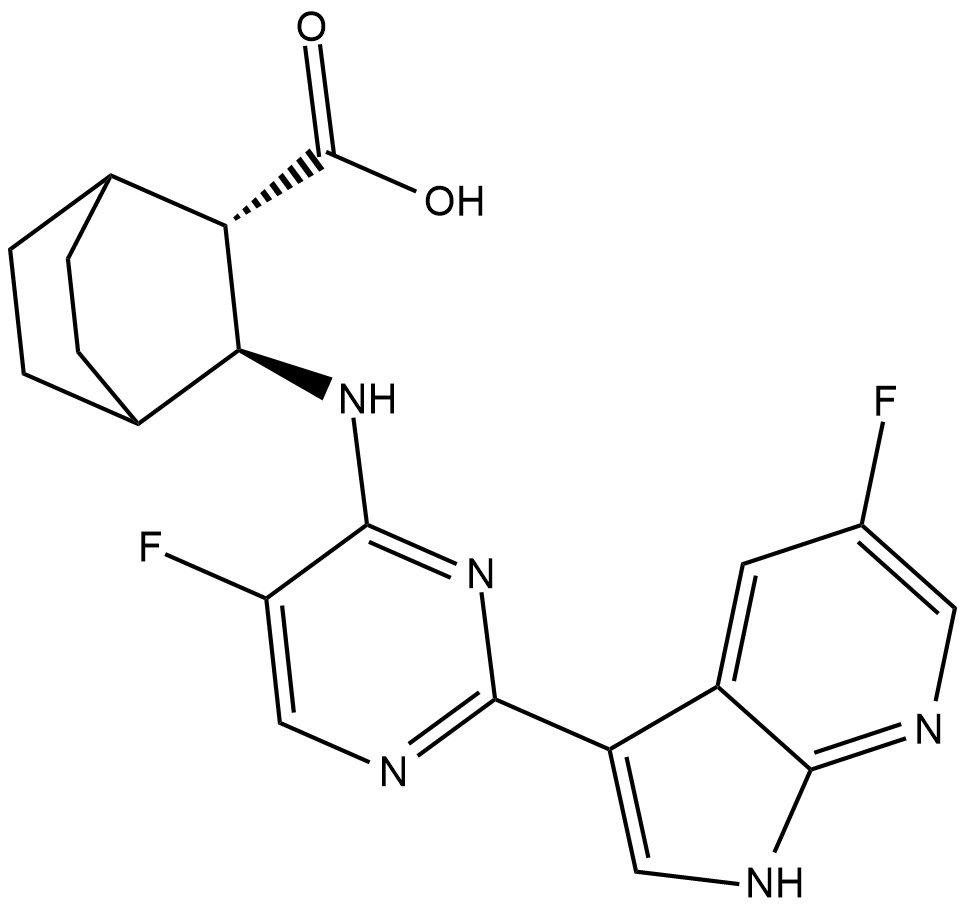
Pimodivir (Synonyms: JNJ 63623872, JNJ 872, VX 787) |
Catalog No.GC19295
 One-Click Copy Product Info
|

Pimodivir is an orally bioavailable inhibitor of influenza A virus polymerases through interaction with the viral PB2 subunit.
Products are for research use only. Not for human use. We do not sell to patients.
Cas No.: 1629869-44-8
Sample solution is provided at 25 µL, 10mM.
_1-3.$$$39978408@51.jpg');)
_1-9.$$$38538795@65.jpg');)
_1-9.$$$39112701@51.jpg');)
_1-7.$$$37316672@70.jpg');)
_366-372.$$$36198801@70.jpg');)
.$$$38565142@65.jpg');)
_1867-1883.$$$33248023@67.jpg');)
_eads6055.$$$39977546@45.jpg');)
_eadm9805.$$$40080571@45.jpg');)
_eadj3020.$$$39666821@45.jpg');)
_1-20.$$$39757301@28.jpg');)
_1-24.$$$38898113@28.jpg');)
_273-287.$$$36806353@46.jpg');)
_1-16.$$$37156877@44.jpg');)
_1-19.$$$37460805@44.jpg');)
_1291-1307.$$$34518654@46.jpg');)
Pimodivir is an orally bioavailable inhibitor of influenza A virus polymerases through interaction with the viral PB2 subunit.
Pimodivir rescues macrophages from virus-mediated death at non-cytotoxic concentrations 24 hpi. The EC50 value for Pimodivir are 8 and 12 nM for A(H1N1) and A(H3N2) strains, respectively, whereas the CC50 values are >1 uM, giving selectivity indexes (SI) > 125 and > 83 for A(H1N1) and A(H3N2) strains, respectively. Pimodivir significantly attenuates the transcription of viral M1 RNA in macrophages, which are infected with A(H1N1) or A(H3N2) strains for 8 h. Pimodivir inhibits the transcription of viral but not cellular genes. Pimodivir allows some activation of IAV-mediated expression of several cellular genes, which are involved in tryptophan and nucleotide metabolism. Pimodivir possesses excellent anti-IAV but not immuno/metabolo-modulating effect[2]. Pimodivir is very potent against influenza A strains, including pandemic 2009 H1N1 and avian H5N1[3]. Pimodivir shows potent activity against all influenza A virus strains tested, with an EC50 range of 0.13 to 3.2 nM. Pimodivir-selected PB2 variant viruses maintain susceptibility to neuraminidase inhibitors in vitro[4].
Pimodivir (2, 6, and 20 mg/kg/day, p.o.) and oseltamivir (20 mg/kg/day) completely prevent death in the H1N1pdm virus infection in mice. Pimodivir (20 mg/kg/day) is more effective than oseltamivir (20 mg/kg/day) in improving body weight and reducing the severity of lung infection[1]. Moreover, Pimodivir shows 100% survival in a +48 h delay to treatment mouse influenza model at 10, 3 and 1 mpk (BID × 10 days) whereas the SOC, oseltamivir, provide no survival benefit in this model at 10 mpk[3]. Pimodivir (1, 3, or 10 mg/kg, bid) provided complete survival, with a dose-dependent reduction in BW loss of the mice[4].
References:
[1]. Smee DF, et al. Activities of JNJ63623872 and oseltamivir against influenza A H1N1pdm and H3N2 virus infections in mice. Antiviral Res. 2016 Dec;136:45-50.
[2]. Fu Y, et al. JNJ872 inhibits influenza A virus replication without altering cellular antiviral responses. Antiviral Res. 2016 Sep;133:23-31.
[3]. Boyd MJ, et al. Isosteric replacements of the carboxylic acid of drug candidate VX-787: Effect of charge on antiviral potency and kinase activity of azaindole-based influenza PB2 inhibitors. Bioorg Med Chem Lett. 2015 May 1;25(9):1990-4.
[4]. Byrn RA, et al. Preclinical activity of VX-787, a first-in-class, orally bioavailable inhibitor of the influenza virus polymerase PB2 subunit. Antimicrob Agents Chemother. 2015 Mar;59(3):1569-82.
Cell experiment: | The compound cytotoxicity and efficacy testing is performed in 96-well plates with macrophages at 95% confluence. The compounds are added to the medium, and 30 min later, the cells are infected with virus or non-infected. The cell viability is analyzed with the Cell Titer Glo assay at 24 hpi. The luminescence is read with a PHERAstar FS plate reader. |
Animal experiment: | The mice are anesthetized by intraperitoneal injection of ketamine/xylazine (50/5 mg/kg), and the animals are infected intranasally with a 90-μL suspension of influenza virus. The virus challenge is approximately four 50% mouse lethal infectious doses. Treatments are given twice a day (at 12 h intervals) for 10 days starting 2 h before virus challenge. Parameters for assessing the infection are survival, mean day of death, body weight changes, and lung infection parameters (hemorrhage score, weight, and virus titer). Animals are weighed individually every other day through day 21 of the infection. Initially, there are 15 mice per group treated with compound and 25 placebos. Five mice in each group are subsequently sacrificed for determination of lung infection parameters. A larger number of placebos are used than compound-treated mice to achieve greater statistical power, especially if some animals in that group survive the infection. One mouse that dies during the treatment period is presumed to have died from treatment trauma because its death occurs well before other mice die from influenza. It is excluded from the total counts. Animals that die during infection are accounted for in the tabular data. |
References: [1]. Smee DF, et al. Activities of JNJ63623872 and oseltamivir against influenza A H1N1pdm and H3N2 virus infections in mice. Antiviral Res. 2016 Dec;136:45-50. | |
| Cas No. | 1629869-44-8 | SDF | |
| Synonyms | JNJ 63623872, JNJ 872, VX 787 | ||
| Canonical SMILES | O=C([C@H]1C(CC2)CCC2[C@@H]1NC3=NC(C4=CNC5=NC=C(F)C=C54)=NC=C3F)O | ||
| Formula | C20H19F2N5O2 | M.Wt | 399.39 |
| Solubility | DMSO : ≥ 12.5 mg/mL (31.30 mM) | Storage | Store at -20°C |
| General tips | Please select the appropriate solvent to prepare the stock solution according to the
solubility of the product in different solvents; once the solution is prepared, please store it in
separate packages to avoid product failure caused by repeated freezing and thawing.Storage method
and period of the stock solution: When stored at -80°C, please use it within 6 months; when stored
at -20°C, please use it within 1 month. To increase solubility, heat the tube to 37°C and then oscillate in an ultrasonic bath for some time. |
||
| Shipping Condition | Evaluation sample solution: shipped with blue ice. All other sizes available: with RT, or with Blue Ice upon request. | ||
| Prepare stock solution | |||

|
1 mg | 5 mg | 10 mg |
| 1 mM | 2.5038 mL | 12.5191 mL | 25.0382 mL |
| 5 mM | 500.8 μL | 2.5038 mL | 5.0076 mL |
| 10 mM | 250.4 μL | 1.2519 mL | 2.5038 mL |
Step 1: Enter information below (Recommended: An additional animal making an allowance for loss during the experiment)
 g
μL
g
μL
Step 2: Enter the in vivo formulation (This is only the calculator, not formulation. Please contact us first if there is no in vivo formulation at the solubility Section.)
Calculation results:
Working concentration: mg/ml;
Method for preparing DMSO master liquid: mg drug pre-dissolved in μL DMSO ( Master liquid concentration mg/mL, Please contact us first if the concentration exceeds the DMSO solubility of the batch of drug. )
Method for preparing in vivo formulation: Take μL DMSO master liquid, next addμL PEG300, mix and clarify, next addμL Tween 80, mix and clarify, next add μL saline, mix and clarify.
Method for preparing in vivo formulation: Take μL DMSO master liquid, next add μL Corn oil, mix and clarify.
Note: 1. Please make sure the liquid is clear before adding the next solvent.
2. Be sure to add the solvent(s) in order. You must ensure that the solution obtained, in the previous addition, is a clear solution before proceeding to add the next solvent. Physical methods such as vortex, ultrasound or hot water bath can be used to aid dissolving.
3. All of the above co-solvents are available for purchase on the GlpBio website.
Quality Control & SDS
- View current batch:
- Purity: >99.00% Appearance: A solid
- COA (Certificate of Analysis)
- SDS (Safety Data Sheet)
- Datasheet
Average Rating: 5 (Based on Reviews and 24 reference(s) in Google Scholar.)