

RG-14620 (Synonyms: Tyrphostin RG14620) |
Catalog No.GC10217
 One-Click Copy Product Info
|

inhibitor of epidermal growth factor (EGF) receptor kinase
Products are for research use only. Not for human use. We do not sell to patients.
Cas No.: 136831-49-7
Sample solution is provided at 25 µL, 10mM.
_1-3.$$$39978408@51.jpg');)
_1-9.$$$38538795@65.jpg');)
_1-9.$$$39112701@51.jpg');)
_1-7.$$$37316672@70.jpg');)
_366-372.$$$36198801@70.jpg');)
.$$$38565142@65.jpg');)
_1867-1883.$$$33248023@67.jpg');)
_eads6055.$$$39977546@45.jpg');)
_eadm9805.$$$40080571@45.jpg');)
_eadj3020.$$$39666821@45.jpg');)
_1-20.$$$39757301@28.jpg');)
_1-24.$$$38898113@28.jpg');)
_273-287.$$$36806353@46.jpg');)
_1-16.$$$37156877@44.jpg');)
_1-19.$$$37460805@44.jpg');)
_1291-1307.$$$34518654@46.jpg');)
RG-14620 is a tyrosine kinase and epidermal growth factor (EGF) receptor [1].
Protein tyrosine kinases (PTKs) have been involved in regulating cell proliferation, cell differentiation, and signaling processes in the immune system. Dysfunction of protein tyrosine kinases result in inflammatory responses and diseases including cancer, atherosclerosis, and psoriasis [2]. The epidermal growth factor receptor (EGFR) is a transmembrane glycoprotein. Activation of EGFR results in autophosphorylation of receptor tyrosine kinase and has been involved in regulating cellular proliferation, differentiation, and survival. Overexpression of EGFR has been identified in a variety of tumor cell lines and has been associated with poor prognosis and decreased survival [3].
RG-14620 inhibited the activity of epidermal growth factor (EGF) receptor kinase with an IC50 value of 3 μM in HT-22 cells [1]. RG-14620 suppressed not only EGF-stimulated cancer cell proliferation in vitro but also tumor growth in nude mice [4]. Tyrphostin RG-14620 dose-dependently inhibited the EGFR-associated tyrosine kinase with half maximal inhibition at 7 μM [5].
References:
[1] Sagara, Y. , Ishige, K., Tsai, C., et al. Tyrphostins protect neuronal cells from oxidative stress. The Journal of Biological Chemisty, 277(39), 36204-36215(2002).
[2] Levitzki A, Gazit A. Tyrosine kinase inhibition: an approach to drug development[J]. Science, 1995, 267(5205): 1782.
[3] Herbst R S. Review of epidermal growth factor receptor biology[J]. International Journal of Radiation Oncology Biology Physics, 2004, 59(2): S21-S26.
[4] Yoneda T, Lyall R M, Alsina M M, et al. The antiproliferative effects of tyrosine kinase inhibitors tyrphostins on a human squamous cell carcinoma in vitro and in nude mice[J]. Cancer research, 1991, 51(16): 4430-4435.
[5] Piontek M, Hengels K J, Porschen R, et al. Antiproliferative effect of tyrosine kinase inhibitors in epidermal growth factor-stimulated growth of human gastric cancer cells[J]. Anticancer research, 1992, 13(6A): 2119-2123.
Cell experiment: | MH-85 cells and HER 14 cells are plated in complete medium, either αMEM or DMEM, respectively, supplemented with 10% FCS. After overnight culture, the culture medium is switched to αMEM supplemented with 0.2% PCS and 50 ng/mL EGF (MH-85) or DMEM supplemented with 0.5% PCS and 50 ng/mL EGF (HER14). The cells are cultured in this medium in the presence or absence of increasing concentrations of RG-13022 or RG-14620 for 10 days. At the end of culture, the cells are fixed with 4% (v/v) formaldehyde in calcium-magnesium-free phosphate-buffered saline for 15 min at room temperature and stained with hematoxylin. Numbers of colonies including more than 20 cells in each well are counted under the microscope[2]. |
Animal experiment: | Mice: RG14620 in 0.1 mL 100% DMSO is injected i.p. twice a day from 1day after MH-85 tumor inoculation. Control animals are given the same vehicle[1]. |
References: [1]. Sagara Y, et al. Tyrphostins protect neuronal cells from oxidative stress. J Biol Chem. 2002 Sep 27;277(39):36204-15. | |
| Cas No. | 136831-49-7 | SDF | |
| Synonyms | Tyrphostin RG14620 | ||
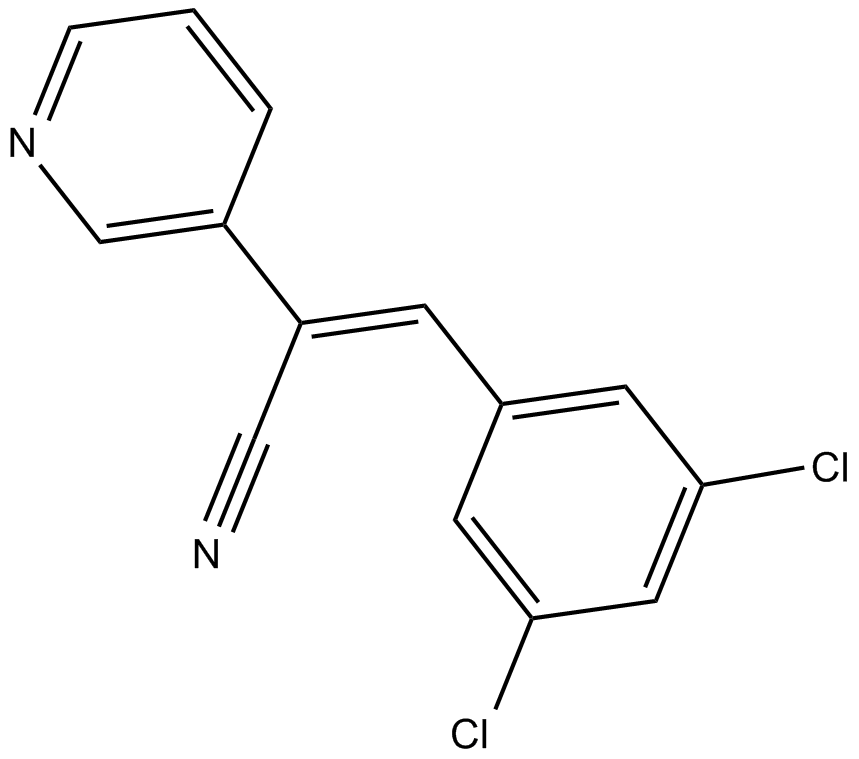
| Chemical Name | α-[(3,5-dichlorophenyl)methylene]-3-pyridineacetonitrile | ||
| Canonical SMILES | ClC1=CC(/C=C(C#N)/C2=CN=CC=C2)=CC(Cl)=C1 | ||
| Formula | C14H8Cl2N2 | M.Wt | 275.1 |
| Solubility | ≤1mg/ml in ethanol;20mg/ml in DMSO;20mg/ml in dimethyl formamide | Storage | Store at -20°C |
| General tips | Please select the appropriate solvent to prepare the stock solution according to the
solubility of the product in different solvents; once the solution is prepared, please store it in
separate packages to avoid product failure caused by repeated freezing and thawing.Storage method
and period of the stock solution: When stored at -80°C, please use it within 6 months; when stored
at -20°C, please use it within 1 month. To increase solubility, heat the tube to 37°C and then oscillate in an ultrasonic bath for some time. |
||
| Shipping Condition | Evaluation sample solution: shipped with blue ice. All other sizes available: with RT, or with Blue Ice upon request. | ||
| Prepare stock solution | |||

|
1 mg | 5 mg | 10 mg |
| 1 mM | 3.635 mL | 18.1752 mL | 36.3504 mL |
| 5 mM | 727 μL | 3.635 mL | 7.2701 mL |
| 10 mM | 363.5 μL | 1.8175 mL | 3.635 mL |
Step 1: Enter information below (Recommended: An additional animal making an allowance for loss during the experiment)
 g
μL
g
μL
Step 2: Enter the in vivo formulation (This is only the calculator, not formulation. Please contact us first if there is no in vivo formulation at the solubility Section.)
Calculation results:
Working concentration: mg/ml;
Method for preparing DMSO master liquid: mg drug pre-dissolved in μL DMSO ( Master liquid concentration mg/mL, Please contact us first if the concentration exceeds the DMSO solubility of the batch of drug. )
Method for preparing in vivo formulation: Take μL DMSO master liquid, next addμL PEG300, mix and clarify, next addμL Tween 80, mix and clarify, next add μL saline, mix and clarify.
Method for preparing in vivo formulation: Take μL DMSO master liquid, next add μL Corn oil, mix and clarify.
Note: 1. Please make sure the liquid is clear before adding the next solvent.
2. Be sure to add the solvent(s) in order. You must ensure that the solution obtained, in the previous addition, is a clear solution before proceeding to add the next solvent. Physical methods such as vortex, ultrasound or hot water bath can be used to aid dissolving.
3. All of the above co-solvents are available for purchase on the GlpBio website.
Quality Control & SDS
- View current batch:
- Purity: >99.50% Appearance: A solid
- COA (Certificate of Analysis)
- SDS (Safety Data Sheet)
- Datasheet
Average Rating: 5 (Based on Reviews and 4 reference(s) in Google Scholar.)