

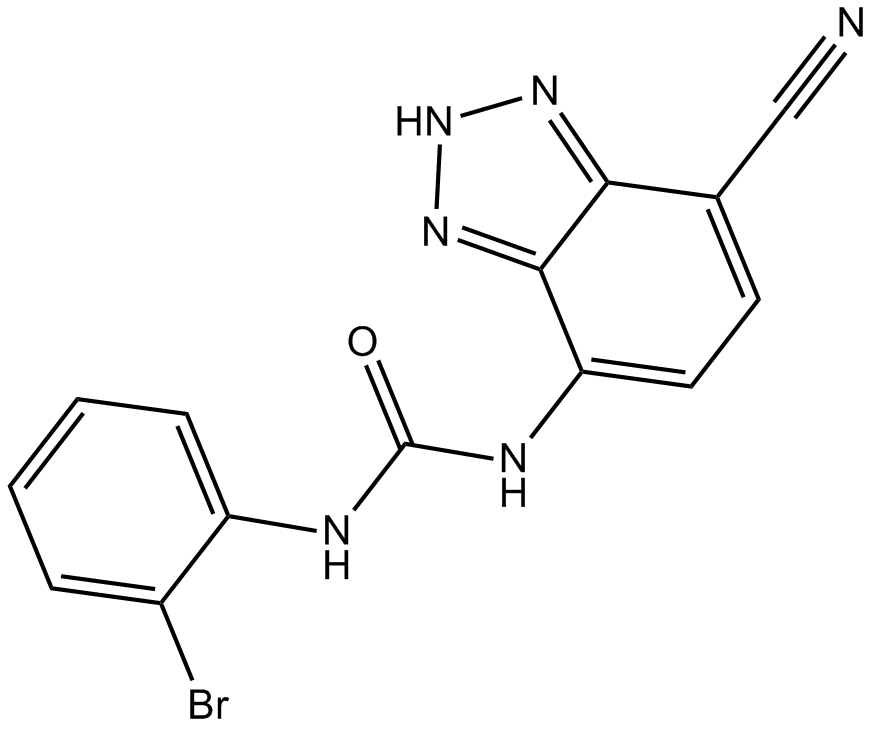
SB 265610 |
Catalog No.GC13458
 One-Click Copy Product Info
|

SB 265610 is a competitive non-peptide allosteric CXCR2 antagonist that blocks neutrophil chemotaxis (IC50=70nM) and calcium mobilization (IC50=3.7nM).
Products are for research use only. Not for human use. We do not sell to patients.
Cas No.: 211096-49-0
Sample solution is provided at 25 µL, 10mM.
_1-3.$$$39978408@51.jpg');)
_1-9.$$$38538795@65.jpg');)
_1-9.$$$39112701@51.jpg');)
_1-7.$$$37316672@70.jpg');)
_366-372.$$$36198801@70.jpg');)
.$$$38565142@65.jpg');)
_1867-1883.$$$33248023@67.jpg');)
_eads6055.$$$39977546@45.jpg');)
_eadm9805.$$$40080571@45.jpg');)
_eadj3020.$$$39666821@45.jpg');)
_1-20.$$$39757301@28.jpg');)
_1-24.$$$38898113@28.jpg');)
_273-287.$$$36806353@46.jpg');)
_1-16.$$$37156877@44.jpg');)
_1-19.$$$37460805@44.jpg');)
_1291-1307.$$$34518654@46.jpg');)
SB 265610 is a competitive non-peptide allosteric CXCR2 antagonist that blocks neutrophil chemotaxis (IC50=70nM) and calcium mobilization (IC50=3.7nM). SB 265610 can be used for research related to inflammatory diseases and cancer[1-4].
In vitro, SB 265610 (1–20μM) was used to treat SW480 cells for 48 hours. SB 265610 failed to induce G2-M phase arrest[5]. SB 265610 (1μM) was used to treat PyMT-Luc and 17L3C-Luc breast cancer cell lines for 4 hours. SB 265610 significantly attenuated mesenchymal stem cell-conditioned medium-induced cancer cell migration and reduced CXCR2 phosphorylation[6].
In vivo, SB 265610 (2mg/kg; once daily) was intraperitoneally injected into BALB/c or C57BL/6 mice bearing MC38 or CT26 colorectal cancer cells for 12 days. SB 265610 blocked the tumor-promoting effect of METTL3[7]. SB 265610 (100mg/kg/day) was administered to Nitrogen mustard-induced chemical burn model C57-Black mice via dietary supplementation for 5 days. SB 265610 significantly lowered myeloperoxidase activity and impaired the wound healing process[8].
References:
[1] Auten RL, Richardson RM, White JR, et al. Nonpeptide CXCR2 antagonist prevents neutrophil accumulation in hyperoxia-exposed newborn rats. J Pharmacol Exp Ther. 2001 Oct;299(1):90-5.
[2] Planagumà A, Domènech T, Pont M, et al. Combined anti CXC receptors 1 and 2 therapy is a promising anti-inflammatory treatment for respiratory diseases by reducing neutrophil migration and activation. Pulm Pharmacol Ther. 2015 Oct;34:37-45.
[3] Clément S, Pascarella S, Conzelmann S, et al. The hepatitis C virus core protein indirectly induces alpha-smooth muscle actin expression in hepatic stellate cells via interleukin-8. J Hepatol. 2010 May;52(5):635-43.
[4] He Q, Huang W, Liu D, et al. Homeobox B5 promotes metastasis and poor prognosis in Hepatocellular Carcinoma, via FGFR4 and CXCL1 upregulation. Theranostics. 2021 Mar 31;11(12):5759-5777.
[5] Goda AE, Koyama M, Sowa Y, et al. Molecular mechanisms of the antitumor activity of SB225002: a novel microtubule inhibitor. Biochem Pharmacol. 2013 Jun 15;85(12):1741-52.
[6] Halpern JL, Kilbarger A, Lynch CC. Mesenchymal stem cells promote mammary cancer cell migration in vitro via the CXCR2 receptor. Cancer Lett. 2011 Sep 1;308(1):91-9.
[7] Chen H, Pan Y, Zhou Q, et al. METTL3 Inhibits Antitumor Immunity by Targeting m6A-BHLHE41-CXCL1/CXCR2 Axis to Promote Colorectal Cancer. Gastroenterology. 2022 Oct;163(4):891-907.
[8] Milatovic S, Nanney LB, Yu Y, et al. Impaired healing of nitrogen mustard wounds in CXCR2 null mice. Wound Repair Regen. 2003 May-Jun;11(3):213-9.
| Cell experiment [1]: | |
Cell lines | SW480 cells (colorectal carcinoma cell line) |
Preparation Method | SW480 cells were maintained in DMEM supplemented with 10% fetal bovine serum (FBS), L-glutamine, penicillin, and streptomycin at 37°C in a humidified atmosphere of 5% CO₂. Cells was treated with SB 265610 at concentrations of 1, 10, and 20μM for 48 hours. |
Reaction Conditions | 1-20μM; 48h |
Applications | SB265610 failed to induce a G2-M arrest. |
| Animal experiment [2]: | |
Animal models | C57-Black wild type mice |
Preparation Method | SB 265610 (100mg/kg/day) was administered to Nitrogen mustard-induced chemical burn model C57-Black mice via dietary supplementation for 5 days. |
Dosage form | 100mg/kg/day; dietary supplementation; 5 days |
Applications | SB 265610 significantly lowered myeloperoxidase (MPO) activity and markedly impaired the wound healing process. |
References: | |
| Cas No. | 211096-49-0 | SDF | |
| Chemical Name | 1-(2-bromophenyl)-3-(7-cyano-2H-benzo[d][1,2,3]triazol-4-yl)urea | ||
| Canonical SMILES | BrC1=CC=CC=C1NC(NC2=CC=C(C#N)C3=NNN=C23)=O | ||
| Formula | C14H9BrN6O | M.Wt | 357.16 |
| Solubility | 3mg/mL in DMSO, 3mg/mL in DMF, 5mg/mL in Ethanol | Storage | Store at -20°C |
| General tips | Please select the appropriate solvent to prepare the stock solution according to the
solubility of the product in different solvents; once the solution is prepared, please store it in
separate packages to avoid product failure caused by repeated freezing and thawing.Storage method
and period of the stock solution: When stored at -80°C, please use it within 6 months; when stored
at -20°C, please use it within 1 month. To increase solubility, heat the tube to 37°C and then oscillate in an ultrasonic bath for some time. |
||
| Shipping Condition | Evaluation sample solution: shipped with blue ice. All other sizes available: with RT, or with Blue Ice upon request. | ||
| Prepare stock solution | |||

|
1 mg | 5 mg | 10 mg |
| 1 mM | 2.7999 mL | 13.9993 mL | 27.9987 mL |
| 5 mM | 560 μL | 2.7999 mL | 5.5997 mL |
| 10 mM | 280 μL | 1.3999 mL | 2.7999 mL |
Step 1: Enter information below (Recommended: An additional animal making an allowance for loss during the experiment)
 g
μL
g
μL
Step 2: Enter the in vivo formulation (This is only the calculator, not formulation. Please contact us first if there is no in vivo formulation at the solubility Section.)
Calculation results:
Working concentration: mg/ml;
Method for preparing DMSO master liquid: mg drug pre-dissolved in μL DMSO ( Master liquid concentration mg/mL, Please contact us first if the concentration exceeds the DMSO solubility of the batch of drug. )
Method for preparing in vivo formulation: Take μL DMSO master liquid, next addμL PEG300, mix and clarify, next addμL Tween 80, mix and clarify, next add μL saline, mix and clarify.
Method for preparing in vivo formulation: Take μL DMSO master liquid, next add μL Corn oil, mix and clarify.
Note: 1. Please make sure the liquid is clear before adding the next solvent.
2. Be sure to add the solvent(s) in order. You must ensure that the solution obtained, in the previous addition, is a clear solution before proceeding to add the next solvent. Physical methods such as vortex, ultrasound or hot water bath can be used to aid dissolving.
3. All of the above co-solvents are available for purchase on the GlpBio website.
Quality Control & SDS
- View current batch:
- Purity: >98.00% Appearance: A solid
- COA (Certificate of Analysis)
- SDS (Safety Data Sheet)
- Datasheet
Average Rating: 5 (Based on Reviews and 26 reference(s) in Google Scholar.)