

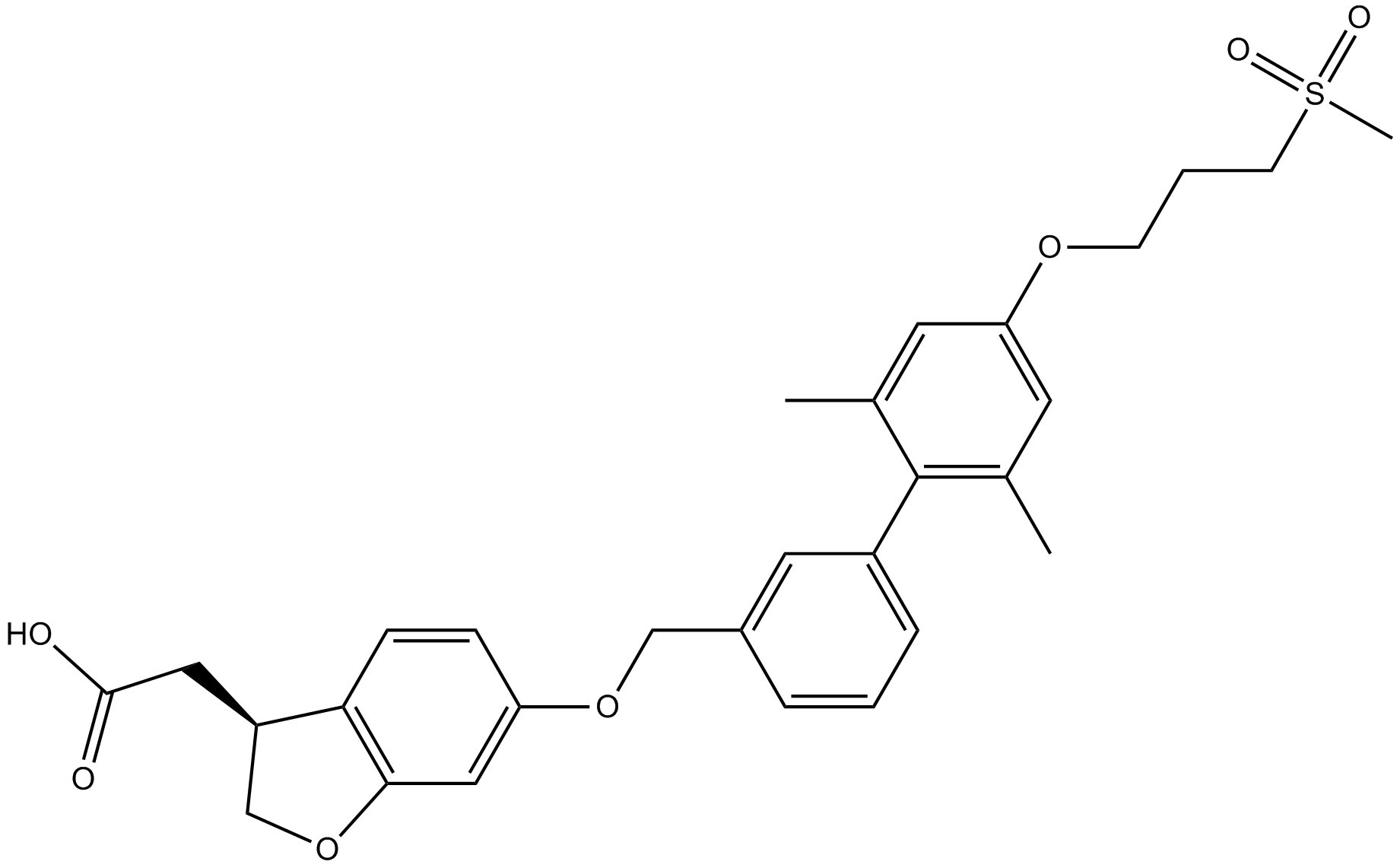
TAK-875 (Synonyms: TAK 875;TAK875) |
Catalog No.GC16555
 One-Click Copy Product Info
|

TAK-875 is a potent, selective and orally bioavailable GPR40 (G protein-coupled receptor 40) agonist with an EC50 value of 0.014μM for human GPR40.
Products are for research use only. Not for human use. We do not sell to patients.
Cas No.: 1000413-72-8
Sample solution is provided at 25 µL, 10mM.
_1-3.$$$39978408@51.jpg');)
_1-9.$$$38538795@65.jpg');)
_1-9.$$$39112701@51.jpg');)
_1-7.$$$37316672@70.jpg');)
_366-372.$$$36198801@70.jpg');)
.$$$38565142@65.jpg');)
_1867-1883.$$$33248023@67.jpg');)
_eads6055.$$$39977546@45.jpg');)
_eadm9805.$$$40080571@45.jpg');)
_eadj3020.$$$39666821@45.jpg');)
_1-20.$$$39757301@28.jpg');)
_1-24.$$$38898113@28.jpg');)
_273-287.$$$36806353@46.jpg');)
_1-16.$$$37156877@44.jpg');)
_1-19.$$$37460805@44.jpg');)
_1291-1307.$$$34518654@46.jpg');)
TAK-875 is a potent, selective and orally bioavailable GPR40 (G protein-coupled receptor 40) agonist with an EC50 value of 0.014μM for human GPR40. GPR40 is highly expressed in pancreatic β cells and β cell lines in humans and rodents, and has also been found in multiple regions of the human brain. TAK-875 demonstrates potent plasma hypoglycemic and insulin-promoting effects in oral glucose tolerance tests of female Wistar fat rats with impaired glucose tolerance, and has been selected as a clinical candidate drug for the treatment of diabetes[1].
In vitro, TAK-875 dose-dependently increased intracellular inositol monophosphate (IP) production and Ca²⁺ levels at 0.1-10µM and 3-30µM in rat insulinoma INS-1 833/15 cells under 1-10mM glucose, and stimulated insulin secretion at 0.001-10µM in the presence of 10mM glucose[2]. TAK-875 at 6.25-100µM for 72h did not alter glucose-stimulated insulin secretion, insulin content, or caspase-3/7 activity in INS-1 833/15 cells[2].
In vivo, intravenous administration of TAK-875 at 1mg/kg in rats resulted in a plasma clearance (CL) of 34.16mL/h·kg, a terminal half-life (t₁/₂λ) of 4.7h, and a steady-state volume of distribution (Vd(ss)) of 208.49mL/kg, whereas oral gavage at 3mg/kg resulted in good absorption, with an AUC0–24h of 65µg·h/mL, a Cmax of 5.77µg/mL, and an oral bioavailability of 76%[1]. TAK-875 (1-10mg/kg; p.o.) significantly improved glucose tolerance and enhanced insulin secretion in type 2 diabetic N-STZ-1.5 rat models[2]. TAK-875 (10mg/kg; p.o.) significantly increased plasma insulin levels and reduced fasting hyperglycemia in male Zucker diabetic fatty rats[2].
References:
[1] Negoro N, Sasaki S, Mikami S, et al. Discovery of TAK-875: A Potent, Selective, and Orally Bioavailable GPR40 Agonist. ACS Med Chem Lett. 2010;1(6):290-294.
[2] Tsujihata Y, Ito R, Suzuki M, et al. TAK-875, an orally available G protein-coupled receptor 40/free fatty acid receptor 1 agonist, enhances glucose-dependent insulin secretion and improves both postprandial and fasting hyperglycemia in type 2 diabetic rats. J Pharmacol Exp Ther. 2011;339(1):228-237.
| Cell experiment [1]: | |
Cell lines | INS-1 832/13 cells |
Preparation Method | Cells were seeded at a density of 2x10⁴ cells/well in a 96-well black plate coated with poly-D-lysine, and 1% BSA and 0.1% DMSO alone (control), palmitic acid (62.5, 125, 250, 500 and 1000μM), oleic acid (62.5, 125, 250, 500 and 1000μM), or TAK-875 (6.25, 12.5, 25, 50 and 100μM) was added to the plate with 1% BSA and 0.1% DMSO, followed by culture for 72h. After the culture, caspase 3/7 activity was measured with the Apo-one homogeneous caspase 3/7 assay. |
Reaction Conditions | 6.25, 12.5, 25, 50 and 100μM; 72h |
Applications | In these cells, 72h exposure to palmitic acid (62.5-1000μM) and oleic acid (62.5-1000μM) caused dose-dependent enhancement of caspase 3/7 activity, and statistically significant effects were observed at doses above 250μM palmitic acid and 500μM oleic acid. In contrast, TAK-875 (6.25-100μM) did not show any effect on caspase 3/7 activity under the same conditions. |
| Animal experiment [1]: | |
Animal models | SD rats (8 weeks old) |
Preparation Method | SD rats (8 weeks old) were fasted overnight and orally given vehicle (0.5% methylcellulose), TAK-875 (10 or 30mg/kg), nateglinide (50mg/kg), or glibenclamide (10mg/kg). Blood samples were collected from the tail vein before drug administration (time 0) and 0.5, 1, 2, and 3h after drug administration, and plasma glucose and insulin levels were measured as described above. |
Dosage form | 10 or 30mg/kg; p.o. |
Applications | Nateglinide (50mg/kg) lowered plasma glucose levels below normal fasting levels in SD rats by increasing plasma insulin. glibenclamide (10mg/kg) gradually decreased plasma glucose levels below normal fasting levels with a significant increase in plasma insulin levels. In contrast, TAK-875 at 30mg/kg, which is a 3- to 10-fold higher dose compared with the dose that improved glucose tolerance in diabetic rats, did not alter fasting glucose levels in SD rats with normal glucose homeostasis. TAK-875 did not significantly alter insulin secretion in SD rats with normal fasting glucose levels. |
References: | |
| Cas No. | 1000413-72-8 | SDF | |
| Synonyms | TAK 875;TAK875 | ||
| Chemical Name | 2-[(3S)-6-[[3-[2,6-dimethyl-4-(3-methylsulfonylpropoxy)phenyl]phenyl]methoxy]-2,3-dihydro-1-benzofuran-3-yl]acetic acid | ||
| Canonical SMILES | CC1=CC(=CC(=C1C2=CC(=CC=C2)COC3=CC4=C(C=C3)C(CO4)CC(=O)O)C)OCCCS(=O)(=O)C | ||
| Formula | C29H32O7S | M.Wt | 524.64 |
| Solubility | ≥ 26.25mg/mL in DMSO | Storage | Store at -20°C |
| General tips | Please select the appropriate solvent to prepare the stock solution according to the
solubility of the product in different solvents; once the solution is prepared, please store it in
separate packages to avoid product failure caused by repeated freezing and thawing.Storage method
and period of the stock solution: When stored at -80°C, please use it within 6 months; when stored
at -20°C, please use it within 1 month. To increase solubility, heat the tube to 37°C and then oscillate in an ultrasonic bath for some time. |
||
| Shipping Condition | Evaluation sample solution: shipped with blue ice. All other sizes available: with RT, or with Blue Ice upon request. | ||
| Prepare stock solution | |||

|
1 mg | 5 mg | 10 mg |
| 1 mM | 1.9061 mL | 9.5303 mL | 19.0607 mL |
| 5 mM | 381.2 μL | 1.9061 mL | 3.8121 mL |
| 10 mM | 190.6 μL | 953 μL | 1.9061 mL |
Step 1: Enter information below (Recommended: An additional animal making an allowance for loss during the experiment)
 g
μL
g
μL
Step 2: Enter the in vivo formulation (This is only the calculator, not formulation. Please contact us first if there is no in vivo formulation at the solubility Section.)
Calculation results:
Working concentration: mg/ml;
Method for preparing DMSO master liquid: mg drug pre-dissolved in μL DMSO ( Master liquid concentration mg/mL, Please contact us first if the concentration exceeds the DMSO solubility of the batch of drug. )
Method for preparing in vivo formulation: Take μL DMSO master liquid, next addμL PEG300, mix and clarify, next addμL Tween 80, mix and clarify, next add μL saline, mix and clarify.
Method for preparing in vivo formulation: Take μL DMSO master liquid, next add μL Corn oil, mix and clarify.
Note: 1. Please make sure the liquid is clear before adding the next solvent.
2. Be sure to add the solvent(s) in order. You must ensure that the solution obtained, in the previous addition, is a clear solution before proceeding to add the next solvent. Physical methods such as vortex, ultrasound or hot water bath can be used to aid dissolving.
3. All of the above co-solvents are available for purchase on the GlpBio website.
Quality Control & SDS
- View current batch:
- Purity: >98.50% Appearance: A solid
- COA (Certificate of Analysis)
- SDS (Safety Data Sheet)
- Datasheet
Average Rating: 5 (Based on Reviews and 13 reference(s) in Google Scholar.)