

Berzosertib (VE-822) |
Catalog No.GC15337
 One-Click Copy Product Info
|

Berzosertib (VE-822) is an intravenous (i.v.), highly potent and selective inhibitor of ATR (IC50 =19nM).
Products are for research use only. Not for human use. We do not sell to patients.
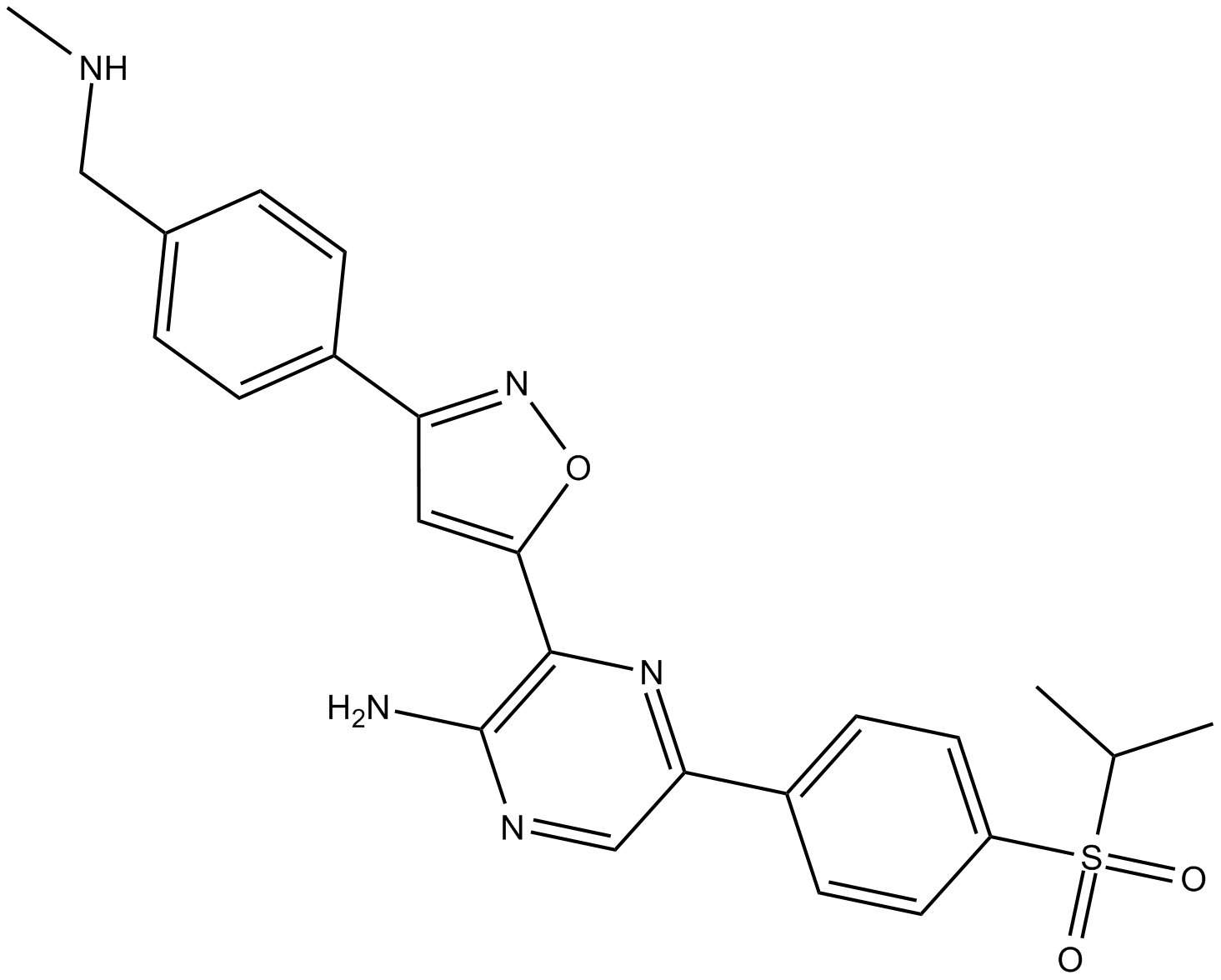
Cas No.: 1232416-25-9
Sample solution is provided at 25 µL, 10mM.
_1-3.$$$39978408@51.jpg');)
_1-9.$$$38538795@65.jpg');)
_1-9.$$$39112701@51.jpg');)
_1-7.$$$37316672@70.jpg');)
_366-372.$$$36198801@70.jpg');)
.$$$38565142@65.jpg');)
_1867-1883.$$$33248023@67.jpg');)
_eads6055.$$$39977546@45.jpg');)
_eadm9805.$$$40080571@45.jpg');)
_eadj3020.$$$39666821@45.jpg');)
_1-20.$$$39757301@28.jpg');)
_1-24.$$$38898113@28.jpg');)
_273-287.$$$36806353@46.jpg');)
_1-16.$$$37156877@44.jpg');)
_1-19.$$$37460805@44.jpg');)
_1291-1307.$$$34518654@46.jpg');)
Berzosertib (VE-822) is an intravenous (i.v.), highly potent and selective inhibitor of ATR (IC50 =19nM) [1]. Under radiation, Berzosertib can activate both the canonical cGAS-STING-pTBK1/pIRF3 axis by increasing cytosolic double-stranded DNA levels and the non-canonical STING signaling by attenuating SHP1-mediated inhibition of the TRAF6-STING-p65 axis, via promoting SUMOylation of SHP1 at lysine 127 [2]. Berzosertib has been widely used to inhibit tumor progression and enhance the killing effect of radiation therapy on tumors[3].
In vitro, Berzosertib treatment for 72h significantly inhibited the viability of Cal-27 and FaDu cells with IC50 values of 0.285µM and 0.252µM, respectively[4]. Treatment with 80nM Berzosertib for 19 hours significantly reduced the phosphorylation level of Chk1 and decreased the survival of MiaPaCa-2 cells under 4Gy radiation[5]. Treatment with 6µM Berzosertib for 24 hours led to a significant increase in the levels of γ-H2AX, pp53, and cc3 in U2OS cells, accompanied by DNA breaks and cell apoptosis[6].
In vivo, Berzosertib treatment via a single oral dose of 60mg/kg for 48 hours led to the accumulation of DNA damage and a decrease in P-Chk1 expression within the tumors of mice bearing the OD26749 xenografts [7]. Administering 60mg/kg of Berzosertib orally 4 times per week for 3 weeks significantly inhibited tumor growth in H827-xenograft mice and upregulated the activity of OTUD1 protein[8].
References:
[1] Middleton M R, Dean E, Evans T R J, et al. Phase 1 study of the ATR inhibitor berzosertib (formerly M6620, VX-970) combined with gemcitabine±cisplatin in patients with advanced solid tumours[J]. British Journal of Cancer, 2021, 125(4): 510-519.
[2] Liu C, Wang X, Qin W, et al. Combining radiation and the ATR inhibitor berzosertib activates STING signaling and enhances immunotherapy via inhibiting SHP1 function in colorectal cancer[J]. Cancer Communications, 2023, 43(4): 435-454.
[3] Wang L W, Jiang S, Yuan Y H, et al. Recent advances in synergistic antitumor effects exploited from the inhibition of ataxia telangiectasia and RAD3-related protein kinase (ATR)[J]. Molecules, 2022, 27(8): 2491.
[4] Schnoell J, Sparr C, Al-Gboore S, et al. The ATR inhibitor berzosertib acts as a radio-and chemosensitizer in head and neck squamous cell carcinoma cell lines[J]. Investigational New Drugs, 2023, 41(6): 842-850.
[5] Fokas E, Prevo R, Pollard J R, et al. Targeting ATR in vivo using the novel inhibitor VE-822 results in selective sensitization of pancreatic tumors to radiation[J]. Cell death & disease, 2012, 3(12): e441-e441.
[6] Yin Q, Liu X, Hu L, et al. VE-822, a novel DNA Holliday junction stabilizer, inhibits homologous recombination repair and triggers DNA damage response in osteogenic sarcomas[J]. Biochemical pharmacology, 2021, 193: 114767.
[7] Hall A B, Newsome D, Wang Y, et al. Potentiation of tumor responses to DNA damaging therapy by the selective ATR inhibitor VX-970[J]. Oncotarget, 2014, 5(14): 5674.
[8] Zhang Q, Li J, Chen Z, et al. VE-822 upregulates the deubiquitinase OTUD1 to stabilize FHL1 to inhibit the progression of lung adenocarcinoma[J]. Cellular Oncology, 2023, 46(4): 1001-1014.
| Cell experiment [1]: | |
|
Cell lines |
Cal-27 cells |
|
Preparation Method |
Cal-27 cells were grown in DMEM with 10% (v/v) fetal bovine serum (FBS), antibiotic/antimycotic solution at 37°C in 5% CO2/atmosphere. Cal-27 cells were cultured in growth medium in 96-well dishes at a density of 5000 cells per well. One day after seeding, cells were treated with Berzosertib (0.031, 0.063, 0.125, 0.25, and 0.5µM). After 72h of incubation, cell viability was measured. |
|
Reaction Conditions |
0.031, 0.063, 0.125, 0.25, and 0.5µM; 72h |
|
Applications |
Berzosertib treatment significantly inhibited the cell viability of Cal-27 cells in a dose-dependent manner. |
| Animal experiment [2]: | |
|
Animal models |
BALB/c nude mice |
|
Preparation Method |
Male BALB/c nude mice (4 weeks old) were housed singly in a standard environment with food and water ad libitum. H827 cells (5×10⁶) were suspended in 200µl PBS and then injected subcutaneously into the left and right. Two weeks after tumors became measurable, mice were randomly divided into PBS-treatment and Berzosertib treatment groups. Berzosertib was administered at a dose of 60mg/kg in 5% DMSO + 45% PEG300 + 50% sterile PBS once per day for 4 consecutive days every week by oral gavage and lasted 3 weeks. Tumor volume was measured and tumor volume=0.5×length×width2. |
|
Dosage form |
60mg/kg; 4 times a week for 3 weeks; p.o. |
|
Applications |
Berzosertib treatment significantly inhibited tumor growth in the H827 xenograft mouse model. |
|
References: |
|
| Cas No. | 1232416-25-9 | SDF | |
| Chemical Name | 3-[3-[4-(methylaminomethyl)phenyl]-1,2-oxazol-5-yl]-5-(4-propan-2-ylsulfonylphenyl)pyrazin-2-amine | ||
| Canonical SMILES | CC(C)S(=O)(=O)C1=CC=C(C=C1)C2=CN=C(C(=N2)C3=CC(=NO3)C4=CC=C(C=C4)CNC)N | ||
| Formula | C24H25N5O3S | M.Wt | 463.55 |
| Solubility | ≥ 50mg/mL in DMSO | Storage | Store at -20° C |
| General tips | Please select the appropriate solvent to prepare the stock solution according to the
solubility of the product in different solvents; once the solution is prepared, please store it in
separate packages to avoid product failure caused by repeated freezing and thawing.Storage method
and period of the stock solution: When stored at -80°C, please use it within 6 months; when stored
at -20°C, please use it within 1 month. To increase solubility, heat the tube to 37°C and then oscillate in an ultrasonic bath for some time. |
||
| Shipping Condition | Evaluation sample solution: shipped with blue ice. All other sizes available: with RT, or with Blue Ice upon request. | ||
| Prepare stock solution | |||

|
1 mg | 5 mg | 10 mg |
| 1 mM | 2.1573 mL | 10.7863 mL | 21.5726 mL |
| 5 mM | 431.5 μL | 2.1573 mL | 4.3145 mL |
| 10 mM | 215.7 μL | 1.0786 mL | 2.1573 mL |
Step 1: Enter information below (Recommended: An additional animal making an allowance for loss during the experiment)
 g
μL
g
μL
Step 2: Enter the in vivo formulation (This is only the calculator, not formulation. Please contact us first if there is no in vivo formulation at the solubility Section.)
Calculation results:
Working concentration: mg/ml;
Method for preparing DMSO master liquid: mg drug pre-dissolved in μL DMSO ( Master liquid concentration mg/mL, Please contact us first if the concentration exceeds the DMSO solubility of the batch of drug. )
Method for preparing in vivo formulation: Take μL DMSO master liquid, next addμL PEG300, mix and clarify, next addμL Tween 80, mix and clarify, next add μL saline, mix and clarify.
Method for preparing in vivo formulation: Take μL DMSO master liquid, next add μL Corn oil, mix and clarify.
Note: 1. Please make sure the liquid is clear before adding the next solvent.
2. Be sure to add the solvent(s) in order. You must ensure that the solution obtained, in the previous addition, is a clear solution before proceeding to add the next solvent. Physical methods such as vortex, ultrasound or hot water bath can be used to aid dissolving.
3. All of the above co-solvents are available for purchase on the GlpBio website.
Quality Control & SDS
- View current batch:
- Purity: >98.00% Appearance: A solid
- COA (Certificate of Analysis)
- SDS (Safety Data Sheet)
- Datasheet
Average Rating: 5 (Based on Reviews and 15 reference(s) in Google Scholar.)