

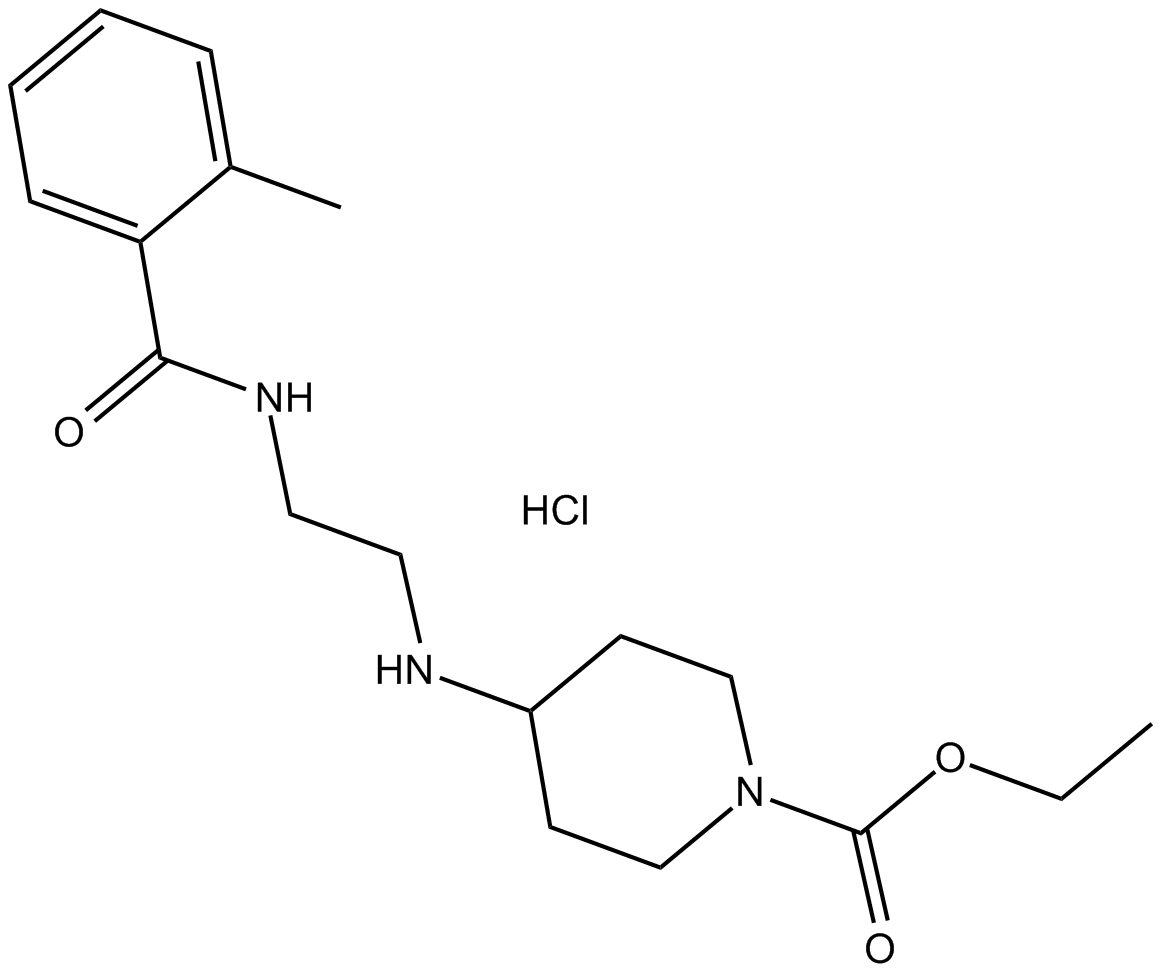
VU 0357017 hydrochloride (Synonyms: CID-25010775) |
Catalog No.GC16655
 One-Click Copy Product Info
|

Positive allosteric modulator of muscarinic M1 receptors
Products are for research use only. Not for human use. We do not sell to patients.
Cas No.: 1135242-13-5
Sample solution is provided at 25 µL, 10mM.
_1-3.$$$39978408@51.jpg');)
_1-9.$$$38538795@65.jpg');)
_1-9.$$$39112701@51.jpg');)
_1-7.$$$37316672@70.jpg');)
_366-372.$$$36198801@70.jpg');)
.$$$38565142@65.jpg');)
_1867-1883.$$$33248023@67.jpg');)
_eads6055.$$$39977546@45.jpg');)
_eadm9805.$$$40080571@45.jpg');)
_eadj3020.$$$39666821@45.jpg');)
_1-20.$$$39757301@28.jpg');)
_1-24.$$$38898113@28.jpg');)
_273-287.$$$36806353@46.jpg');)
_1-16.$$$37156877@44.jpg');)
_1-19.$$$37460805@44.jpg');)
_1291-1307.$$$34518654@46.jpg');)
VU0357017 hydrochloride is a highly selective M1 agonists that appear to act at an allosteric site to activate the receptor (EC50 = 477 ± 172 nM; pEC50 = 6.37 ± 0.15).IC50 value: 477 ± 172 nM (EC50) [1]Target: M1in vitro: VU0357017 is a M1-selective agonists that appear to activate M1 through actions at an allosteric site. Ki values of VU0357017 derived from competition binding experiment is 9.91(rM1), 21.4 (rM2), 55.3 (rM3), 35 (rM4), and 50 (rM5), respectively. [1] VU0357017 is a potent and efficacious M1 agonist, selective versus M2 M5 family members and allosteric agonist. VU0357017 is a highly selective M1 agonist suggests that these compounds are unlikely to act at the highly conserved orthosteric site on M1 and are more likely to act as allosteric agonists. [2] VU0357017 has robust effects on M1-activation of calcium mobilization and ERK1/2 phosphorylation but have little effect on β-arrestin recruitment. VU0357017 induces calcium release and ERK phosphorylation but is without effects on β-arrestin recruitment. VU0357017 significantly enhances threshold Θ-burst LTP and VU0364572 induces LTD at the Schaffer collateral-CA1 synapse of rodent hippocampal slices. [3]in vivo: VU0357017 has robust efficacy in improving hippocampal-dependent learning in rats. VU0357017 enhances performance in Morris water maze and contextual fear conditioning in rats. [3]
References:
[1]. Digby GJ, et al. Chemical modification of the M(1) agonist VU0364572 reveals molecular switches in pharmacology and a bitopic binding mode. ACS Chem Neurosci. 2012 Dec 19;3(12):1025-36.
[2]. Lebois EP, et al. Discovery and characterization of novel subtype-selective allosteric agonists for the investigation of M(1) receptor function in the central nervous system. ACS Chem Neurosci. 2010;1(2):104-121.
[3]. Digby GJ, et al. Novel allosteric agonists of M1 muscarinic acetylcholine receptors induce brain region-specific responses that correspond with behavioral effects in animal models. J Neurosci. 2012 Jun 20;32(25):8532-44.
[4]. Sheffler DJ, et al. Further exploration of M allosteric agonists: subtle structural changes abolish M allosteric agonism and result in pan-mAChR orthosteric antagonism. Bioorg Med Chem Lett. 2013 Jan 1;23(1):223-7.
| Cas No. | 1135242-13-5 | SDF | |
| Synonyms | CID-25010775 | ||
| Chemical Name | ethyl 4-((2-(2-methylbenzamido)ethyl)amino)piperidine-1-carboxylate hydrochloride | ||
| Canonical SMILES | O=C(N1CCC(CC1)NCCNC(C2=CC=CC=C2C)=O)OCC.Cl | ||
| Formula | C18H27N3O3.HCl | M.Wt | 369.89 |
| Solubility | DMSO: 3 mg/ml,PBS (pH 7.2): 5 mg/ml | Storage | Store at -20°C |
| General tips | Please select the appropriate solvent to prepare the stock solution according to the
solubility of the product in different solvents; once the solution is prepared, please store it in
separate packages to avoid product failure caused by repeated freezing and thawing.Storage method
and period of the stock solution: When stored at -80°C, please use it within 6 months; when stored
at -20°C, please use it within 1 month. To increase solubility, heat the tube to 37°C and then oscillate in an ultrasonic bath for some time. |
||
| Shipping Condition | Evaluation sample solution: shipped with blue ice. All other sizes available: with RT, or with Blue Ice upon request. | ||
| Prepare stock solution | |||

|
1 mg | 5 mg | 10 mg |
| 1 mM | 2.7035 mL | 13.5175 mL | 27.0351 mL |
| 5 mM | 540.7 μL | 2.7035 mL | 5.407 mL |
| 10 mM | 270.4 μL | 1.3518 mL | 2.7035 mL |
Step 1: Enter information below (Recommended: An additional animal making an allowance for loss during the experiment)
 g
μL
g
μL
Step 2: Enter the in vivo formulation (This is only the calculator, not formulation. Please contact us first if there is no in vivo formulation at the solubility Section.)
Calculation results:
Working concentration: mg/ml;
Method for preparing DMSO master liquid: mg drug pre-dissolved in μL DMSO ( Master liquid concentration mg/mL, Please contact us first if the concentration exceeds the DMSO solubility of the batch of drug. )
Method for preparing in vivo formulation: Take μL DMSO master liquid, next addμL PEG300, mix and clarify, next addμL Tween 80, mix and clarify, next add μL saline, mix and clarify.
Method for preparing in vivo formulation: Take μL DMSO master liquid, next add μL Corn oil, mix and clarify.
Note: 1. Please make sure the liquid is clear before adding the next solvent.
2. Be sure to add the solvent(s) in order. You must ensure that the solution obtained, in the previous addition, is a clear solution before proceeding to add the next solvent. Physical methods such as vortex, ultrasound or hot water bath can be used to aid dissolving.
3. All of the above co-solvents are available for purchase on the GlpBio website.
Quality Control & SDS
- View current batch:
- Purity: >99.00% Appearance: A solid
- COA (Certificate of Analysis)
- SDS (Safety Data Sheet)
- Datasheet
Average Rating: 5 (Based on Reviews and 1 reference(s) in Google Scholar.)