

WM-8014 (Synonyms: WM8014,WM 8014) |
Catalog No.GC18153
 One-Click Copy Product Info
|

Inhibitor for KAT6A (MOZ) and KAT6B (MORF/QKF), anticancer
Products are for research use only. Not for human use. We do not sell to patients.
Cas No.: 2055397-18-5
Sample solution is provided at 25 µL, 10mM.
_1-3.$$$39978408@51.jpg');)
_1-9.$$$38538795@65.jpg');)
_1-9.$$$39112701@51.jpg');)
_1-7.$$$37316672@70.jpg');)
_366-372.$$$36198801@70.jpg');)
.$$$38565142@65.jpg');)
_1867-1883.$$$33248023@67.jpg');)
_eads6055.$$$39977546@45.jpg');)
_eadm9805.$$$40080571@45.jpg');)
_eadj3020.$$$39666821@45.jpg');)
_1-20.$$$39757301@28.jpg');)
_1-24.$$$38898113@28.jpg');)
_273-287.$$$36806353@46.jpg');)
_1-16.$$$37156877@44.jpg');)
_1-19.$$$37460805@44.jpg');)
_1291-1307.$$$34518654@46.jpg');)
Target: lysine acetyltransferases, KAT6A(MOZ), KAT6B(MORF/QKF)
WM-8014 induces cell cycle exit and cellular senescence without causing DNA damage. Senescence is INK4A/ARF-dependent and is accompanied by changes in gene expression that are typical of loss of KAT6A function. WM-8014 potentiates oncogene-induced senescence in vitro and in a zebrafish model of hepatocellular carcinoma.
Data:
Treatment of MEFs with WM-8014 leads to cellular senescence.
Because KAT6A suppresses senescence, the ability of WM-8014 to induce cell cycle arrest is tested in embryonic day (E)14.5 mouse embryonic fibroblasts (MEFs). Cells treated with WM-8014 failed to proliferate after 10 days of treatment (IC50 2.4 μM).
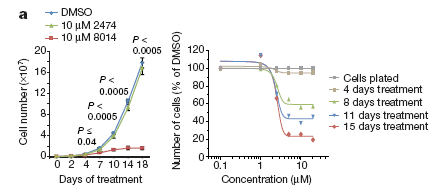
(Left: effects of WM-8014 compared with the inactive compound WM-2474 or DMSO vehicle control on cell growth of MEFs grown in 3% O2. Right: effects of the dose of WM-8014 and the duration of treatment.)
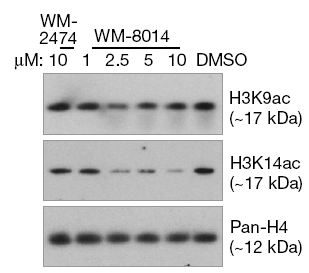
Western blot of MEFs treated with increasing doses of WM-8014 and controls as indicated.
KD(KAT6A)=0.005μM KD(KAT5) = 0.9μM KD(KAT7) = 0.09 μM
References
1. Baell JB, et al. Inhibitors of histone acetyltransferases KAT6A/B induce senescence and arrest tumour growth. Nature. 2018 Aug;560(7717):253-257.
Kinase experiment: | To determine the inhibition of Moz activity by the test compounds, assay reactions are conducted in a volume of 8 μL in 384-well low volume assay plates. The reactions are performed in assay buffer (100 mM Tris-HCl, pH 7.8, 15 mM NaCl, 1 mM EDTA, 0.01% Tween-20, 1 mM Dithiothreitol, and 0.02% m/v chicken egg white albumin). Reactions are set up with 0.4 μM Acetyl coenzyme A (AcCoA), 50 nM N-terminal histone H4 peptide (sequence SGRGKGGKGLGKGGAKRHRKV-GGK-biotin), 10 nM MOZ enzyme, and an acetyl-lysine specific antibody (final dilution 1: 10000). 11-point dilution series of the compounds (WM-8014) of the invention are prepared in DMSO; a volume of 100 nL is transferred using a pin tool into assay plates containing substrates, before adding enzyme to start the reaction. Positive (no compound) and negative (AcCoA omitted) control reactions are included on the same plates and receive the same amount of DMSO as the compound treated wells. After adding all reagents, the plates are sealed with adhesive seals and incubated for 90 minutes at room temperature[1]. |
References: [1]. ARYL SULFONOHYDRAZIDES. WO2016198507 A1. | |
| Cas No. | 2055397-18-5 | SDF | |
| Synonyms | WM8014,WM 8014 | ||
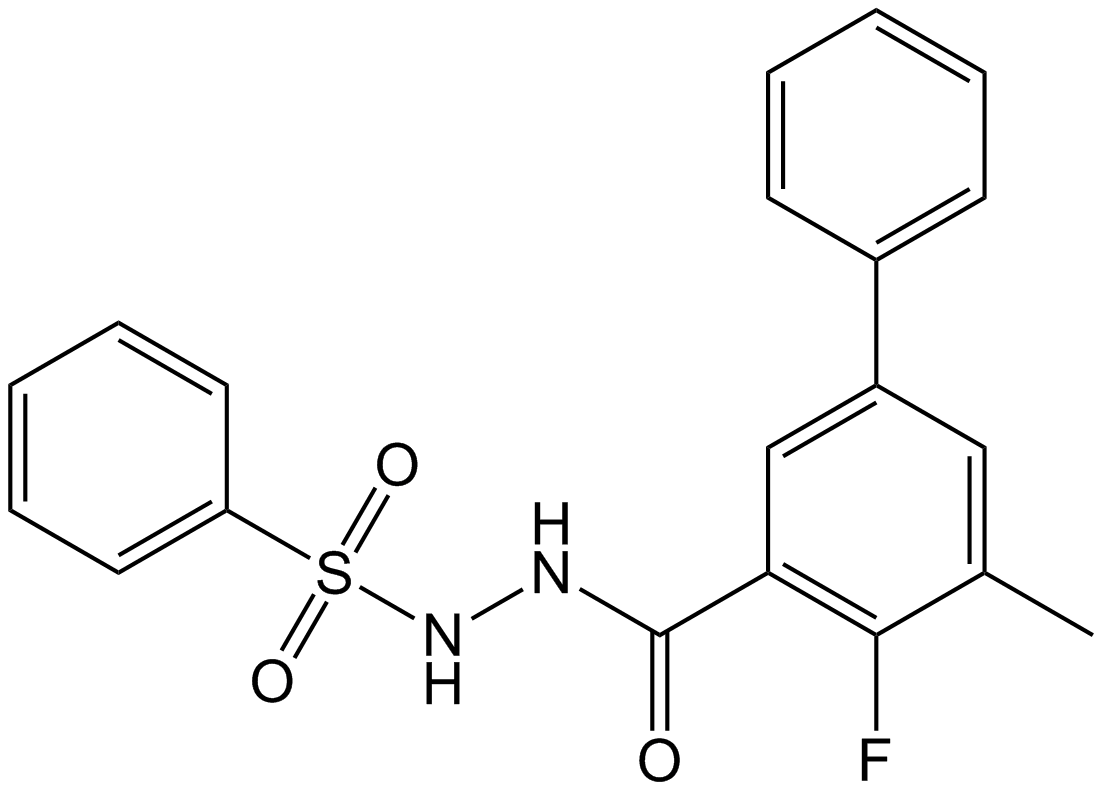
| Chemical Name | N'-(4-fluoro-5-methyl-[1,1'-biphenyl]-3-carbonyl)benzenesulfonohydrazide | ||
| Canonical SMILES | O=S(C1=CC=CC=C1)(NNC(C2=C(F)C(C)=CC(C3=CC=CC=C3)=C2)=O)=O | ||
| Formula | C20H17FN2O3S | M.Wt | 384.42 |
| Solubility | DMF: 50 mg/ml,DMF:PBS (pH 7.2) (1:7): 0.1 mg/ml,DMSO: 33 mg/ml,Ethanol: 2 mg/ml | Storage | Store at -20°C |
| General tips | Please select the appropriate solvent to prepare the stock solution according to the
solubility of the product in different solvents; once the solution is prepared, please store it in
separate packages to avoid product failure caused by repeated freezing and thawing.Storage method
and period of the stock solution: When stored at -80°C, please use it within 6 months; when stored
at -20°C, please use it within 1 month. To increase solubility, heat the tube to 37°C and then oscillate in an ultrasonic bath for some time. |
||
| Shipping Condition | Evaluation sample solution: shipped with blue ice. All other sizes available: with RT, or with Blue Ice upon request. | ||
| Prepare stock solution | |||

|
1 mg | 5 mg | 10 mg |
| 1 mM | 2.6013 mL | 13.0066 mL | 26.0132 mL |
| 5 mM | 520.3 μL | 2.6013 mL | 5.2026 mL |
| 10 mM | 260.1 μL | 1.3007 mL | 2.6013 mL |
Step 1: Enter information below (Recommended: An additional animal making an allowance for loss during the experiment)
 g
μL
g
μL
Step 2: Enter the in vivo formulation (This is only the calculator, not formulation. Please contact us first if there is no in vivo formulation at the solubility Section.)
Calculation results:
Working concentration: mg/ml;
Method for preparing DMSO master liquid: mg drug pre-dissolved in μL DMSO ( Master liquid concentration mg/mL, Please contact us first if the concentration exceeds the DMSO solubility of the batch of drug. )
Method for preparing in vivo formulation: Take μL DMSO master liquid, next addμL PEG300, mix and clarify, next addμL Tween 80, mix and clarify, next add μL saline, mix and clarify.
Method for preparing in vivo formulation: Take μL DMSO master liquid, next add μL Corn oil, mix and clarify.
Note: 1. Please make sure the liquid is clear before adding the next solvent.
2. Be sure to add the solvent(s) in order. You must ensure that the solution obtained, in the previous addition, is a clear solution before proceeding to add the next solvent. Physical methods such as vortex, ultrasound or hot water bath can be used to aid dissolving.
3. All of the above co-solvents are available for purchase on the GlpBio website.
Quality Control & SDS
- View current batch:
- Purity: >99.50% Appearance: A solid
- COA (Certificate of Analysis)
- SDS (Safety Data Sheet)
- Datasheet
Average Rating: 5 (Based on Reviews and 27 reference(s) in Google Scholar.)