

5-(Biotinamido)pentylamine |
Catalog No.GC62166
 One-Click Copy Product Info
|

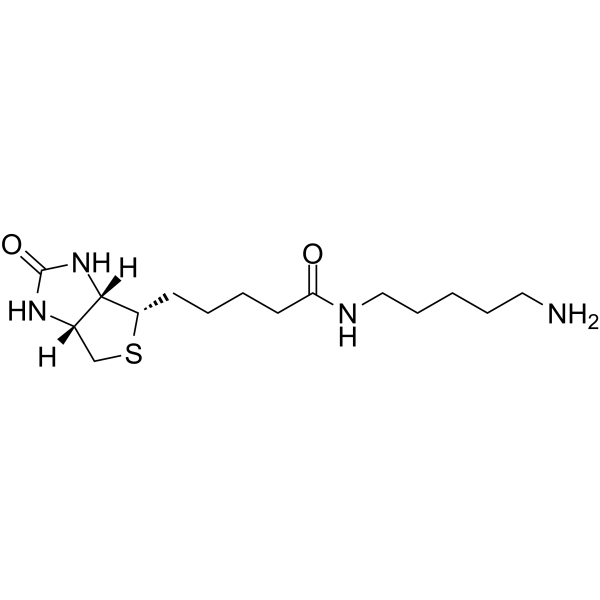
5-(Biotinamido)pentylamine is a biotin derivative with a C5 carbon chain spacer.
Products are for research use only. Not for human use. We do not sell to patients.
Cas No.: 115416-38-1
Sample solution is provided at 25 µL, 10mM.
_1-3.$$$39978408@51.jpg');)
_1-9.$$$38538795@65.jpg');)
_1-9.$$$39112701@51.jpg');)
_1-7.$$$37316672@70.jpg');)
_366-372.$$$36198801@70.jpg');)
.$$$38565142@65.jpg');)
_1867-1883.$$$33248023@67.jpg');)
_eads6055.$$$39977546@45.jpg');)
_eadm9805.$$$40080571@45.jpg');)
_eadj3020.$$$39666821@45.jpg');)
_1-20.$$$39757301@28.jpg');)
_1-24.$$$38898113@28.jpg');)
_273-287.$$$36806353@46.jpg');)
_1-16.$$$37156877@44.jpg');)
_1-19.$$$37460805@44.jpg');)
_1291-1307.$$$34518654@46.jpg');)
5-(Biotinamido)pentylamine is a biotin derivative with a C5 carbon chain spacer [1]. 5‑(Biotinamido)pentylamine is mainly used as an amine donor substrate for transglutaminase (TG). After being catalyzed by the enzyme, it can covalently bind to the glutamine residues in the protein through a γ‑amide bond, thereby introducing the biotin tag into the target protein [2-3].
References:
[1]. Ikura K, Kita K, Fujita I, et al. Identification of amine acceptor protein substrates of transglutaminase in liver extracts: use of 5-(biotinamido) pentylamine as a probe. Archives of biochemistry and biophysics. 1998 Aug 15; 356(2): 280-286.
[2]. Slaughter TF, Achyuthan KE, Lai TS, et al. A microtiter plate transglutaminase assay utilizing 5-(biotinamido) pentylamine as substrate. Analytical biochemistry. 1992 Aug 15; 205(1): 166-171.
[3]. Ichikawa A, Ishizaki J, Morita M, et al. Identification of new amine acceptor protein substrate candidates of transglutaminase in rat liver extract: use of 5-(biotinamido) pentylamine as a probe. Bioscience, biotechnology, and biochemistry. 2008 Apr 23; 72(4): 1056-1062.
This protocol describes the use of 5-(Biotinamido)pentylamine as a biotinylated amine donor substrate for measuring transglutaminase (TG) activity in microtiter‑plate (ELISA) or dot‑blot formats. Actual conditions may require optimization depending on TG isoform, enzyme concentration, and sample type [1–2].
1. Preparation of Reagents and Materials
Prepare 5‑(Biotinamido)pentylamine, purified TG enzyme, N,N′‑dimethylcasein, streptavidin-HRP, p-nitrophenyl phosphate (pNPP) for colorimetric readout, assay buffer (100mM Tris-HCl, pH 7.4, with 10-20mM DTT and 10-20mM CaCl₂), and blocking/wash buffers (1–5% BSA).
2. Experimental Steps
(1) Coating and Blocking (for ELISA format)
Coat microplate wells with 100µg/mL dimethylcasein in PBS overnight at 4 ℃. Wash with TBST and block with 1–5% BSA at room temperature for 1 hour.
(2) TG Reaction
Using a 96-well plate, 0.5-2mM 5-(Biotinamido)pentylamine, 0.1–1µg/well TGase, 50–100µg total protein lysate, and a reaction buffer containing Tris-HCl, DTT, and CaCl₂ were mixed to form a reaction system and incubated at 37°C for 30–60 minutes to catalyze the covalent binding of the amine donor to the protein substrate.
(3) Washing
Stop the reaction and wash wells or membrane with TBST 3 times to remove unbound reagents.
(4) Detection
Add streptavidin-HRP or streptavidin-IRDye conjugate diluted in blocking buffer, incubate for 1 hour at room temperature, then wash 3 times.
(5) Signal Development
For colorimetric readout, add pNPP substrate and measure absorbance at 405nm after 15–30 minutes. For fluorescence or chemiluminescence, scan using appropriate imager.
Notes and Precautions
(1) Optimize TG and substrate concentrations to ensure linear detection. Avoid signal saturation.
(2) Include EGTA-treated controls (no Ca²⁺) and no-enzyme blanks to determine background signal.
(3) Use known TG inhibitors (e.g., cystamine or Z-DON) as positive controls for inhibition screening.
(4) When using complex lysates, dot-blot detection may provide higher specificity and better visualization.
(5) Signal can be normalized to total protein content or housekeeping enzyme activity.
(6) 5‑(Biotinamido)pentylamine stock solutions (e.g., 50mM in water or DMSO) should be stored at -20℃ and protected from light.
References:
[1]. Slaughter TF, Achyuthan KE, Lai TS, et al. A microtiter plate transglutaminase assay utilizing 5-(biotinamido) pentylamine as substrate. Analytical biochemistry. 1992 Aug 15; 205(1): 166-171.
[2]. Ichikawa A, Ishizaki J, Morita M, et al. Identification of new amine acceptor protein substrate candidates of transglutaminase in rat liver extract: use of 5-(biotinamido) pentylamine as a probe. Bioscience, biotechnology, and biochemistry. 2008 Apr 23; 72(4): 1056-1062.
| Cas No. | 115416-38-1 | SDF | |
| Formula | C15H28N4O2S | M.Wt | 328.47 |
| Solubility | DMSO : 100 mg/mL (304.44 mM; Need ultrasonic) | Storage | Store at -20°C |
| General tips | Please select the appropriate solvent to prepare the stock solution according to the
solubility of the product in different solvents; once the solution is prepared, please store it in
separate packages to avoid product failure caused by repeated freezing and thawing.Storage method
and period of the stock solution: When stored at -80°C, please use it within 6 months; when stored
at -20°C, please use it within 1 month. To increase solubility, heat the tube to 37°C and then oscillate in an ultrasonic bath for some time. |
||
| Shipping Condition | Evaluation sample solution: shipped with blue ice. All other sizes available: with RT, or with Blue Ice upon request. | ||
| Prepare stock solution | |||

|
1 mg | 5 mg | 10 mg |
| 1 mM | 3.0444 mL | 15.2221 mL | 30.4442 mL |
| 5 mM | 608.9 μL | 3.0444 mL | 6.0888 mL |
| 10 mM | 304.4 μL | 1.5222 mL | 3.0444 mL |
Step 1: Enter information below (Recommended: An additional animal making an allowance for loss during the experiment)
 g
μL
g
μL
Step 2: Enter the in vivo formulation (This is only the calculator, not formulation. Please contact us first if there is no in vivo formulation at the solubility Section.)
Calculation results:
Working concentration: mg/ml;
Method for preparing DMSO master liquid: mg drug pre-dissolved in μL DMSO ( Master liquid concentration mg/mL, Please contact us first if the concentration exceeds the DMSO solubility of the batch of drug. )
Method for preparing in vivo formulation: Take μL DMSO master liquid, next addμL PEG300, mix and clarify, next addμL Tween 80, mix and clarify, next add μL saline, mix and clarify.
Method for preparing in vivo formulation: Take μL DMSO master liquid, next add μL Corn oil, mix and clarify.
Note: 1. Please make sure the liquid is clear before adding the next solvent.
2. Be sure to add the solvent(s) in order. You must ensure that the solution obtained, in the previous addition, is a clear solution before proceeding to add the next solvent. Physical methods such as vortex, ultrasound or hot water bath can be used to aid dissolving.
3. All of the above co-solvents are available for purchase on the GlpBio website.
Quality Control & SDS
- View current batch:
- Purity: >95.00% Appearance: A solid
- COA (Certificate of Analysis)
- SDS (Safety Data Sheet)
- Datasheet
Average Rating: 5 (Based on Reviews and 23 reference(s) in Google Scholar.)