

5-Hydroxydecanoate sodium |
Catalog No.GC60029
 One-Click Copy Product Info
|

5-Hydroxydecanoate sodium is a selective ATP-sensitive K+ (KATP) channel blocker with an IC50 value of 28.7μM.
Products are for research use only. Not for human use. We do not sell to patients.
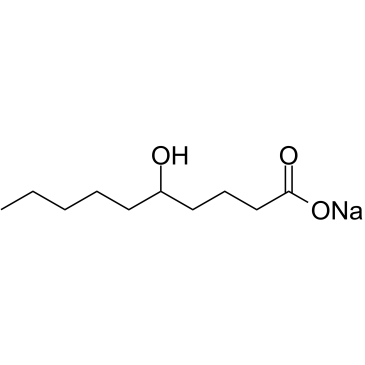
Cas No.: 71186-53-3
Sample solution is provided at 25 µL, 10mM.
5-Hydroxydecanoate sodium is a selective ATP-sensitive K+ (KATP) channel blocker with an IC50 value of 28.7μM [1]. 5-Hydroxydecanoate sodium can traverse the mitochondrial inner membrane and acts as a substrate for mitochondrial outer membrane acyl-CoA synthetase, with the activity of inhibiting both ischaemic and pharmacological preconditioning [2]. 5-Hydroxydecanoate sodium has been widely used to alter mitochondrial membrane potential and inhibit the proliferation of hypoxic human pulmonary artery smooth muscle cells (hPASMCs)[3].
In vitro, 5-Hydroxydecanoate sodium treatment (10μM) for 24 hours inhibited the toxicity of 6-hydroxydopamine (6-OHDA) to isolated dopaminergic neurons and blocked the decrease in mitochondrial membrane potential induced by 6-OHDA[4]. Pre-treatment with 100μM 5-Hydroxydecanoate sodium for 30 minutes significantly abolished the inhibitory effect of Penehyclidine hydrochloride (PHC) on the cell damage in H9c2 cells induced by anoxia/reoxygenation (A/R), promoted Ca2+ overload and ROS generation, and facilitated the release of cytochrome C from mitochondria into the cytoplasm[5]. Treatment with 100μM 5-Hydroxydecanoate sodium for 20 minutes can weaken the protective effect of puerarin (Pue) in the isolated cardiomyocyte ischemia model and promote cell death[6].
In vivo, injecting 5-Hydroxydecanoate sodium (10mg/kg) and paclitaxel (4.5mg/kg) intraperitoneally every other day for a week enabled the mice to regain the thermal sensitivity and alleviate mechanical allodynia[7]. Two intraperitoneal injections of 5-Hydroxydecanoate sodium (5mg/kg) were administered weekly for 12 weeks, which aggravated the atherosclerotic degree and pro-inflammatory response in ApoE−/− mice fed with a high-fat diet[8].
References:
[1] Li X, Rapedius M, Baukrowitz T, et al. 5-Hydroxydecanoate and coenzyme A are inhibitors of native sarcolemmal KATP channels in inside-out patches[J]. Biochimica et Biophysica Acta (BBA)-General Subjects, 2010, 1800(3): 385-391.
[2] Hanley P J, Gopalan K V, Lareau R A, et al. β‐Oxidation of 5‐hydroxydecanoate, a Putative Blocker of Mitochondrial ATP‐Sensitive Potassium Channels[J]. The Journal of physiology, 2003, 547(2): 387-393.
[3] Wang T, ZHANG Z, XU Y, et al. 5‐Hydroxydecanoate inhibits proliferation of hypoxic human pulmonary artery smooth muscle cells by blocking mitochondrial KATP channels 1[J]. Acta Pharmacologica Sinica, 2007, 28(10): 1531-1540.
[4] Rodriguez-Pallares J, Parga J A, Joglar B, et al. The mitochondrial ATP-sensitive potassium channel blocker 5-hydroxydecanoate inhibits toxicity of 6-hydroxydopamine on dopaminergic neurons[J]. Neurotoxicity research, 2009, 15(1): 82-95.
[5] Zi C, Zhang C, Yang Y, et al. Penehyclidine hydrochloride protects against anoxia/reoxygenation injury in cardiomyocytes through ATP‐sensitive potassium channels, and the Akt/GSK‐3β and Akt/mTOR signaling pathways[J]. Cell Biology International, 2020, 44(6): 1353-1362.
[6] Gao Q, Pan H Y, Qiu S, et al. Atractyloside and 5-hydroxydecanoate block the protective effect of puerarin in isolated rat heart[J]. Life sciences, 2006, 79(3): 217-224.
[7] Chen L H, Sun Y T, Chen Y F, et al. Integrating image-based high-content screening with mouse models identifies 5-hydroxydecanoate as a neuroprotective drug for paclitaxel-induced neuropathy[J]. Molecular cancer therapeutics, 2015, 14(10): 2206-2214.
[8] Zhang Y, Ding X, Yuan C, et al. Anti-Inflammatory Responses Produced with Nippostrongylus brasiliensis-Derived Uridine via the Mitochondrial ATP-Sensitive Potassium Channel and Its Anti-Atherosclerosis Effect in an Apolipoprotein E Gene Knockout Mouse Model[J]. Biomolecules, 2024, 14(6): 672.
| Cell experiment [1]: | |
Cell lines | H9c2 cells |
Preparation Method | H9c2 cells were maintained in Dulbecco's Modified Eagle Medium (DMEM) containing 10% fetal bovine serum (FBS) in a humidified 5% CO2 incubator (95% air/5% CO2) at 37°C. H9c2 cells were seeded at 4×10⁵ cells per well in six-well plates and cultured at 37°C before dividing into 5 groups. (i) Control group: H9c2 cells were cultured in Tyrode solution for 3h and then in DMEM for another 2h in a humidified 5% CO2 incubator (95% air/5% CO2) at 37°C. (ii) PHC group: H9c2 cells were pretreated with 0.1μM PHC and then processed as the control group. (iii) A/R group: H9c2 cells were cultured in an anoxic atmosphere (95% N2/5% CO2) for 3h and then re-oxygenated (95% air/5% CO2) for another 2h. (iv) A/R + PHC group: H9c2 cells were pretreated with 0.1μM PHC for 2h prior to A/R treatment. (v) A/R+PHC+5-Hydroxydecanoate sodium group: H9c2 cells were pretreated with 100μM 5-Hydroxydecanoate sodium for 30min and then with 0.1μM PHC for another 2h prior to A/R treatment. Cell proliferation was determined. |
Reaction Conditions | 100μM; 24h |
Applications | 5-Hydroxydecanoate sodium treatment abolished the inhibitory effect of PHC on the cell death in H9c2 cells induced by A/R. |
| Animal experiment [2]: | |
Animal models | Female C57BL/6J mice |
Preparation Method | Female C57BL/6J mice (ages 7 weeks) were housed in a temperature-controlled (23±2°C) room maintained on a 12/12h light/dark cycle. Paclitaxel (4.5mg/kg), vehicle (saline), or 5-Hydroxydecanoate sodium (10mg/kg) was injected intraperitoneally on four alternative days (days 0, 2, 4, and 6). The baseline measurement of each test was taken prior to paclitaxel or vehicle administration, and five additional sessions of tests were recorded weekly for 5 weeks. Heat hypersensitivity of tail withdrawal was measured by the tail immersion assay. Motor function impairment was measured by the grip strength test. |
Dosage form | 10mg/kg; every other day for a week; i.p. |
Applications | 5-Hydroxydecanoate sodium treatment enabled the mice to regain the thermal sensitivity and alleviate mechanical allodynia. |
References: | |
| Cas No. | 71186-53-3 | SDF | |
| Canonical SMILES | CCCCCC(O)CCCC(O[Na])=O | ||
| Formula | C10H19NaO3 | M.Wt | 210.25 |
| Solubility | DMSO : 12.5 mg/mL (59.45 mM; Need ultrasonic); H2O : 10 mg/mL (47.56 mM; Need ultrasonic) | Storage | Store at -20°C |
| General tips | Please select the appropriate solvent to prepare the stock solution according to the
solubility of the product in different solvents; once the solution is prepared, please store it in
separate packages to avoid product failure caused by repeated freezing and thawing.Storage method
and period of the stock solution: When stored at -80°C, please use it within 6 months; when stored
at -20°C, please use it within 1 month. To increase solubility, heat the tube to 37°C and then oscillate in an ultrasonic bath for some time. |
||
| Shipping Condition | Evaluation sample solution: shipped with blue ice. All other sizes available: with RT, or with Blue Ice upon request. | ||
| Prepare stock solution | |||

|
1 mg | 5 mg | 10 mg |
| 1 mM | 4.7562 mL | 23.7812 mL | 47.5624 mL |
| 5 mM | 951.2 μL | 4.7562 mL | 9.5125 mL |
| 10 mM | 475.6 μL | 2.3781 mL | 4.7562 mL |
Step 1: Enter information below (Recommended: An additional animal making an allowance for loss during the experiment)
 g
μL
g
μL
Step 2: Enter the in vivo formulation (This is only the calculator, not formulation. Please contact us first if there is no in vivo formulation at the solubility Section.)
Calculation results:
Working concentration: mg/ml;
Method for preparing DMSO master liquid: mg drug pre-dissolved in μL DMSO ( Master liquid concentration mg/mL, Please contact us first if the concentration exceeds the DMSO solubility of the batch of drug. )
Method for preparing in vivo formulation: Take μL DMSO master liquid, next addμL PEG300, mix and clarify, next addμL Tween 80, mix and clarify, next add μL saline, mix and clarify.
Method for preparing in vivo formulation: Take μL DMSO master liquid, next add μL Corn oil, mix and clarify.
Note: 1. Please make sure the liquid is clear before adding the next solvent.
2. Be sure to add the solvent(s) in order. You must ensure that the solution obtained, in the previous addition, is a clear solution before proceeding to add the next solvent. Physical methods such as vortex, ultrasound or hot water bath can be used to aid dissolving.
3. All of the above co-solvents are available for purchase on the GlpBio website.
Quality Control & SDS
- View current batch:
- Purity: >98.00% Appearance: A solid
- COA (Certificate of Analysis)
- SDS (Safety Data Sheet)
- Datasheet
Average Rating: 5 (Based on Reviews and 30 reference(s) in Google Scholar.)