

ACP-105 |
Catalog No.GC31738
 One-Click Copy Product Info
|

ACP-105 is an orally available, selective amd potent androgen receptor modulator (SARM), with pEC50s of 9.0 and 9.3 for AR wild type and T877A mutant, respectively.
Products are for research use only. Not for human use. We do not sell to patients.
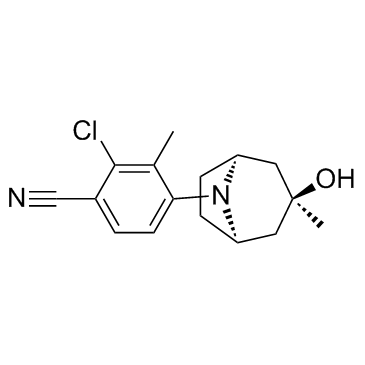
Cas No.: 899821-23-9
Sample solution is provided at 25 µL, 10mM.
_1-3.$$$39978408@51.jpg');)
_1-9.$$$38538795@65.jpg');)
_1-9.$$$39112701@51.jpg');)
_1-7.$$$37316672@70.jpg');)
_366-372.$$$36198801@70.jpg');)
.$$$38565142@65.jpg');)
_1867-1883.$$$33248023@67.jpg');)
_eads6055.$$$39977546@45.jpg');)
_eadm9805.$$$40080571@45.jpg');)
_eadj3020.$$$39666821@45.jpg');)
_1-20.$$$39757301@28.jpg');)
_1-24.$$$38898113@28.jpg');)
_273-287.$$$36806353@46.jpg');)
_1-16.$$$37156877@44.jpg');)
_1-19.$$$37460805@44.jpg');)
_1291-1307.$$$34518654@46.jpg');)
ACP-105 is an orally available, selective amd potent androgen receptor modulator (SARM), with pEC50s of 9.0 and 9.3 for AR wild type and T877A mutant, respectively.
ACP-105 is an orally available, selective amd potent androgen receptor modulator (SARM), with pEC50s of 9.0 and 9.3 for AR wild type and T877A mutant, respectively. The half-lives of ACP-105 (compound 1) in human hepatocytes is measured and found to be 5.0 h[1].
ACP-105 enhances freezing in both sham-irradiated and irradiated mice (effect of ACP-105: F=5.44; p=0.028). For MAP-2 immunoreactivity in the cortex of sham-irradiated mice, there is a brain area×ACP-105 interaction (F=6.655; p=0.0027). While ACP-105 reduces MAP-2 immunoreactivity in the sensorymotor cortex, there is a trend towards increased MAP-2 immunoreactivity in the enthorhinal cortex[2].
[1]. Schlienger N, et al. Synthesis, structure-activity relationships, and characterization of novel nonsteroidal and selective androgen receptor modulators. J Med Chem. 2009 Nov 26;52(22):7186-91. [2]. Dayger C, et al. Effects of the SARM ACP-105 on rotorod performance and cued fear conditioning in sham-irradiated and irradiated female mice. Brain Res. 2011 Mar 24;1381:134-40.
Animal experiment: | Mice[2]Two-month-old C56Bl/6J female mice are kept on a 12:12 hr light-dark schedule (lights on at 6 AM) with lab chow and water given ad libitum. Following i.p. anesthesia (ketamine, 80 mg/kg and xylazine, 20 mg/kg), mice are sham-irradiated (n=7 sham vehicle-treated mice and n=7 ACP-105-treated mice) or irradiated (n=8 vehicle-treated mice and n=7 ACP-105-treated mice) using a dose of 10 Gy in a Mark 1 Cesium Irradiator. Twenty-four hours following irradiation, the mice are implanted with Alzet minipumps filled with ACP-105 at 1 mg/kg/day or 1.09 mg/200 μL in 10% Tween in saline or vehicle. Behavioral testing starts two weeks after irradiation. Mice receives three trials per day for three subsequent days. Mice are tested for fear conditioning in week 2. During contextual fear conditioning, mice learn to associate the environmental context with a mild foot shock. Contextual conditioned fear is assessed during the first 3 minutes of the contextual test trial when freezing behavior is most robust. Cued conditioned fear is assessed during the presentation of the tone (the last 3 minutes of the trial)[2]. |
References: [1]. Schlienger N, et al. Synthesis, structure-activity relationships, and characterization of novel nonsteroidal and selective androgen receptor modulators. J Med Chem. 2009 Nov 26;52(22):7186-91. | |
| Cas No. | 899821-23-9 | SDF | |
| Canonical SMILES | N#CC1=CC=C(N2[C@@H]3C[C@](O)(C)C[C@H]2CC3)C(C)=C1Cl | ||
| Formula | C16H19ClN2O | M.Wt | 290.79 |
| Solubility | DMSO : ≥ 103 mg/mL (354.21 mM) | Storage | Store at -20°C |
| General tips | Please select the appropriate solvent to prepare the stock solution according to the
solubility of the product in different solvents; once the solution is prepared, please store it in
separate packages to avoid product failure caused by repeated freezing and thawing.Storage method
and period of the stock solution: When stored at -80°C, please use it within 6 months; when stored
at -20°C, please use it within 1 month. To increase solubility, heat the tube to 37°C and then oscillate in an ultrasonic bath for some time. |
||
| Shipping Condition | Evaluation sample solution: shipped with blue ice. All other sizes available: with RT, or with Blue Ice upon request. | ||
| Prepare stock solution | |||

|
1 mg | 5 mg | 10 mg |
| 1 mM | 3.4389 mL | 17.1945 mL | 34.3891 mL |
| 5 mM | 687.8 μL | 3.4389 mL | 6.8778 mL |
| 10 mM | 343.9 μL | 1.7195 mL | 3.4389 mL |
Step 1: Enter information below (Recommended: An additional animal making an allowance for loss during the experiment)
 g
μL
g
μL
Step 2: Enter the in vivo formulation (This is only the calculator, not formulation. Please contact us first if there is no in vivo formulation at the solubility Section.)
Calculation results:
Working concentration: mg/ml;
Method for preparing DMSO master liquid: mg drug pre-dissolved in μL DMSO ( Master liquid concentration mg/mL, Please contact us first if the concentration exceeds the DMSO solubility of the batch of drug. )
Method for preparing in vivo formulation: Take μL DMSO master liquid, next addμL PEG300, mix and clarify, next addμL Tween 80, mix and clarify, next add μL saline, mix and clarify.
Method for preparing in vivo formulation: Take μL DMSO master liquid, next add μL Corn oil, mix and clarify.
Note: 1. Please make sure the liquid is clear before adding the next solvent.
2. Be sure to add the solvent(s) in order. You must ensure that the solution obtained, in the previous addition, is a clear solution before proceeding to add the next solvent. Physical methods such as vortex, ultrasound or hot water bath can be used to aid dissolving.
3. All of the above co-solvents are available for purchase on the GlpBio website.
Quality Control & SDS
- View current batch:
- Purity: >99.00% Appearance: A solid
- COA (Certificate of Analysis)
- SDS (Safety Data Sheet)
- Datasheet
Average Rating: 5 (Based on Reviews and 21 reference(s) in Google Scholar.)