

AM 281 |
Catalog No.GC16480
 One-Click Copy Product Info
|

AM 281 is a high-affinity and selective CB2 receptor antagonist with an IC50 of 13μM. AM 281 is used to study the role of the endocannabinoid system in various physiological and pathological processes and has potential applications in the research of inflammation, pain, and neurodegenerative diseases.
Products are for research use only. Not for human use. We do not sell to patients.
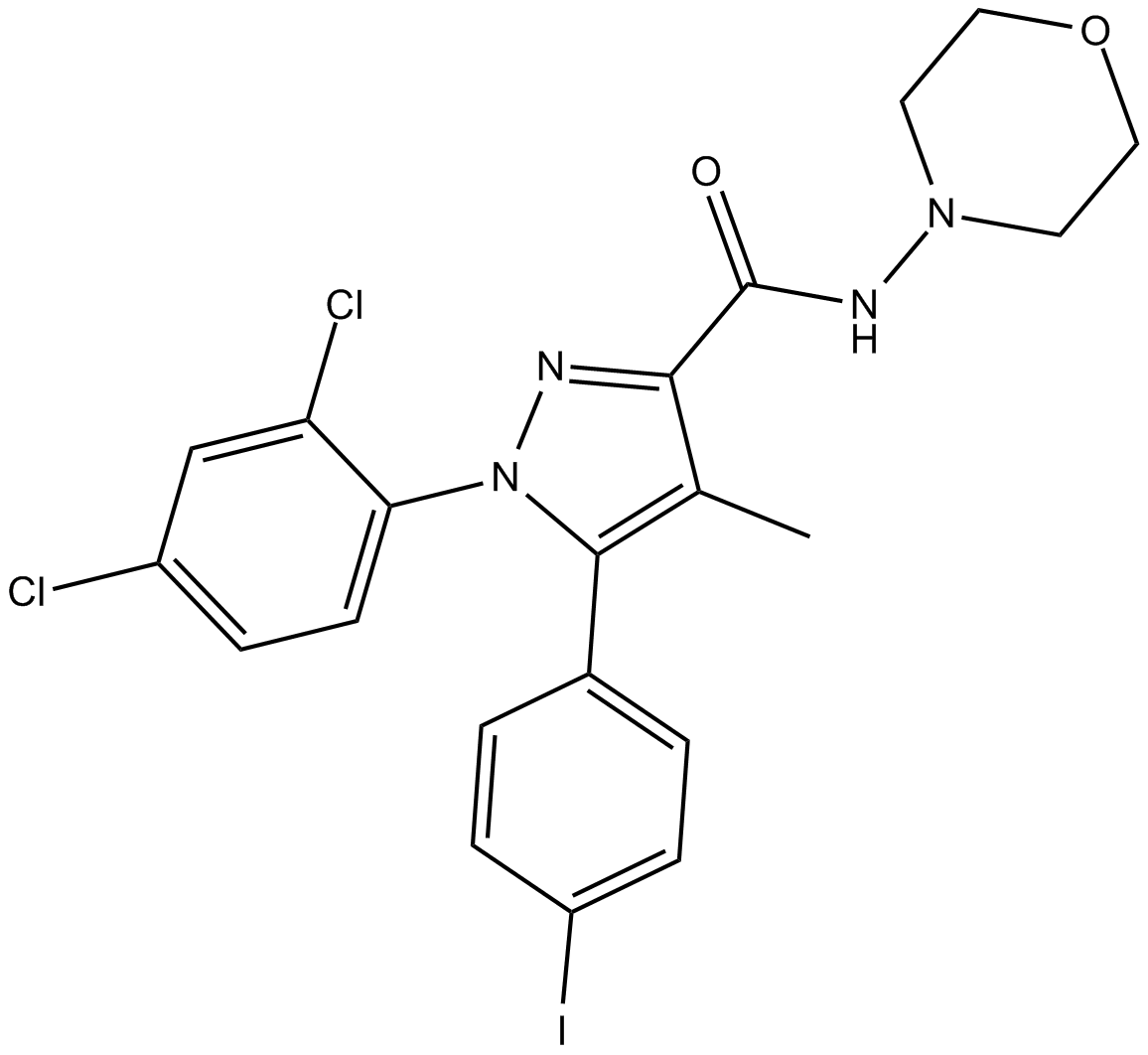
Cas No.: 202463-68-1
Sample solution is provided at 25 µL, 10mM.
_1-3.$$$39978408@51.jpg');)
_1-9.$$$38538795@65.jpg');)
_1-9.$$$39112701@51.jpg');)
_1-7.$$$37316672@70.jpg');)
_366-372.$$$36198801@70.jpg');)
.$$$38565142@65.jpg');)
_1867-1883.$$$33248023@67.jpg');)
_eads6055.$$$39977546@45.jpg');)
_eadm9805.$$$40080571@45.jpg');)
_eadj3020.$$$39666821@45.jpg');)
_1-20.$$$39757301@28.jpg');)
_1-24.$$$38898113@28.jpg');)
_273-287.$$$36806353@46.jpg');)
_1-16.$$$37156877@44.jpg');)
_1-19.$$$37460805@44.jpg');)
_1291-1307.$$$34518654@46.jpg');)
AM 281 is a high-affinity and selective CB2 receptor antagonist with an IC50 of 13μM[1]. AM 281 is used to study the role of the endocannabinoid system in various physiological and pathological processes and has potential applications in the research of inflammation, pain, and neurodegenerative diseases[2]. AM 281 selectively activates the CB2 receptor, which is mainly expressed in immune cells and peripheral tissues, while having minimal activation of the CB1 receptor expressed in the central nervous system[3]. AM 281 has been shown to modulate immune responses and has potential therapeutic applications in diseases related to the endocannabinoid system[4].
In vitro, AM 281 (2μM) was used to pre-treat myocardial HL-1 cells for 30 minutes, followed by co-incubation with quetiapine (Que, 2μM) for 24 hours. AM 281 significantly reduced quetiapine-induced myocardial cell damage. AM 281 inhibited the activation of necroptosis by reducing the protein levels of RIP3 and MLKL and inhibiting the phosphorylation of MLKL in myocardial cells. Additionally, AM 281 significantly decreased inflammation and fibrosis in myocardial cells, improving their pathological state[5]. AM 281 (1, 2, and 4μmol/L) was used to pre-treat rat embryonic ventricular myocardial-derived H9c2 cells for 2 hours, followed by co-incubation with doxorubicin (DOX, 1 or 5μM) for 18 hours. AM 281 significantly increased cell viability and inhibited DOX-induced DNA damage and apoptosis[6].
In vivo, AM 281 (0.62, 1.25, and 2.5mg/kg) was administered via intraperitoneal injection to mice that had been treated with morphine (30-90mg/kg) for 3 consecutive days. AM 281 (2.5mg/kg) significantly improved the recognition index (RI) and alleviated memory deficits in mice undergoing spontaneous morphine withdrawal by inhibiting the activation of CB1 receptors[7]. AM 281 (1, 2, and 4mg/kg) was administered via intraperitoneal injection 30 minutes before the first re-exposure to the aversive context in mice. The results showed that AM 281 at a dose of 1mg/kg significantly increased freezing behavior (fear response) in mice[8].
References:
[1] Kadoi Y, Hinohara H, Kunimoto F, et al. Cannabinoid antagonist AM 281 reduces mortality rate and neurologic dysfunction after cecal ligation and puncture in rats. Crit Care Med. 2005 Nov;33(11):2629-36.
[2] Droste SM, Saland SK, Schlitter EK, et al. AM 251 differentially effects food-maintained responding depending on food palatability. Pharmacol Biochem Behav. 2010 Jun;95(4):443-8.
[3] Rutkowska M, Jamontt J, Gliniak H. Effects of cannabinoids on the anxiety-like response in mice. Pharmacol Rep. 2006 Mar-Apr;58(2):200-6.
[4] Gifford AN, Bruneus M, Gatley SJ, et al. Large receptor reserve for cannabinoid actions in the central nervous system. J Pharmacol Exp Ther. 1999 Feb;288(2):478-83.
[5] Li X, Peng Z, Zhou Y, Wang J, et al. Quetiapine induces myocardial necroptotic cell death through bidirectional regulation of cannabinoid receptors. Toxicol Lett. 2019 Oct 1;313:77-90.
[6] Mukhopadhyay P, Bátkai S, Rajesh M, et al. Pharmacological inhibition of CB1 cannabinoid receptor protects against doxorubicin-induced cardiotoxicity. J Am Coll Cardiol. 2007 Aug 7;50(6):528-36.
[7] Vaseghi G, Rabbani M, Hajhashemi V. The effect of AM281, a cannabinoid antagonist, on memory performance during spontaneous morphine withdrawal in mice. Res Pharm Sci. 2013 Jan;8(1):59-64.
[8] Lisboa SF, Gomes FV, Silva AL, et al. Increased Contextual Fear Conditioning in iNOS Knockout Mice: Additional Evidence for the Involvement of Nitric Oxide in Stress-Related Disorders and Contribution of the Endocannabinoid System. Int J Neuropsychopharmacol. 2015 Jan 24;18(8):pyv005.
| Cell experiment [1]: | |
Cell lines | Rat embryonic ventricular myocardial H9c2 cells |
Preparation Method | AM 281 (1, 2, 4 μmol/L) pre-treats rat embryonic ventricular myogenic H9c2 cells for 2h, followed by co-incubation with doxorubicin (DOX, 1 or 5μM) for 18h. |
Reaction Conditions | 0, 1, 2, and 4μmol/L; 20h |
Applications | AM 281 significantly prevented cell death and apoptosis induced by doxorubicin (DOX) in H9c2 cells. |
| Animal experiment [2]: | |
Animal models | C57BL/6J mice and inducible nitric oxide synthase (iNOS) knockout (KO) mice |
Preparation Method | Male C57BL/6J and iNOS KO mice (8–12 weeks old) were used. For the fear conditioning experiment, mice were subjected to contextual fear conditioning (CFC) by exposing them to three inescapable electrical footshocks (0.75mA, 2 seconds each) in a conditioning chamber. Freezing behavior was evaluated 24, 48, 72, and 96 hours after conditioning. For drug treatment, AM 281 (1, 2, and 4mg/kg) was administered intraperitoneally (i.p.) 30 minutes before the first reexposure to the context chamber. |
Dosage form | 1, 2, and 4mg/kg; i.p |
Applications | AM 281 (1mg/kg) significantly increased freezing behavior in wild-type (WT) mice during contextual fear conditioning, indicating enhanced fear expression. However, in iNOS KO mice, AM 281 did not alter baseline freezing behavior but facilitated fear extinction when administered before reexposure to the context chamber. |
References: | |
| Cas No. | 202463-68-1 | SDF | |
| Chemical Name | 1-(2,4-dichlorophenyl)-5-(4-iodophenyl)-4-methyl-N-morpholino-1H-pyrazole-3-carboxamide | ||
| Canonical SMILES | IC1=CC=C(C=C1)C2=C(C)C(C(NN3CCOCC3)=O)=NN2C(C(Cl)=C4)=CC=C4Cl | ||
| Formula | C21H19Cl2IN4O2 | M.Wt | 557.22 |
| Solubility | ≥ 1.86mg/mL in DMSO with ultrasonic and warming | Storage | Store at -20°C |
| General tips | Please select the appropriate solvent to prepare the stock solution according to the
solubility of the product in different solvents; once the solution is prepared, please store it in
separate packages to avoid product failure caused by repeated freezing and thawing.Storage method
and period of the stock solution: When stored at -80°C, please use it within 6 months; when stored
at -20°C, please use it within 1 month. To increase solubility, heat the tube to 37°C and then oscillate in an ultrasonic bath for some time. |
||
| Shipping Condition | Evaluation sample solution: shipped with blue ice. All other sizes available: with RT, or with Blue Ice upon request. | ||
| Prepare stock solution | |||

|
1 mg | 5 mg | 10 mg |
| 1 mM | 1.7946 mL | 8.9731 mL | 17.9462 mL |
| 5 mM | 358.9 μL | 1.7946 mL | 3.5892 mL |
| 10 mM | 179.5 μL | 897.3 μL | 1.7946 mL |
Step 1: Enter information below (Recommended: An additional animal making an allowance for loss during the experiment)
 g
μL
g
μL
Step 2: Enter the in vivo formulation (This is only the calculator, not formulation. Please contact us first if there is no in vivo formulation at the solubility Section.)
Calculation results:
Working concentration: mg/ml;
Method for preparing DMSO master liquid: mg drug pre-dissolved in μL DMSO ( Master liquid concentration mg/mL, Please contact us first if the concentration exceeds the DMSO solubility of the batch of drug. )
Method for preparing in vivo formulation: Take μL DMSO master liquid, next addμL PEG300, mix and clarify, next addμL Tween 80, mix and clarify, next add μL saline, mix and clarify.
Method for preparing in vivo formulation: Take μL DMSO master liquid, next add μL Corn oil, mix and clarify.
Note: 1. Please make sure the liquid is clear before adding the next solvent.
2. Be sure to add the solvent(s) in order. You must ensure that the solution obtained, in the previous addition, is a clear solution before proceeding to add the next solvent. Physical methods such as vortex, ultrasound or hot water bath can be used to aid dissolving.
3. All of the above co-solvents are available for purchase on the GlpBio website.
Quality Control & SDS
- View current batch:
- Purity: >98.00% Appearance: A solid
- COA (Certificate of Analysis)
- SDS (Safety Data Sheet)
- Datasheet
Average Rating: 5 (Based on Reviews and 20 reference(s) in Google Scholar.)