

Arecaidine but-2-ynyl ester tosylate |
Catalog No.GC11415
 One-Click Copy Product Info
|

Arecaidine but-2-ynyl ester tosylate is a selective muscarinic acetylcholine receptor (mAChR) M2 agonist.
Products are for research use only. Not for human use. We do not sell to patients.
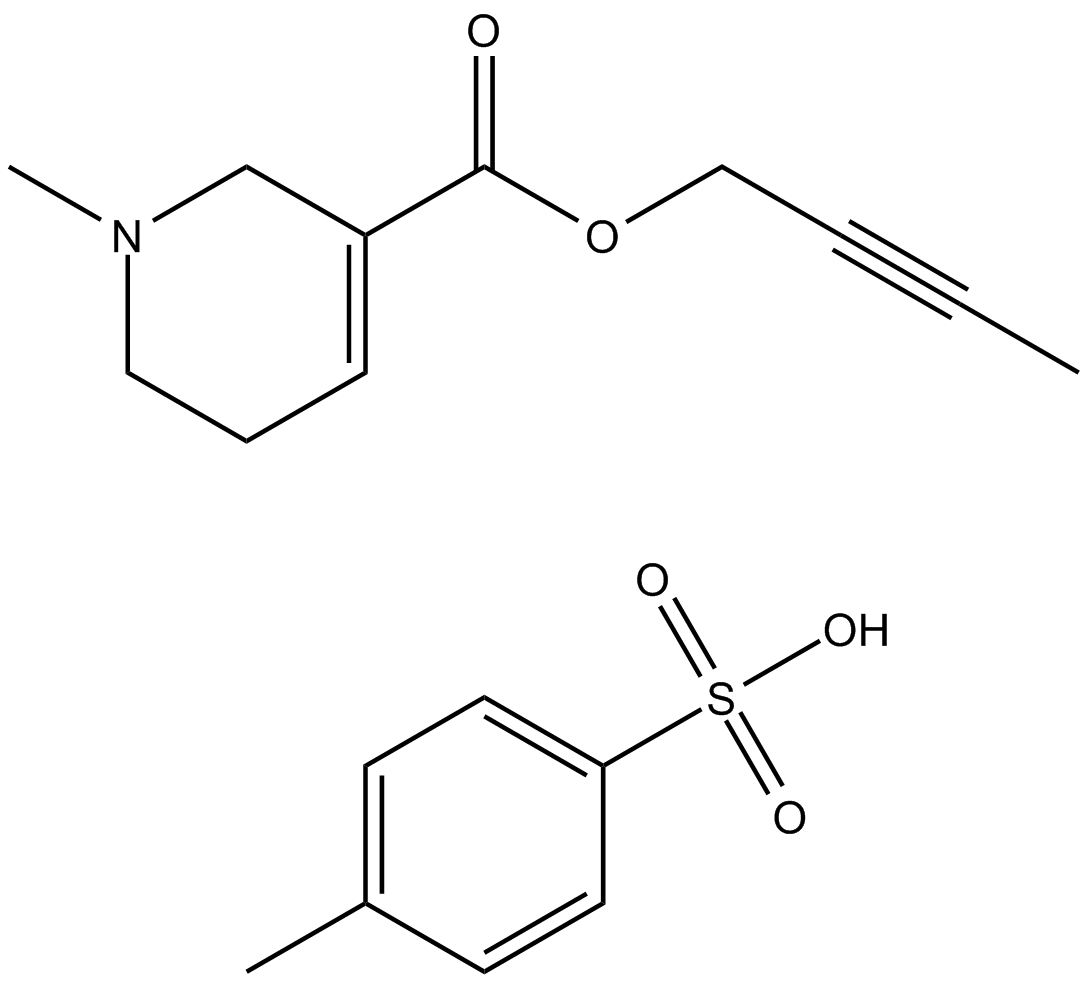
Cas No.: 119630-77-2
Sample solution is provided at 25 µL, 10mM.
_1-3.$$$39978408@51.jpg');)
_1-9.$$$38538795@65.jpg');)
_1-9.$$$39112701@51.jpg');)
_1-7.$$$37316672@70.jpg');)
_366-372.$$$36198801@70.jpg');)
.$$$38565142@65.jpg');)
_1867-1883.$$$33248023@67.jpg');)
_eads6055.$$$39977546@45.jpg');)
_eadm9805.$$$40080571@45.jpg');)
_eadj3020.$$$39666821@45.jpg');)
_1-20.$$$39757301@28.jpg');)
_1-24.$$$38898113@28.jpg');)
_273-287.$$$36806353@46.jpg');)
_1-16.$$$37156877@44.jpg');)
_1-19.$$$37460805@44.jpg');)
_1291-1307.$$$34518654@46.jpg');)
Arecaidine but-2-ynyl ester tosylate is a selective muscarinic acetylcholine receptor (mAChR) M2 agonist[1-2]. Arecaidine but-2-ynyl ester tosylate dose-dependently reduces mean arterial pressure and heart rate by activating M2 receptors. Arecaidine but-2-ynyl ester tosylate can be used in research related to cardiovascular diseases[3-4].
In vitro, MDA-MB-231 and MCF-7 breast cancer cells were treated with Arecaidine but-2-ynyl ester tosylate (0.01μM – 1mM) for 24 hours. Arecaidine but-2-ynyl ester tosylate significantly inhibited cell viability, proliferation, clonogenicity, and migratory capacity, while also downregulating the expression of cell cycle-related genes (CCND1, CDK6, MKI67). Arecaidine but-2-ynyl ester tosylate caused cell cycle arrest in MDA-MB-231 cells and induced apoptosis in MCF-7 cells[5]. In anticholinesterase-pretreated rat diaphragm neuromuscular junction preparations, Arecaidine but-2-ynyl ester tosylate (0.5–50μM) did not significantly alter non-quantal acetylcholine release as measured by the H-effect (endplate hyperpolarization amplitude)[6].
In vivo, Arecaidine but-2-ynyl ester tosylate (3, 10, 30mM) was microinjected (0.5μl) into the cerebellar cortex (lobule VI) of anesthetized SD rats. Arecaidine but-2-ynyl ester tosylate dose-dependently reduced mean arterial pressure and heart rate, with this cardiovascular inhibitory effect recovering within approximately 2.5 minutes[7]. Intrathecal injection of Arecaidine but-2-ynyl ester tosylate (0.3–30nmol/mouse) dose-dependently suppressed leukocyte migration in a zymosan-induced air pouch model in ICR mice and selectively increased Fos expression (a neuronal activation marker) in sympathetic preganglionic neurons of the T7-T11 spinal segments (which primarily project to the adrenal medulla)[8].
References:
[1] Liu J, Evans MS, Lee TJ. Presynaptic muscarinic M(2)-receptor-mediated inhibition of N-type Ca(2+) channels in cultured sphenopalatine ganglion: direct evidence for acetylcholine inhibition of cerebral nitrergic neurogenic vasodilation. J Pharmacol Exp Ther. 2002 Jul;302(1):397-405
[2] Chiang PH, Yeh WC, Lee CT, et al. M(1)-like muscarinic acetylcholine receptors regulate fast-spiking interneuron excitability in rat dentate gyrus. Neuroscience. 2010 Aug 11;169(1):39-51.
[3] Shi H, Yang B, Xu D, et al. Electrophysiological characterization of cardiac muscarinic acetylcholine receptors: different subtypes mediate different potassium currents. Cell Physiol Biochem. 2003;13(2):59-74.
[4] Finney SM, Stewart LH, Gillespie JI. Cholinergic activation of phasic activity in the isolated bladder: possible evidence for M3- and M2-dependent components of a motor/sensory system. BJU Int. 2007 Sep;100(3):668-78.
[5] Yavuz M, Kahyaogullari BN, Demircan T. Anti-carcinogenic effects of arecaidine but-2-ynyl ester tosylate on breast cancer: proliferation inhibition and activation of apoptosis. Mol Biol Rep. 2025 Mar 4;52(1):278.
[6] Malomouzh AI, Mukhtarov MR, Nikolsky EE, et al. Muscarinic M1 acetylcholine receptors regulate the non-quantal release of acetylcholine in the rat neuromuscular junction via NO-dependent mechanism. J Neurochem. 2007 Sep;102(6):2110-2117
[7] Zhang C, Sun T, Zhou P, et al. Role of Muscarinic Acetylcholine Receptor-2 in the Cerebellar Cortex in Cardiovascular Modulation in Anaesthetized Rats. Neurochem Res. 2016 Apr;41(4):804-12.
[8] Yoon SY, Kwon YB, Kim HW, et al. A spinal muscarinic M2 receptor-GABAergic disinhibition pathway that modulates peripheral inflammation in mice. Neuropharmacology. 2007 Oct;53(5):677-86.
| Cell experiment [1]: | |
Cell lines | MDA-MB-231 (human triple-negative breast adenocarcinoma cell line) and MCF-7 (human estrogen receptor-positive breast adenocarcinoma cell line) |
Preparation Method | MDA-MB-231 and MCF-7 cells were maintained in Dulbecco's Modified Eagle Medium (DMEM) supplemented with 10% heat-inactivated fetal bovine serum (FBS) and 1% penicillin/streptomycin at 37°C, 5% CO₂. Cells were treated with Arecaidine but-2-ynyl ester tosylate (0.01μM–1mM) for 24 hours. |
Reaction Conditions | 0.01μM–1mM; 24h. |
Applications | Arecaidine but-2-ynyl ester tosylate significantly inhibits cell viability, proliferation, clonogenicity, and migratory capacity in breast cancer cells. Arecaidine but-2-ynyl ester tosylate induces cell cycle arrest in MDA-MB-231 cells and promotes apoptotic cell death in MCF-7 cells. Arecaidine but-2-ynyl ester tosylate downregulates the expression of key proliferation- and cell cycle-associated genes, including CCND1, CDK6, and MKI67. |
| Animal experiment [2]: | |
Animal models | Male ICR mice |
Preparation Method | Mice received an intrathecal injection of Arecaidine but-2-ynyl ester tosylate (0.3, 1, 3, 10, 30nmol/mouse in 0.5μl) 5 minutes before the induction of local inflammation via zymosan injection into a preformed subcutaneous air pouch. Leukocyte migration into the pouch was quantified 4 hours post-zymosan. In a separate immunohistochemical analysis, animals were perfused 4 hours after zymosan injection to assess neuronal activation. |
Dosage form | 0.3, 1, 3, 10, 30nmol/mouse in 0.5μl; i.t.; single injection. |
Applications | Intrathecal Arecaidine but-2-ynyl ester tosylate dose-dependently suppressed zymosan-induced leukocyte migration and selectively increased Fos expression (a marker of neuronal activation) in sympathetic preganglionic neurons of the T7-T11 spinal segments. Arecaidine but-2-ynyl ester tosylate anti-inflammatory effect is mediated by the suppression of spinal GABAB receptor-mediated inhibitory input, leading to the disinhibition of sympathetic preganglionic neurons and subsequent release of anti-inflammatory catecholamines from the adrenal medulla. |
References: | |
| Cas No. | 119630-77-2 | SDF | |
| Chemical Name | but-2-yn-1-yl 1-methyl-1,2,5,6-tetrahydropyridine-3-carboxylate 4-methylbenzenesulfonate | ||
| Canonical SMILES | CC#CCOC(C(C1)=CCCN1C)=O.CC2=CC=C(S(O)(=O)=O)C=C2 | ||
| Formula | C11H15NO2.C7H8SO3 | M.Wt | 365.44 |
| Solubility | Soluble to 100 mM in sterile water | Storage | Store at -20°C |
| General tips | Please select the appropriate solvent to prepare the stock solution according to the
solubility of the product in different solvents; once the solution is prepared, please store it in
separate packages to avoid product failure caused by repeated freezing and thawing.Storage method
and period of the stock solution: When stored at -80°C, please use it within 6 months; when stored
at -20°C, please use it within 1 month. To increase solubility, heat the tube to 37°C and then oscillate in an ultrasonic bath for some time. |
||
| Shipping Condition | Evaluation sample solution: shipped with blue ice. All other sizes available: with RT, or with Blue Ice upon request. | ||
| Prepare stock solution | |||

|
1 mg | 5 mg | 10 mg |
| 1 mM | 2.7364 mL | 13.6821 mL | 27.3643 mL |
| 5 mM | 547.3 μL | 2.7364 mL | 5.4729 mL |
| 10 mM | 273.6 μL | 1.3682 mL | 2.7364 mL |
Step 1: Enter information below (Recommended: An additional animal making an allowance for loss during the experiment)
 g
μL
g
μL
Step 2: Enter the in vivo formulation (This is only the calculator, not formulation. Please contact us first if there is no in vivo formulation at the solubility Section.)
Calculation results:
Working concentration: mg/ml;
Method for preparing DMSO master liquid: mg drug pre-dissolved in μL DMSO ( Master liquid concentration mg/mL, Please contact us first if the concentration exceeds the DMSO solubility of the batch of drug. )
Method for preparing in vivo formulation: Take μL DMSO master liquid, next addμL PEG300, mix and clarify, next addμL Tween 80, mix and clarify, next add μL saline, mix and clarify.
Method for preparing in vivo formulation: Take μL DMSO master liquid, next add μL Corn oil, mix and clarify.
Note: 1. Please make sure the liquid is clear before adding the next solvent.
2. Be sure to add the solvent(s) in order. You must ensure that the solution obtained, in the previous addition, is a clear solution before proceeding to add the next solvent. Physical methods such as vortex, ultrasound or hot water bath can be used to aid dissolving.
3. All of the above co-solvents are available for purchase on the GlpBio website.
Quality Control & SDS
- View current batch:
- Purity: >98.00% Appearance: A solid
- COA (Certificate of Analysis)
- SDS (Safety Data Sheet)
- Datasheet
Average Rating: 5 (Based on Reviews and 25 reference(s) in Google Scholar.)