

Herbacetin (Synonyms: Isoarticulatidin, 8-hydroxy Kaempferol, 3,5,7,8,4'-Pentahydroxyflavone) |
Catalog No.GC38635
 One-Click Copy Product Info
|

Herbacetin, a natural compound found in flax and other plants, is an effective and nontoxic allosteric inhibitor of Ornithine decarboxylase (ODC).
Products are for research use only. Not for human use. We do not sell to patients.
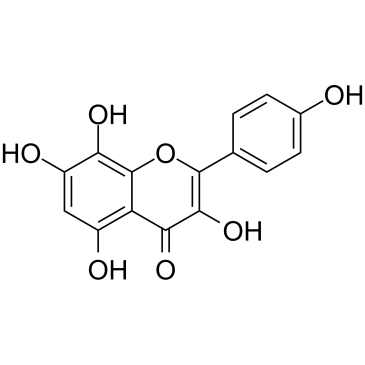
Cas No.: 527-95-7
Sample solution is provided at 25 µL, 10mM.
Herbacetin, a natural compound found in flax and other plants, is an effective and nontoxic allosteric inhibitor of Ornithine decarboxylase (ODC). ODC is a rate-limiting enzyme in the first step of polyamine biosynthesis that is associated with cell growth and tumor formation. Herbacetin exhibits potent anticancer activity in colon cancer cell lines with high ODC expression by binding to aspartate 44 in ODC[1]. Herbacetin also exerts potent anti-inflammatory effects by inhibiting the release of pro-inflammatory cytokines such as TNF-α and IL-1β and reducing cellular nitric oxide (NO) production, while also exhibiting antihyperglycemic and antihyperlipidemic properties[2][3]. Herbacetin is also a potent cytochrome P450 (CYP) inhibitor that inhibits CYP3A4, CYP2B6, CYP2C9, and CYP2E1 in a mixed manner and non-competitively blocks CYP2D6, with IC₅₀ values below 10μM for each tested isoenzyme[4].
In vitro, Herbacetin (5-30μM; 48h) inhibited the proliferation and increased the doubling time of colon cancer cells (HCT116, DLD1 and HT29) in a dose-dependent manner, particularly HCT116 cells expressing high levels of ODC[1]. Herbacetin (5-30μM; 48h) dose-dependently inhibited ODC activity in the HCT116 cell line, thereby suppressing the reporter activity of the MAP kinase transcription factor activator protein-1 (AP-1)[1].
In vivo, treatment with Herbacetin (0.4 and 2mg/kg; i.p.; 3 times per week for 8 weeks) significantly suppressed polyp number, size, ODC activity, and markedly decreased putrescine and spermidine levels in APCMin/+ mice, in which ODC expression is upregulated in intestinal tissue, without overt signs of toxicity or significant body weight loss[1]. Treatment with Herbacetin (0.4 and 2mg/kg; i.p.; 3 times per week for 2 weeks) strongly suppressed tumor growth by more than 70% and markedly decreased the expression of phosphorylated ERKs and RSK in HCT116 colon cancer xenograft mice[1]. Herbacetin (100mg/kg; p.o.; 5 times per week for 18 days) significantly suppressed tumor growth and phosphorylated ERKs and RSK in HCT116 colon cancer xenograft mice[1].
References:
[1] Kim DJ, Roh E, Lee MH, et al. Herbacetin Is a Novel Allosteric Inhibitor of Ornithine Decarboxylase with Antitumor Activity. Cancer Res. 2016;76(5):1146-1157.
[2] Li, Liang et al. “Herbacetin inhibits RANKL-mediated osteoclastogenesis in vitro and prevents inflammatory bone loss in vivo.” European journal of pharmacology vol. 777 (2016): 17-25.
[3] Veeramani, Chinnadurai et al. “Herbacetin, a flaxseed flavonoid, ameliorates high percent dietary fat induced insulin resistance and lipid accumulation through the regulation of hepatic lipid metabolizing and lipid-regulating enzymes.” Chemico-biological interactions vol. 288 (2018): 49-56.
[4] Qian, Jianchang et al. “Herbacetin Broadly Blocks the Activities of CYP450s by Different Inhibitory Mechanisms.” Planta medica vol. 88,7 (2022): 507-517.
| Cell experiment [1]: | |
Cell lines | HCT116, DLD1, and HT29 |
Preparation Method | Cells were seeded in 96-well plates and incubated for 24h and then treated with different doses of Herbacetin. Detect the effect of Herbacetin on the doubling time and cell cycles of each colon cancer cell line. |
Reaction Conditions | 5-30μM; 48h |
Applications | Herbacetin inhibits the proliferation of colon cancer cells in a dose-dependent manner, particularly HCT116 cells expressing high levels of ODC. Herbacetin increased the doubling time of colon cancer cells in a dose-dependent manner. |
| Animal experiment [1]: | |
Animal models | C57BL/6J APCMin+ |
Preparation Method | Ornithine decarboxylase (ODC) gene expression is up-regulated in the intestinal tissue of APCMin+ mice. Mice (5-6 weeks old) were divided into 3 groups: 1) untreated vehicle group; 2) mice treated with Herbacetin (0.4mg/kg); 3) mice treated with Herbacetin (2mg/kg). Herbacetin or vehicle was injected i.p. 3 times a week for 8 weeks. |
Dosage form | 0.4 and 2mg/kg; i.p.; 3 times a week for 8 weeks. |
Applications | Treatment of mice with 0.4 or 2mg/kg of Herbacetin significantly suppressed polyp number, size, and ODC activity compared to the vehicle-treated group. Mice tolerated treatment with Herbacetin without overt signs of toxicity or significant body weight loss. Putrescine and spermidine, but not spermine, content was markedly decreased by treatment with Herbacetin. |
References: | |
| Cas No. | 527-95-7 | SDF | |
| Synonyms | Isoarticulatidin, 8-hydroxy Kaempferol, 3,5,7,8,4'-Pentahydroxyflavone | ||
| Canonical SMILES | O=C1C(O)=C(C2=CC=C(O)C=C2)OC3=C(O)C(O)=CC(O)=C13 | ||
| Formula | C15H10O7 | M.Wt | 302.24 |
| Solubility | DMSO: 100 mg/mL (330.86 mM) | Storage | Store at -20°C,protect from light |
| General tips | Please select the appropriate solvent to prepare the stock solution according to the
solubility of the product in different solvents; once the solution is prepared, please store it in
separate packages to avoid product failure caused by repeated freezing and thawing.Storage method
and period of the stock solution: When stored at -80°C, please use it within 6 months; when stored
at -20°C, please use it within 1 month. To increase solubility, heat the tube to 37°C and then oscillate in an ultrasonic bath for some time. |
||
| Shipping Condition | Evaluation sample solution: shipped with blue ice. All other sizes available: with RT, or with Blue Ice upon request. | ||
| Prepare stock solution | |||

|
1 mg | 5 mg | 10 mg |
| 1 mM | 3.3086 mL | 16.5431 mL | 33.0863 mL |
| 5 mM | 661.7 μL | 3.3086 mL | 6.6173 mL |
| 10 mM | 330.9 μL | 1.6543 mL | 3.3086 mL |
Step 1: Enter information below (Recommended: An additional animal making an allowance for loss during the experiment)
 g
μL
g
μL
Step 2: Enter the in vivo formulation (This is only the calculator, not formulation. Please contact us first if there is no in vivo formulation at the solubility Section.)
Calculation results:
Working concentration: mg/ml;
Method for preparing DMSO master liquid: mg drug pre-dissolved in μL DMSO ( Master liquid concentration mg/mL, Please contact us first if the concentration exceeds the DMSO solubility of the batch of drug. )
Method for preparing in vivo formulation: Take μL DMSO master liquid, next addμL PEG300, mix and clarify, next addμL Tween 80, mix and clarify, next add μL saline, mix and clarify.
Method for preparing in vivo formulation: Take μL DMSO master liquid, next add μL Corn oil, mix and clarify.
Note: 1. Please make sure the liquid is clear before adding the next solvent.
2. Be sure to add the solvent(s) in order. You must ensure that the solution obtained, in the previous addition, is a clear solution before proceeding to add the next solvent. Physical methods such as vortex, ultrasound or hot water bath can be used to aid dissolving.
3. All of the above co-solvents are available for purchase on the GlpBio website.
Quality Control & SDS
- View current batch:
- Purity: >98.50% Appearance: A solid
- COA (Certificate of Analysis)
- SDS (Safety Data Sheet)
- Datasheet
Average Rating: 5 (Based on Reviews and 25 reference(s) in Google Scholar.)