

ART812 |
Catalog No.GC64426
 One-Click Copy Product Info
|

ART812 is an orally bioavailable small-molecule inhibitor of DNA polymerase theta (Polθ) with an IC50 value of 7.6nM.
Products are for research use only. Not for human use. We do not sell to patients.
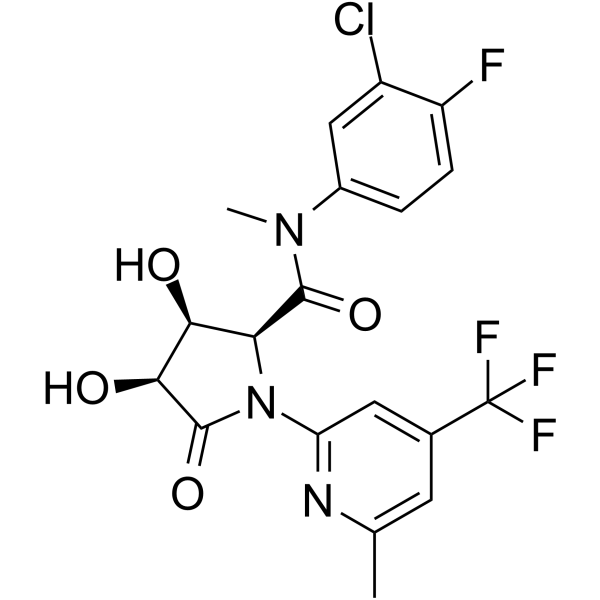
Cas No.: 2607138-82-7
Sample solution is provided at 25 µL, 10mM.
_1-3.$$$39978408@51.jpg');)
_1-9.$$$38538795@65.jpg');)
_1-9.$$$39112701@51.jpg');)
_1-7.$$$37316672@70.jpg');)
_366-372.$$$36198801@70.jpg');)
.$$$38565142@65.jpg');)
_1867-1883.$$$33248023@67.jpg');)
_eads6055.$$$39977546@45.jpg');)
_eadm9805.$$$40080571@45.jpg');)
_eadj3020.$$$39666821@45.jpg');)
_1-20.$$$39757301@28.jpg');)
_1-24.$$$38898113@28.jpg');)
_273-287.$$$36806353@46.jpg');)
_1-16.$$$37156877@44.jpg');)
_1-19.$$$37460805@44.jpg');)
_1291-1307.$$$34518654@46.jpg');)
ART812 is an orally bioavailable small-molecule inhibitor of DNA polymerase theta (Polθ) with an IC50 value of 7.6nM[1]. ART812 acts through an allosteric mechanism of inhibition, targeting the polymerase domain of Polθ, thereby eliciting synthetic lethality in tumor cells deficient in homologous recombination (HR) repair[2]. ART812 has demonstrated single-agent anti-tumor efficacy in preclinical studies against models of PARP inhibitor-resistant cancer[3-4].
In vitro, ART812 (100-500nM) treatment of HEK293 cells transfected with a microhomology-mediated end joining (MMEJ) reporter for 24 hours significantly inhibits TMEJ-mediated DNA repair activity[5].
In vivo, ART812 (100mg/kg) administered orally once daily (QD) to female SRG OncoRats bearing established MDA-MB-436 BRCA1 mutant, SHLD2 knockout tumor xenografts significantly inhibited tumor growth and was well-tolerated over a 76-day treatment period[1].
References:
[1] Zatreanu D, Robinson HMR, Alkhatib O, et al. Polθ inhibitors elicit BRCA-gene synthetic lethality and target PARP inhibitor resistance. Nat Commun. 2021 Jun 17;12(1):3636.
[2] Barszczewska-Pietraszek G, Drzewiecka M, Czarny P, et al. Polθ Inhibition: An Anticancer Therapy for HR-Deficient Tumours. Int J Mol Sci. 2022 Dec 24;24(1):319.
[3] Bazan Russo TD, Mujacic C, Di Giovanni E, et al. Polθ: emerging synthetic lethal partner in homologous recombination-deficient tumors. Cancer Gene Ther. 2024 Nov;31(11):1619-1631.
[4] Federica G, Michela C, Giovanna D. Targeting the DNA damage response in cancer. MedComm (2020). 2024 Oct 31;5(11):e788.
[5] Stockley ML, Ferdinand A, Benedetti G, et al. Discovery, Characterization, and Structure-Based Optimization of Small-Molecule In Vitro and In Vivo Probes for Human DNA Polymerase Theta. J Med Chem. 2022 Oct 27;65(20):13879-13891.
| Cell experiment [1]: | |
Cell lines | HEK293 cells (human embryonic kidney cell line) |
Preparation Method | HEK293 cells were transfected with a NanoLuciferase-encoding TMEJ (Theta-Mediated End Joining) reporter substrate and a Firefly luciferase plasmid (for normalization). Cells were treated with ART812 (100–500nM) for 24 hours. |
Reaction Conditions | 100–500nM; 24 hours |
Applications | ART812 significantly inhibited TMEJ-mediated DNA repair in HEK293 cells, demonstrating a cellular EC50 of 150nM. |
| Animal experiment [2]: | |
Animal models | Female athymic nude mice (immunodeficient model) |
Preparation Method | Mice were treated with either vehicle control or ART812 (150mg/kg; oral administration) for 4 days. Whole blood was collected on day 5 and fixed using a Mouse MicroFlow kit. Blood samples were analyzed for micronucleated reticulocytes (MN-RETs) by flow cytometry. |
Dosage form | 150mg/kg; oral administration |
Applications | ART812 treatment demonstrated a 2-fold induction of micronuclei in reticulocytes, as measured by flow cytometry, indicating significant DNA damage and target engagement of Polθ. |
References: | |
| Cas No. | 2607138-82-7 | SDF | |
| Formula | C19H16ClF4N3O4 | M.Wt | 461.79 |
| Solubility | Storage | Store at -20°C | |
| General tips | Please select the appropriate solvent to prepare the stock solution according to the
solubility of the product in different solvents; once the solution is prepared, please store it in
separate packages to avoid product failure caused by repeated freezing and thawing.Storage method
and period of the stock solution: When stored at -80°C, please use it within 6 months; when stored
at -20°C, please use it within 1 month. To increase solubility, heat the tube to 37°C and then oscillate in an ultrasonic bath for some time. |
||
| Shipping Condition | Evaluation sample solution: shipped with blue ice. All other sizes available: with RT, or with Blue Ice upon request. | ||
| Prepare stock solution | |||

|
1 mg | 5 mg | 10 mg |
| 1 mM | 2.1655 mL | 10.8274 mL | 21.6549 mL |
| 5 mM | 433.1 μL | 2.1655 mL | 4.331 mL |
| 10 mM | 216.5 μL | 1.0827 mL | 2.1655 mL |
Step 1: Enter information below (Recommended: An additional animal making an allowance for loss during the experiment)
 g
μL
g
μL
Step 2: Enter the in vivo formulation (This is only the calculator, not formulation. Please contact us first if there is no in vivo formulation at the solubility Section.)
Calculation results:
Working concentration: mg/ml;
Method for preparing DMSO master liquid: mg drug pre-dissolved in μL DMSO ( Master liquid concentration mg/mL, Please contact us first if the concentration exceeds the DMSO solubility of the batch of drug. )
Method for preparing in vivo formulation: Take μL DMSO master liquid, next addμL PEG300, mix and clarify, next addμL Tween 80, mix and clarify, next add μL saline, mix and clarify.
Method for preparing in vivo formulation: Take μL DMSO master liquid, next add μL Corn oil, mix and clarify.
Note: 1. Please make sure the liquid is clear before adding the next solvent.
2. Be sure to add the solvent(s) in order. You must ensure that the solution obtained, in the previous addition, is a clear solution before proceeding to add the next solvent. Physical methods such as vortex, ultrasound or hot water bath can be used to aid dissolving.
3. All of the above co-solvents are available for purchase on the GlpBio website.
Quality Control & SDS
- View current batch:
- Purity: >98.00% Appearance: A solid
- COA (Certificate of Analysis)
- SDS (Safety Data Sheet)
- Datasheet
Average Rating: 5 (Based on Reviews and 30 reference(s) in Google Scholar.)