

AVE-1625 (Synonyms: Drinabant) |
Catalog No.GC14115
 One-Click Copy Product Info
|

AVE-1625 (AVE1625) is an orally active CB1 receptor antagonist.
Products are for research use only. Not for human use. We do not sell to patients.
Cas No.: 358970-97-5
Sample solution is provided at 25 µL, 10mM.
_1-3.$$$39978408@51.jpg');)
_1-9.$$$38538795@65.jpg');)
_1-9.$$$39112701@51.jpg');)
_1-7.$$$37316672@70.jpg');)
_366-372.$$$36198801@70.jpg');)
.$$$38565142@65.jpg');)
_1867-1883.$$$33248023@67.jpg');)
_eads6055.$$$39977546@45.jpg');)
_eadm9805.$$$40080571@45.jpg');)
_eadj3020.$$$39666821@45.jpg');)
_1-20.$$$39757301@28.jpg');)
_1-24.$$$38898113@28.jpg');)
_273-287.$$$36806353@46.jpg');)
_1-16.$$$37156877@44.jpg');)
_1-19.$$$37460805@44.jpg');)
_1291-1307.$$$34518654@46.jpg');)
AVE-1625 is a highly potent, selective antagonist for the CB1 receptor [1].
The cannabinoid receptor type 1 (CB1) is a G protein-coupled receptor mainly expressed in the central and peripheral nervous system. The CB1 receptor is activated by the endocannabinoid neurotransmitters anandamide and 2-arachidonoylglycerol (2-AG). The CB1 receptor has been implicated in the maintenance of homeostasis in health and disease [2]. The CB1 receptor plays vital roles in modulating neurotransmitter release by preventing the development of excessive neuronal activity, reducing pain and other inflammatory symptoms [2].
AVE-1625 antagonized the CB1 receptor activity with the Ki values of 0.16-0.44 nM [1]. Treatment with AVE-1625 (1-3 mg/kg) significantly improved the performance of rodents in working memory tasks. At 30 mg/kg, AVE-1625 reduced caloric intake by more than 50% of controls and significantly increased lipolysis from fat tissues and reduced hepatic glycogen levels in rodents. In Wistar rats, postprandially administration of AVE1625 slightly increased the basal lipolysis in a dose-dependent manner. AVE1625 caused primary effects on metabolic blood and tissue parameters as well as metabolic rate [3]. As measured by indirect calorimetry, AVE1625 immediately increased the total energy expenditure and a transiently increased glucose oxidation [3].
References:
[1] Borowsky B, Stevens R, Mark B, et al. AVE1625, a cannabinoid CBI antagonist, as a co-treatment for schizophrenia: Improvement in cognitive function and reduction of antipsychotic-side effects in animal models[C]//Neuropsychopharmacology. Macmillan building, 4 crinan st, london n1 9xw, ENGLAND: NATURE PUBLISHING GROUP, 2005, 30: S116-S117.
[2] Herkenham M, Lynn A B, Little M D, et al. Cannabinoid receptor localization in brain[J]. Proceedings of the national Academy of sciences, 1990, 87(5): 1932-1936.
[3] Herling A W, Gossel M, Haschke G, et al. CB1 receptor antagonist AVE1625 affects primarily metabolic parameters independently of reduced food intake in Wistar rats[J]. American Journal of Physiology-Endocrinology and Metabolism, 2007, 293(3): E826-E832.
| Cas No. | 358970-97-5 | SDF | |
| Synonyms | Drinabant | ||
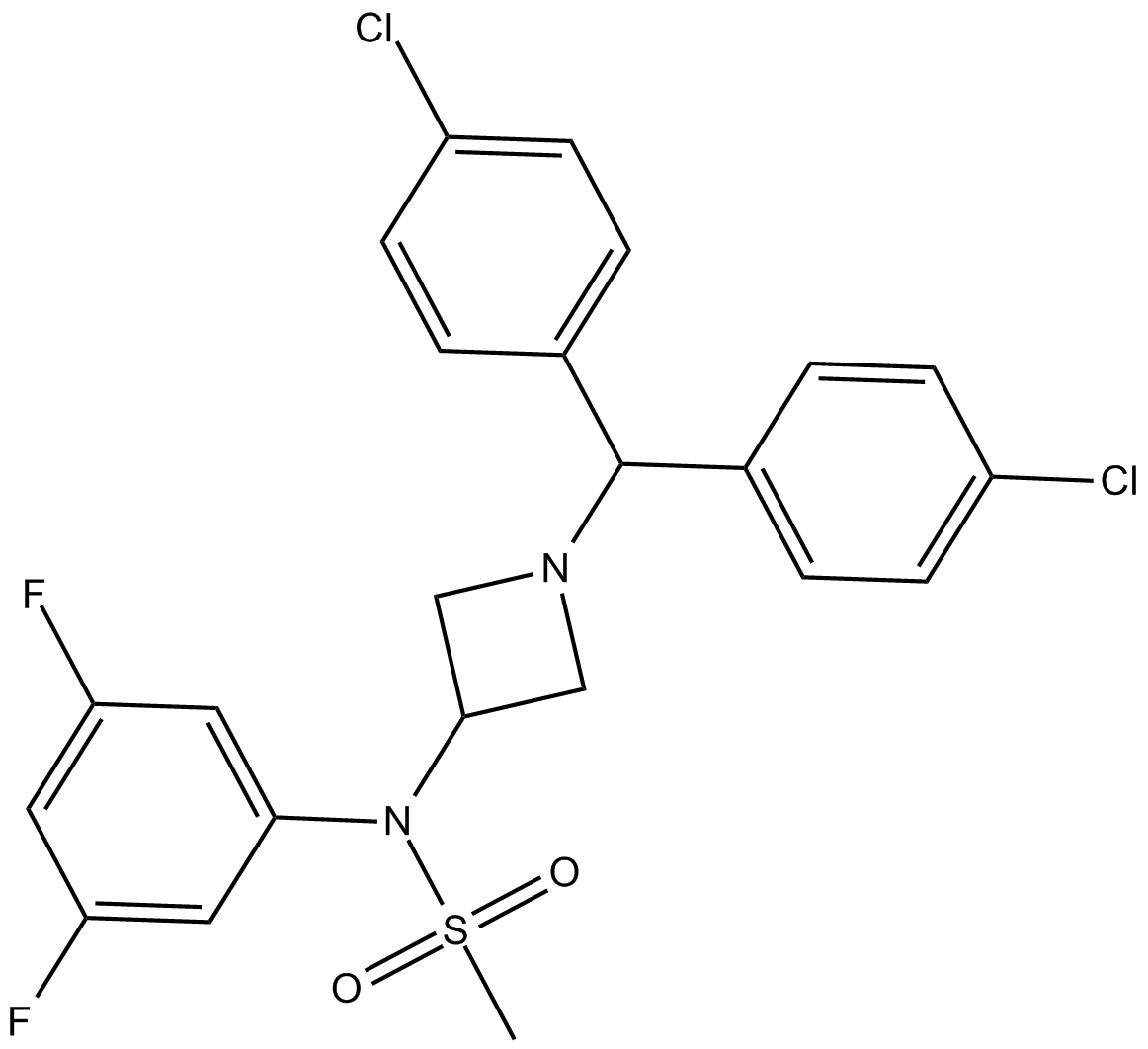
| Chemical Name | N-[1-[bis(4-chlorophenyl)methyl]azetidin-3-yl]-N-(3,5-difluorophenyl)methanesulfonamide | ||
| Canonical SMILES | CS(=O)(N(C1CN(C(C2=CC=C(Cl)C=C2)C3=CC=C(Cl)C=C3)C1)C4=CC(F)=CC(F)=C4)=O | ||
| Formula | C23H20Cl2F2N2O2S | M.Wt | 497.4 |
| Solubility | ≤0.15mg/ml in ethanol;15mg/ml in DMSO;15mg/ml in dimethyl formamide | Storage | Store at -20°C |
| General tips | Please select the appropriate solvent to prepare the stock solution according to the
solubility of the product in different solvents; once the solution is prepared, please store it in
separate packages to avoid product failure caused by repeated freezing and thawing.Storage method
and period of the stock solution: When stored at -80°C, please use it within 6 months; when stored
at -20°C, please use it within 1 month. To increase solubility, heat the tube to 37°C and then oscillate in an ultrasonic bath for some time. |
||
| Shipping Condition | Evaluation sample solution: shipped with blue ice. All other sizes available: with RT, or with Blue Ice upon request. | ||
| Prepare stock solution | |||

|
1 mg | 5 mg | 10 mg |
| 1 mM | 2.0105 mL | 10.0523 mL | 20.1045 mL |
| 5 mM | 402.1 μL | 2.0105 mL | 4.0209 mL |
| 10 mM | 201 μL | 1.0052 mL | 2.0105 mL |
Step 1: Enter information below (Recommended: An additional animal making an allowance for loss during the experiment)
 g
μL
g
μL
Step 2: Enter the in vivo formulation (This is only the calculator, not formulation. Please contact us first if there is no in vivo formulation at the solubility Section.)
Calculation results:
Working concentration: mg/ml;
Method for preparing DMSO master liquid: mg drug pre-dissolved in μL DMSO ( Master liquid concentration mg/mL, Please contact us first if the concentration exceeds the DMSO solubility of the batch of drug. )
Method for preparing in vivo formulation: Take μL DMSO master liquid, next addμL PEG300, mix and clarify, next addμL Tween 80, mix and clarify, next add μL saline, mix and clarify.
Method for preparing in vivo formulation: Take μL DMSO master liquid, next add μL Corn oil, mix and clarify.
Note: 1. Please make sure the liquid is clear before adding the next solvent.
2. Be sure to add the solvent(s) in order. You must ensure that the solution obtained, in the previous addition, is a clear solution before proceeding to add the next solvent. Physical methods such as vortex, ultrasound or hot water bath can be used to aid dissolving.
3. All of the above co-solvents are available for purchase on the GlpBio website.
Quality Control & SDS
- View current batch:
- Purity: >98.00% Appearance: A solid
- COA (Certificate of Analysis)
- SDS (Safety Data Sheet)
- Datasheet
Average Rating: 5 (Based on Reviews and 39 reference(s) in Google Scholar.)