

AVE-8134 |
Catalog No.GC31452
 One-Click Copy Product Info
|

AVE-8134 is a potent PPARα agonist, with EC50 values of 100 and 3000 nM for human and rodent PPARα receptor, respectively.
Products are for research use only. Not for human use. We do not sell to patients.
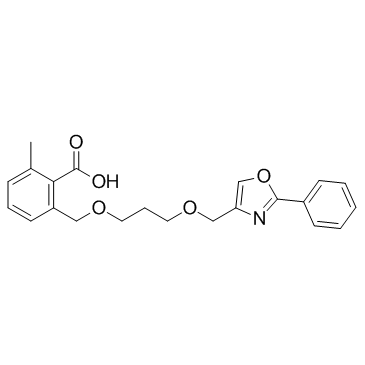
Cas No.: 304025-09-0
Sample solution is provided at 25 µL, 10mM.
_1-3.$$$39978408@51.jpg');)
_1-9.$$$38538795@65.jpg');)
_1-9.$$$39112701@51.jpg');)
_1-7.$$$37316672@70.jpg');)
_366-372.$$$36198801@70.jpg');)
.$$$38565142@65.jpg');)
_1867-1883.$$$33248023@67.jpg');)
_eads6055.$$$39977546@45.jpg');)
_eadm9805.$$$40080571@45.jpg');)
_eadj3020.$$$39666821@45.jpg');)
_1-20.$$$39757301@28.jpg');)
_1-24.$$$38898113@28.jpg');)
_273-287.$$$36806353@46.jpg');)
_1-16.$$$37156877@44.jpg');)
_1-19.$$$37460805@44.jpg');)
_1291-1307.$$$34518654@46.jpg');)
AVE-8134 is a potent PPARα agonist, with EC50 values of 100 and 3000 nM for human and rodent PPARα receptor, respectively.
AVE8134 is a full PPARα dominated PPAR agonist, but not active on PPARδ[1]. In HUVEC, AVE8134 (1 μM) increases Ser-1177-eNOS phosphorylation but not eNOS expression. In monocytes, AVE8134 (10 μM) increases the expression of CD36 and the macrophage scavenger receptor 1, resulting in enhanced uptake of oxidized LDL[2].
In female hApo A1 mice, AVE8134 (130 mg/kg/d, po for 12 d) dose-dependently loweres the plasma triglycerides, and increases the serum HDL-cholesterol, hApo A1 and mouse Apo E levels. In female ZDF rats, AVE8134 (3-30 mg/kg/d for 2 weeks) improves insulin-sensitivity index. In pre-diabetic male ZDF rats, AVE8134 (10 mg/kg/d for 8 weeks) produces an anti-diabetic action comparable to rosiglitazone, without the PPARγ mediated adverse effects on body weight and heart weight. In male ZDF rats, AVE8134 (20 mg/kg/d for 12 weeks) increases mRNA levels of the target genes LPL and PDK4 about 20 fold in the liver, and there is no relevant effect with rosiglitazone[1]. In post-MI rats, AVE8134 (3 mg/kg and 10 mg/kg) dose-dependently improves cardiac output, myocardial contractility and relaxation and reduces lung and left ventricular weight and fibrosis. Treatment at AVE8134 decreases plasma proBNP and arginine and increases plasma citrulline and urinary NOx/creatinine ratio. In DOCA rats, AVE8134 (3 mg/kg/d) prevents development of high blood pressure, myocardial hypertrophy and cardiac fibrosis, and ameliorates endothelial dysfunction. In old SHR, treatment with a low dose of AVE8134 (0.3 mg/kg/d) improves cardiac and vascular function and increases life expectancy without lowering blood pressure. AVE8134 reduces phenylephrine-induced hypertrophy in adult rat cardiomyocytes[2].
[1]. Schafer HL, et al. AVE8134, a novel potent PPARα agonist, improves lipid profile and glucose metabolism in dyslipidemic mice and type 2 diabetic rats. Acta Pharmacol Sin. 2012 Jan;33(1):82-90. [2]. Linz W, et al. The peroxisome proliferator-activated receptor-alpha (PPAR-alpha) agonist, AVE8134, attenuates the progression of heart failure and increases survival in rats. Acta Pharmacol Sin. 2009 Jul;30(7):935-46.
Animal experiment: | Male ZDF rats are treated for 8 weeks. Food consumption and body weight are measured twice a week. The amount of diet for an additional control group is restricted to levels below the estimated consumption of the AVE8134 group: the starting value is 7 g chow/100 g body weight for the first week and than adapted to 8 g/100 g body weight. The chow for that control group is divided into two portions and is offered twice daily when light is switched on and off, all other groups had free access to food, except before measurements of fasted blood glucose, insulin and before oral glucose tolerance test. After two weeks of treatment an oral glucose tolerance test (oGTT) is performed. Briefly, after an overnight fast, the animals are treated with the drugs or vehicle between 06:30 and 07:00, glucose (2 g/kg) is administered orally 2 h later in a volume of 5 mL/kg, blood is drawn from the tip of the tail from using glass capillaries at 0, 30, 60, 90, 120, and 180 min after glucose administration. The glycemic index (GI) is calculated as area under the curve (AUC) of glucose response during oGTT. Blood glucose concentration before oral glucose load (0 min) is defined as baseline of AUC calculation. |
References: [1]. Schafer HL, et al. AVE8134, a novel potent PPARα agonist, improves lipid profile and glucose metabolism in dyslipidemic mice and type 2 diabetic rats. Acta Pharmacol Sin. 2012 Jan;33(1):82-90. | |
| Cas No. | 304025-09-0 | SDF | |
| Canonical SMILES | O=C(O)C1=C(COCCCOCC2=COC(C3=CC=CC=C3)=N2)C=CC=C1C | ||
| Formula | C22H23NO5 | M.Wt | 381.42 |
| Solubility | Soluble in DMSO | Storage | Store at -20°C |
| General tips | Please select the appropriate solvent to prepare the stock solution according to the
solubility of the product in different solvents; once the solution is prepared, please store it in
separate packages to avoid product failure caused by repeated freezing and thawing.Storage method
and period of the stock solution: When stored at -80°C, please use it within 6 months; when stored
at -20°C, please use it within 1 month. To increase solubility, heat the tube to 37°C and then oscillate in an ultrasonic bath for some time. |
||
| Shipping Condition | Evaluation sample solution: shipped with blue ice. All other sizes available: with RT, or with Blue Ice upon request. | ||
| Prepare stock solution | |||

|
1 mg | 5 mg | 10 mg |
| 1 mM | 2.6218 mL | 13.1089 mL | 26.2178 mL |
| 5 mM | 524.4 μL | 2.6218 mL | 5.2436 mL |
| 10 mM | 262.2 μL | 1.3109 mL | 2.6218 mL |
Step 1: Enter information below (Recommended: An additional animal making an allowance for loss during the experiment)
 g
μL
g
μL
Step 2: Enter the in vivo formulation (This is only the calculator, not formulation. Please contact us first if there is no in vivo formulation at the solubility Section.)
Calculation results:
Working concentration: mg/ml;
Method for preparing DMSO master liquid: mg drug pre-dissolved in μL DMSO ( Master liquid concentration mg/mL, Please contact us first if the concentration exceeds the DMSO solubility of the batch of drug. )
Method for preparing in vivo formulation: Take μL DMSO master liquid, next addμL PEG300, mix and clarify, next addμL Tween 80, mix and clarify, next add μL saline, mix and clarify.
Method for preparing in vivo formulation: Take μL DMSO master liquid, next add μL Corn oil, mix and clarify.
Note: 1. Please make sure the liquid is clear before adding the next solvent.
2. Be sure to add the solvent(s) in order. You must ensure that the solution obtained, in the previous addition, is a clear solution before proceeding to add the next solvent. Physical methods such as vortex, ultrasound or hot water bath can be used to aid dissolving.
3. All of the above co-solvents are available for purchase on the GlpBio website.
Quality Control & SDS
- View current batch:
- Purity: >98.00% Appearance: A solid
- COA (Certificate of Analysis)
- SDS (Safety Data Sheet)
- Datasheet
Average Rating: 5 (Based on Reviews and 33 reference(s) in Google Scholar.)