

AZD1152 |
Catalog No.GC14709
 One-Click Copy Product Info
|

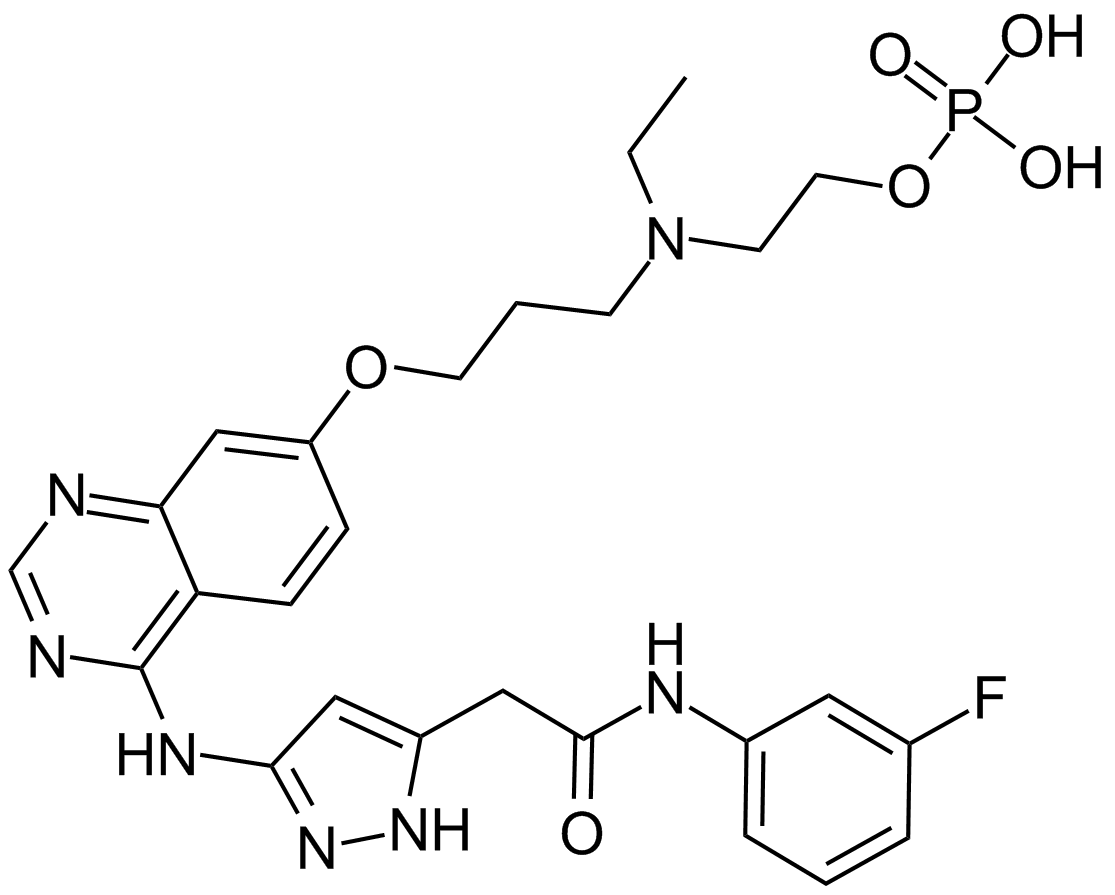
AZD1152 is a highly selective Aurora B kinase (AURKB) inhibitor with an IC50 value of 0.37nM. AZD1152 is a prodrug that is converted in vivo to its active form, AZD1152-hydroxyquinazoline pyrazol anilide (AZD1152-hQPA), and is primarily used for research and treatment of malignant tumors such as acute myeloid leukemia.
Products are for research use only. Not for human use. We do not sell to patients.
Cas No.: 722543-31-9
Sample solution is provided at 25 µL, 10mM.
_1-3.$$$39978408@51.jpg');)
_1-9.$$$38538795@65.jpg');)
_1-9.$$$39112701@51.jpg');)
_1-7.$$$37316672@70.jpg');)
_366-372.$$$36198801@70.jpg');)
.$$$38565142@65.jpg');)
_1867-1883.$$$33248023@67.jpg');)
_eads6055.$$$39977546@45.jpg');)
_eadm9805.$$$40080571@45.jpg');)
_eadj3020.$$$39666821@45.jpg');)
_1-20.$$$39757301@28.jpg');)
_1-24.$$$38898113@28.jpg');)
_273-287.$$$36806353@46.jpg');)
_1-16.$$$37156877@44.jpg');)
_1-19.$$$37460805@44.jpg');)
_1291-1307.$$$34518654@46.jpg');)
AZD1152 is a highly selective Aurora B kinase (AURKB) inhibitor with an IC50 value of 0.37nM[1]. AZD1152 is a prodrug that is converted in vivo to its active form, AZD1152-hydroxyquinazoline pyrazol anilide (AZD1152-hQPA), and is primarily used for research and treatment of malignant tumors such as acute myeloid leukemia[2]. AZD1152 inhibits Aurora B kinase activity by competitively binding to its ATP binding site, affecting histone H3 phosphorylation, spindle assembly, and cytokinesis, thus inducing apoptosis and inhibiting tumor cell proliferation[3].
In vivo, AZD1152 (5, 25mg/kg) administered intraperitoneally to mice with MOLM13 cell xenograft tumors inhibited tumor growth. Furthermore, combination treatment with AZD1152 and vincristine or daunorubicin enhanced their anti-tumor effects[4]. AZD1152 (50, 100mg/kg) administered intraperitoneally to mice with H841 cell xenograft tumors for 10 days inhibited tumor growth and induced tumor regression[5]. AZD1152 (35mg/kg) administered intraperitoneally to mice with a colorectal cancer model for 4 days enhanced the cytotoxic effect of 8 Gy radiation on tumor cells[6].
References:
[1] Yang J, Ikezoe T, Nishioka C, et al. AZD1152, a novel and selective aurora B kinase inhibitor, induces growth arrest, apoptosis, and sensitization for tubulin depolymerizing agent or topoisomerase II inhibitor in human acute leukemia cells in vitro and in vivo[J]. Blood, The Journal of the American Society of Hematology, 2007, 110(6): 2034-2040.
[2] Aihara A, Tanaka S, Yasen M, et al. The selective Aurora B kinase inhibitor AZD1152 as a novel treatment for hepatocellular carcinoma[J]. Journal of hepatology, 2010, 52(1): 63-71.
[3] Borah N A, Reddy M M. Aurora kinase B inhibition: a potential therapeutic strategy for cancer[J]. Molecules, 2021, 26(7): 1981.
[4] Wilkinson R W, Odedra R, Heaton S P, et al. AZD1152, a selective inhibitor of Aurora B kinase, inhibits human tumor xenograft growth by inducing apoptosis[J]. Clinical cancer research, 2007, 13(12): 3682-3688.
[5] Helfrich B A, Kim J, Gao D, et al. Barasertib (AZD1152), a small molecule Aurora B inhibitor, inhibits the growth of SCLC cell lines in vitro and in vivo[J]. Molecular cancer therapeutics, 2016, 15(10): 2314-2322.
[6] Tao Y, Leteur C, Calderaro J, et al. The aurora B kinase inhibitor AZD1152 sensitizes cancer cells to fractionated irradiation and induces mitotic catastrophe[J]. Cell Cycle, 2009, 8(19): 3172-3181.
| Animal experiment [1]: | |
Animal models | Female immune-deficient BALB/c nude mice |
Preparation Method | Female immune-deficient BALB/c nude mice at 4 weeks of age were maintained in pathogen-free conditions with irradiated chow. Animals were bilaterally, subcutaneously injected with 2×10⁶ MOLM13 cells/tumor in 0.1mL Matrigel. When MOLM13 cells formed palpable tumors, mice were divided randomly into control and treatment groups, and treatment was begun. AZD1152 (5 or 25mg/kg) with or without vincristine (0.2mg/kg) was given to mice by intraperitoneal injection 4 times a week or every another day, respectively. Daunorubicin (1mg/kg) was given to mice by intraperitoneal injection 6 times during 2 weeks of treatment either alone or in combination with AZD1152 (5mg/kg). Control diluent was given to the untreated control mice. Body weight and tumors were measured twice a week. At the end of the experiment, animals were killed and tumor weights were measured after their careful resection. Tumor tissue was collected for analysis. |
Dosage form | 5, 25mg/kg/day; i.p. |
Applications | AZD1152 inhibited the proliferation of MOLM13 xenografts in vivo. AZD1152 enhanced the ability of vincristine or daunorubicin to inhibit the proliferation of human MOLM13 leukemic xenografts in vivo. |
References: | |
| Cas No. | 722543-31-9 | SDF | |
| Chemical Name | 2-[ethyl-[3-[4-[[5-[2-(3-fluoroanilino)-2-oxoethyl]-1H-pyrazol-3-yl]amino]quinazolin-7-yl]oxypropyl]amino]ethyl dihydrogen phosphate | ||
| Canonical SMILES | CCN(CCCOC1=CC2=C(C=C1)C(=NC=N2)NC3=NNC(=C3)CC(=O)NC4=CC(=CC=C4)F)CCOP(=O)(O)O | ||
| Formula | C26H31FN7O6P | M.Wt | 587.54 |
| Solubility | ≥ 30 mg/mL in DMSO | Storage | Store at -20°C |
| General tips | Please select the appropriate solvent to prepare the stock solution according to the
solubility of the product in different solvents; once the solution is prepared, please store it in
separate packages to avoid product failure caused by repeated freezing and thawing.Storage method
and period of the stock solution: When stored at -80°C, please use it within 6 months; when stored
at -20°C, please use it within 1 month. To increase solubility, heat the tube to 37°C and then oscillate in an ultrasonic bath for some time. |
||
| Shipping Condition | Evaluation sample solution: shipped with blue ice. All other sizes available: with RT, or with Blue Ice upon request. | ||
| Prepare stock solution | |||

|
1 mg | 5 mg | 10 mg |
| 1 mM | 1.702 mL | 8.5101 mL | 17.0201 mL |
| 5 mM | 340.4 μL | 1.702 mL | 3.404 mL |
| 10 mM | 170.2 μL | 851 μL | 1.702 mL |
Step 1: Enter information below (Recommended: An additional animal making an allowance for loss during the experiment)
 g
μL
g
μL
Step 2: Enter the in vivo formulation (This is only the calculator, not formulation. Please contact us first if there is no in vivo formulation at the solubility Section.)
Calculation results:
Working concentration: mg/ml;
Method for preparing DMSO master liquid: mg drug pre-dissolved in μL DMSO ( Master liquid concentration mg/mL, Please contact us first if the concentration exceeds the DMSO solubility of the batch of drug. )
Method for preparing in vivo formulation: Take μL DMSO master liquid, next addμL PEG300, mix and clarify, next addμL Tween 80, mix and clarify, next add μL saline, mix and clarify.
Method for preparing in vivo formulation: Take μL DMSO master liquid, next add μL Corn oil, mix and clarify.
Note: 1. Please make sure the liquid is clear before adding the next solvent.
2. Be sure to add the solvent(s) in order. You must ensure that the solution obtained, in the previous addition, is a clear solution before proceeding to add the next solvent. Physical methods such as vortex, ultrasound or hot water bath can be used to aid dissolving.
3. All of the above co-solvents are available for purchase on the GlpBio website.
Quality Control & SDS
- View current batch:
- Purity: >99.50% Appearance: A solid
- COA (Certificate of Analysis)
- SDS (Safety Data Sheet)
- Datasheet
Average Rating: 5 (Based on Reviews and 30 reference(s) in Google Scholar.)