
AZD6244(Selumetinib) (Synonyms: AZD6244; ARRY-142886) |
| Catalog No.GC17030 |
AZD6244(Selumetinib) is an oral, small molecule, specific ATP non-competitive inhibitor of MEK1/2 proteins, with the IC50 of 14.1 ± 0.79nM.
Products are for research use only. Not for human use. We do not sell to patients.
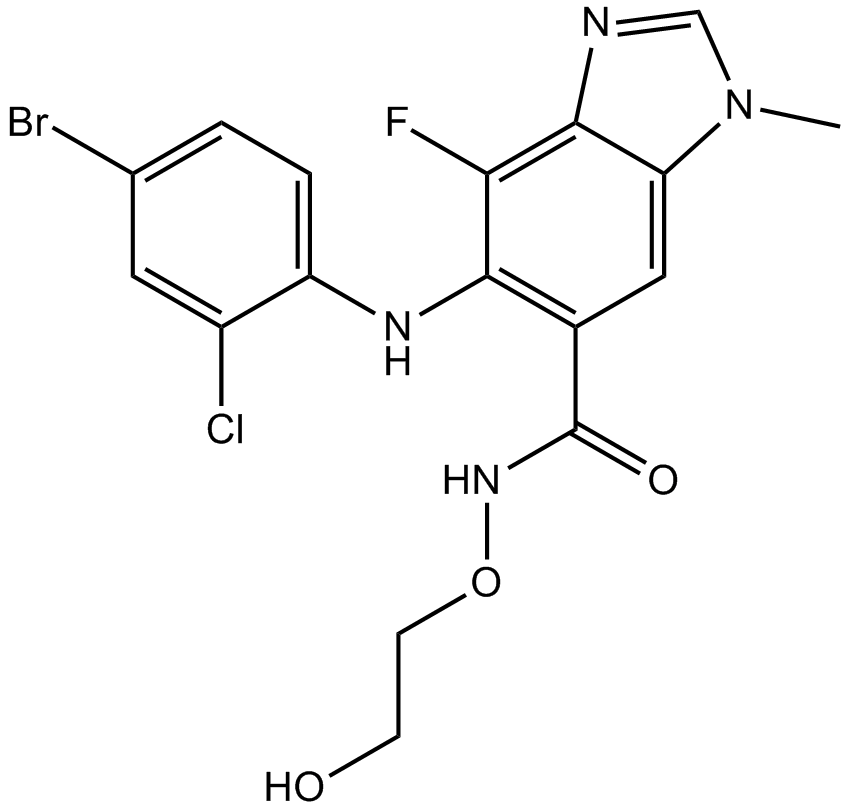
Cas No.: 606143-52-6
Sample solution is provided at 25 µL, 10mM.
AZD6244(Selumetinib) is an oral, small molecule, specific ATP non-competitive inhibitor of MEK1/2 proteins, with the IC50 of 14.1 ± 0.79nM [1]. AZD6244 binds to a unique specific allosteric pocket on the N-terminal domain of MEK1/2 adjacent to the canonical ATP binding site, which results in a conformational change that prevents RaF-induced phosphorylation and locks MEK1/2 in a catalytically inactive state, preventing ERK1/2 activation and inhibiting MAPK signaling[2]. AZD6244 has been widely used in various cellular and animal models for anti-cancer studies[3].
In vitro, AZD6244 treatment for 72 hours significantly inhibited the proliferation of RMG-I and SMOV-2 cells, with an IC50 of 78nM and 850nM, respectively[4]. Treatment of SGC7901 cells with 4000nM AZD6244 for 48 hours significantly inhibited cell proliferation and cell viability, promoted apoptosis, and resulted in a decrease in p-ERK levels[5]. Treatment of Epstein-Barr virus (EBV)-infected HONE-1 cells with AZD6244 at a concentration of 5000nM for 24h inhibited cell proliferation, resulting in cell cycle arrest and an increase in the proportion of apoptotic cells[6].
In vivo, AZD6244 treatment via oral administration at a dose of 50mg/kg twice daily for 21 days significantly inhibited tumor volume growth without altering body weight in a xenograft model bearing hepatocellular carcinoma[7]. Oral administration of AZD6244 at a dose of 30mg/kg daily prevented weight loss, reduced tumor burden, and attenuated muscle atrophy in the mouse cachexia models[8].
References:
[1] Campagne O, Yeo K K, Fangusaro J, et al. Clinical pharmacokinetics and pharmacodynamics of selumetinib[J]. Clinical pharmacokinetics, 2021, 60(3): 283-303.
[2] Roskoski Jr R. Allosteric MEK1/2 inhibitors including cobimetanib and trametinib in the treatment of cutaneous melanomas[J]. Pharmacological Research, 2017, 117: 20-31.
[3] Ciombor K K, Bekaii-Saab T. Selumetinib for the treatment of cancer[J]. Expert opinion on investigational drugs, 2015, 24(1): 111-123.
[4] Bartholomeusz C, Oishi T, Saso H, et al. MEK1/2 Inhibitor Selumetinib (AZD6244) inhibits growth of ovarian clear Cell Carcinoma in a PEA-15–dependent manner in a mouse Xenograft Model[J]. Molecular cancer therapeutics, 2012, 11(2): 360-369.
[5] Gao J H, Wang C H, Tong H, et al. Targeting inhibition of extracellular signal-regulated kinase kinase pathway with AZD6244 (ARRY-142886) suppresses growth and angiogenesis of gastric cancer[J]. Scientific Reports, 2015, 5(1): 16382.
[6] Ma B B Y, Lui V W Y, Cheung C S, et al. Activity of the MEK inhibitor selumetinib (AZD6244; ARRY-142886) in nasopharyngeal cancer cell lines[J]. Investigational new drugs, 2013, 31(1): 30-38.
[7] Huynh H, Soo K C, Chow P K H, et al. Targeted inhibition of the extracellular signal-regulated kinase kinase pathway with AZD6244 (ARRY-142886) in the treatment of hepatocellular carcinoma[J]. Molecular cancer therapeutics, 2007, 6(1): 138-146.
[8] Quan-Jun Y, Yan H, Yong-Long H, et al. Selumetinib attenuates skeletal muscle wasting in murine cachexia model through ERK inhibition and AKT activation[J]. Molecular cancer therapeutics, 2017, 16(2): 334-343.
| Cell experiment [1]: | |
Cell lines | SGC7901 cells |
Preparation Method | SGC7901 cells were cultured in Dulbecco's modified Eagle medium supplemented with 10% fetal bovine serum (FBS) and 100 units of penicillin and streptomycin at 37°C and 5% CO2 humidity. All cells were serum-starved with 0.5% FBS for 24h before adding the corresponding treatments. Cells were seeded in 96-well plates and cultured for 24 hours. Cells were then treated with AZD6244 at various concentrations (0, 1000, 2000, 3000, and 4000nM) for 24 or 48 hours. After that, 10μL of CCK8 solution was added to each well and incubated at 37°C for 2 hours. Optical density (OD) of each well was measured at a wavelength of 450nm. |
Reaction Conditions | 0, 1000, 2000, 3000, and 4000nM; 48h |
Applications | AZD6244 treatment significantly inhibited the cell viability of SGC7901 cells in a dose-dependent manner. |
| Animal experiment [2]: | |
Animal models | SCID mice |
Preparation Method | SCID mice bearing hepatocellular carcinoma (HCC) xenograft tumors were orally administered with 100μL water or 50mg/kg AZD6244 twice daily for 21 days starting on day 7 after tumor implantation. Tumor growth of established tumor xenografts was monitored at least twice a week by measuring the length (a) and width (b) of the tumor with a vernier caliper. The tumor volume was calculated as (a × b2)/2. |
Dosage form | 50mg/kg twice daily for 21 days; p.o. |
Applications | AZD6244 treatment reduced tumor volume without changing the mouse body weight. |
References: | |
| Cas No. | 606143-52-6 | SDF | |
| Synonyms | AZD6244; ARRY-142886 | ||
| Chemical Name | 6-(4-bromo-2-chloroanilino)-7-fluoro-N-(2-hydroxyethoxy)-3-methylbenzimidazole-5-carboxamide | ||
| Canonical SMILES | CN1C=NC2=C1C=C(C(=C2F)NC3=C(C=C(C=C3)Br)Cl)C(=O)NOCCO | ||
| Formula | C17H15BrClFN4O3 | M.Wt | 457.69 |
| Solubility | ≥ 22.9mg/mL in DMSO | Storage | Store at -20°C |
| General tips | Please select the appropriate solvent to prepare the stock solution according to the
solubility of the product in different solvents; once the solution is prepared, please store it in
separate packages to avoid product failure caused by repeated freezing and thawing.Storage method
and period of the stock solution: When stored at -80°C, please use it within 6 months; when stored
at -20°C, please use it within 1 month. To increase solubility, heat the tube to 37°C and then oscillate in an ultrasonic bath for some time. |
||
| Shipping Condition | Evaluation sample solution: shipped with blue ice. All other sizes available: with RT, or with Blue Ice upon request. | ||
| Prepare stock solution | |||
|
1 mg | 5 mg | 10 mg |
| 1 mM | 2.1849 mL | 10.9244 mL | 21.8488 mL |
| 5 mM | 437 μL | 2.1849 mL | 4.3698 mL |
| 10 mM | 218.5 μL | 1.0924 mL | 2.1849 mL |
Step 1: Enter information below (Recommended: An additional animal making an allowance for loss during the experiment)
Step 2: Enter the in vivo formulation (This is only the calculator, not formulation. Please contact us first if there is no in vivo formulation at the solubility Section.)
Calculation results:
Working concentration: mg/ml;
Method for preparing DMSO master liquid: mg drug pre-dissolved in μL DMSO ( Master liquid concentration mg/mL, Please contact us first if the concentration exceeds the DMSO solubility of the batch of drug. )
Method for preparing in vivo formulation: Take μL DMSO master liquid, next addμL PEG300, mix and clarify, next addμL Tween 80, mix and clarify, next add μL ddH2O, mix and clarify.
Method for preparing in vivo formulation: Take μL DMSO master liquid, next add μL Corn oil, mix and clarify.
Note: 1. Please make sure the liquid is clear before adding the next solvent.
2. Be sure to add the solvent(s) in order. You must ensure that the solution obtained, in the previous addition, is a clear solution before proceeding to add the next solvent. Physical methods such as vortex, ultrasound or hot water bath can be used to aid dissolving.
3. All of the above co-solvents are available for purchase on the GlpBio website.
Quality Control & SDS
- View current batch:
- Purity: >99.00%
- COA (Certificate Of Analysis)
- SDS (Safety Data Sheet)
- Datasheet
Average Rating: 5 (Based on Reviews and 30 reference(s) in Google Scholar.)
GLPBIO products are for RESEARCH USE ONLY. Please make sure your review or question is research based.
Required fields are marked with *
