

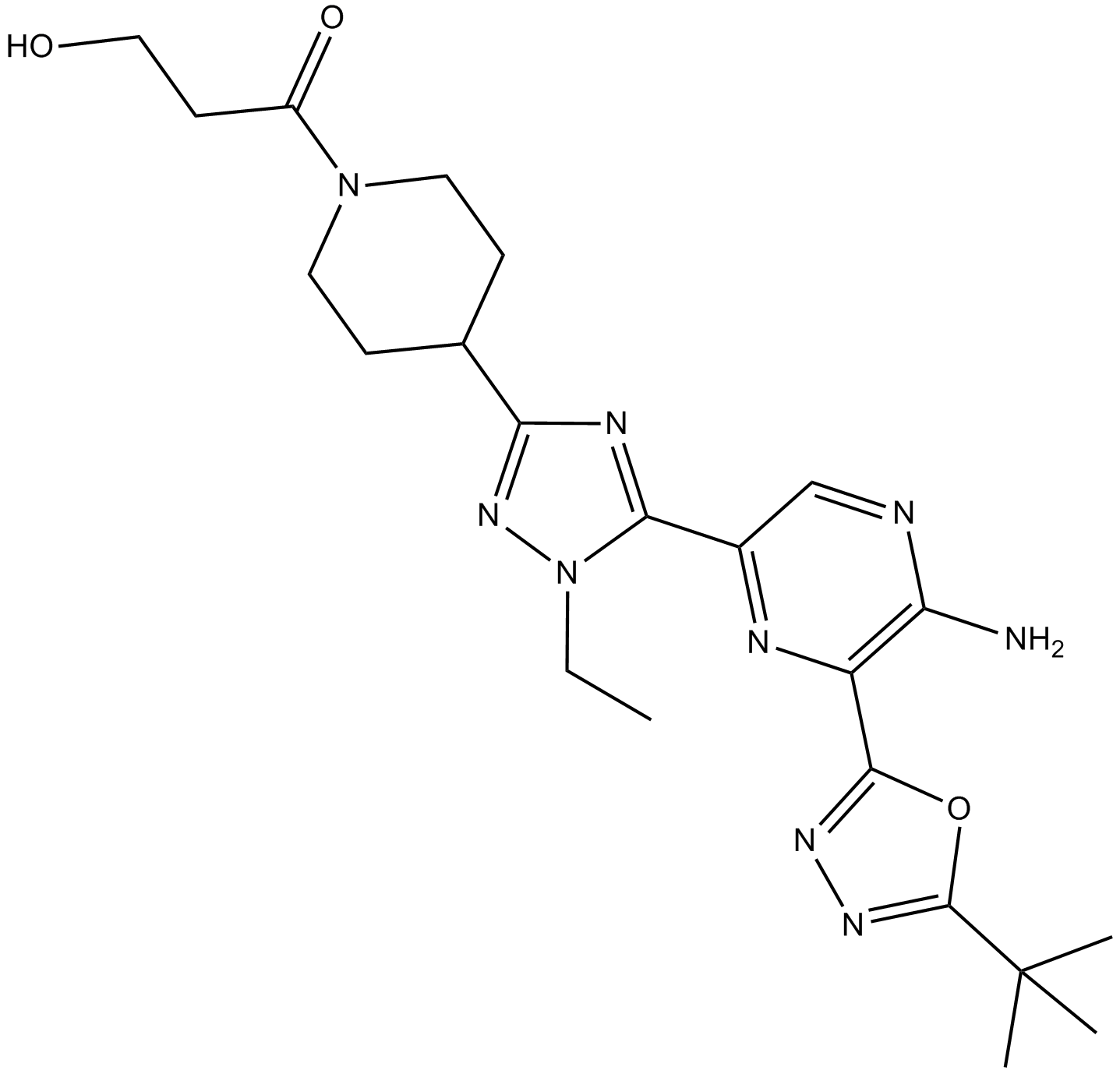
AZD8835 |
Catalog No.GC11248
 One-Click Copy Product Info
|

PI3Kα and PI3Kδ inhibitor
Products are for research use only. Not for human use. We do not sell to patients.
Cas No.: 1620576-64-8
Sample solution is provided at 25 µL, 10mM.
_1-3.$$$39978408@51.jpg');)
_1-9.$$$38538795@65.jpg');)
_1-9.$$$39112701@51.jpg');)
_1-7.$$$37316672@70.jpg');)
_366-372.$$$36198801@70.jpg');)
.$$$38565142@65.jpg');)
_1867-1883.$$$33248023@67.jpg');)
_eads6055.$$$39977546@45.jpg');)
_eadm9805.$$$40080571@45.jpg');)
_eadj3020.$$$39666821@45.jpg');)
_1-20.$$$39757301@28.jpg');)
_1-24.$$$38898113@28.jpg');)
_273-287.$$$36806353@46.jpg');)
_1-16.$$$37156877@44.jpg');)
_1-19.$$$37460805@44.jpg');)
_1291-1307.$$$34518654@46.jpg');)
IC50: 6.2 and 5.7 nM for PI3Kα and PI3Kδ, respectively
AZD8835 is a dual PI3Kα and PI3Kδ inhibitor.
The PIK3CA gene, encoding the p110α catalytic unit of PI3Kα, is one of the most mutated oncogenes in human cancer. Therefore, PI3Kα is a critical target in identifying inhibitors and testing their therapeutic application.
In vitro: AZD8835 was identified as a potent dual inhibitor of PI3Kα and PI3Kδ with good selectivity versus PI3Kβ, PI3Kγ, as well as other kinases that readily inhibited cell growth with mutant PIK3CA status, such as in estrogen receptor-positive breast cancer cell lines including MCF7, BT474, and T47D [1].
In vivo: Previous animal study demonstrated that AZD8835 had antitumor efficacy in breast cancer xenograft models when AZD8835 was continuously dosed. In addition, the monotherapy of AZD8835 was found to be able to induce tumor xenograft regression by using Intermittent High-Dose Scheduling (IHDS). Furthermore, AZD8835 IHDS treatment in combination with other targeted therapeutic agents could further enhance its antitumor activity by up to 92% regression [1].
Clinical trial: A phase I, dose study has been conducted to evaluate the safety and PK of AZD8835 in patients with advanced solid tumours, and this study is still ongoing [https://clinicaltrials.gov/ct2/show/NCT02260661term=AZD8835&rank=1].
Reference:
[1] Hudson K et al. Intermittent High-Dose Scheduling of AZD8835, a Novel Selective Inhibitor of PI3Kα and PI3Kδ, Demonstrates Treatment Strategies for PIK3CA-Dependent Breast Cancers. Mol Cancer Ther.2016 May;15(5):877-89.
| Cas No. | 1620576-64-8 | SDF | |
| Chemical Name | 1-(4-(5-(5-amino-6-(5-(tert-butyl)-1,3,4-oxadiazol-2-yl)pyrazin-2-yl)-1-ethyl-1H-1,2,4-triazol-3-yl)piperidin-1-yl)-3-hydroxypropan-1-one | ||
| Canonical SMILES | O=C(N1CCC(C2=NN(CC)C(C3=NC(C4=NN=C(C(C)(C)C)O4)=C(N)N=C3)=N2)CC1)CCO | ||
| Formula | C22H31N9O3 | M.Wt | 469.54 |
| Solubility | DMF: 16 mg/ml,DMSO: 16 mg/ml,DMSO:PBS (pH 7.2) (1:1): 0.5 mg/ml,Ethanol: 2 mg/ml | Storage | Store at -20°C |
| General tips | Please select the appropriate solvent to prepare the stock solution according to the
solubility of the product in different solvents; once the solution is prepared, please store it in
separate packages to avoid product failure caused by repeated freezing and thawing.Storage method
and period of the stock solution: When stored at -80°C, please use it within 6 months; when stored
at -20°C, please use it within 1 month. To increase solubility, heat the tube to 37°C and then oscillate in an ultrasonic bath for some time. |
||
| Shipping Condition | Evaluation sample solution: shipped with blue ice. All other sizes available: with RT, or with Blue Ice upon request. | ||
| Prepare stock solution | |||

|
1 mg | 5 mg | 10 mg |
| 1 mM | 2.1297 mL | 10.6487 mL | 21.2974 mL |
| 5 mM | 425.9 μL | 2.1297 mL | 4.2595 mL |
| 10 mM | 213 μL | 1.0649 mL | 2.1297 mL |
Step 1: Enter information below (Recommended: An additional animal making an allowance for loss during the experiment)
 g
μL
g
μL
Step 2: Enter the in vivo formulation (This is only the calculator, not formulation. Please contact us first if there is no in vivo formulation at the solubility Section.)
Calculation results:
Working concentration: mg/ml;
Method for preparing DMSO master liquid: mg drug pre-dissolved in μL DMSO ( Master liquid concentration mg/mL, Please contact us first if the concentration exceeds the DMSO solubility of the batch of drug. )
Method for preparing in vivo formulation: Take μL DMSO master liquid, next addμL PEG300, mix and clarify, next addμL Tween 80, mix and clarify, next add μL saline, mix and clarify.
Method for preparing in vivo formulation: Take μL DMSO master liquid, next add μL Corn oil, mix and clarify.
Note: 1. Please make sure the liquid is clear before adding the next solvent.
2. Be sure to add the solvent(s) in order. You must ensure that the solution obtained, in the previous addition, is a clear solution before proceeding to add the next solvent. Physical methods such as vortex, ultrasound or hot water bath can be used to aid dissolving.
3. All of the above co-solvents are available for purchase on the GlpBio website.
Quality Control & SDS
- View current batch:
- Purity: >98.50% Appearance: A solid
- COA (Certificate of Analysis)
- SDS (Safety Data Sheet)
- Datasheet
Average Rating: 5 (Based on Reviews and 36 reference(s) in Google Scholar.)