

BI-749327 |
Catalog No.GC34489
 One-Click Copy Product Info
|

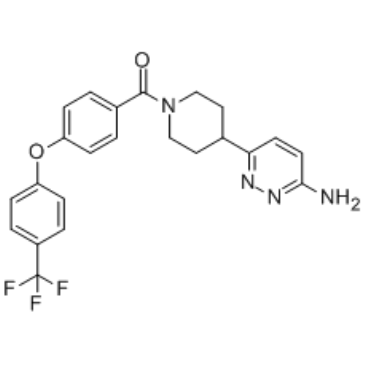
BI-749327 is a highly selective transient receptor potential canonical 6 (TRPC6) channel antagonist that potently inhibits TRPC6 activity in mice, humans, and guinea pigs (IC50=13nM, 19nM, and 15nM).
Products are for research use only. Not for human use. We do not sell to patients.
Cas No.: 2361241-23-6
Sample solution is provided at 25 µL, 10mM.
_1-3.$$$39978408@51.jpg');)
_1-9.$$$38538795@65.jpg');)
_1-9.$$$39112701@51.jpg');)
_1-7.$$$37316672@70.jpg');)
_366-372.$$$36198801@70.jpg');)
.$$$38565142@65.jpg');)
_1867-1883.$$$33248023@67.jpg');)
_eads6055.$$$39977546@45.jpg');)
_eadm9805.$$$40080571@45.jpg');)
_eadj3020.$$$39666821@45.jpg');)
_1-20.$$$39757301@28.jpg');)
_1-24.$$$38898113@28.jpg');)
_273-287.$$$36806353@46.jpg');)
_1-16.$$$37156877@44.jpg');)
_1-19.$$$37460805@44.jpg');)
_1291-1307.$$$34518654@46.jpg');)
BI-749327 is a highly selective transient receptor potential canonical 6 (TRPC6) channel antagonist that potently inhibits TRPC6 activity in mice, humans, and guinea pigs (IC50=13nM, 19nM, and 15nM). BI-749327 can be used in research related to cardiac and renal diseases[1-4].
In vitro, human pulmonary artery endothelial cells (human PAECs) and TRPC6-transfected HEK-293 cells were incubated with BI-749327 (50nM) and a hypotonic solution (220mosmol/kg H₂O), and the cationic current (Ication) was measured. BI-749327 significantly inhibited the mechanically sensitive cationic current in these cells[5]. Human atrial fibroblasts were treated with BI-749327 (1μM) for 48 hours. BI-749327 significantly reduced the transient receptor potential (TRP) currents and inhibited cell migration[6].
In vivo, BI-749327 (12μg/kg) was administered as a single injection into the hindlimb arterial circulation via a superficial abdominal wall arterial catheter in decerebrate male rats. BI-749327 significantly attenuated the reflex pressor responses and renal sympathetic nerve activity induced by static contraction and passive stretch[7]. BI-749327 (50μg/kg; every two days) was intraperitoneally injected into Sprague-Dawley (SD) rats with an intracranial aneurysm model for one month. BI-749327 significantly reduced the expressions of NOX4, p22phox, and p47phox, decreased the production of reactive oxygen species, and improved the phenotypic switch of vascular smooth muscle cells[8].
References:
[1] Lin BL, Matera D, Doerner JF, et al. In vivo selective inhibition of TRPC6 by antagonist BI 749327 ameliorates fibrosis and dysfunction in cardiac and renal disease. Proc Natl Acad Sci U S A. 2019 May 14;116(20):10156-10161.
[2] Ji M, Liu Y, Yang L, et al. BI-749327 inhibits the proliferation of hepatocellular carcinoma by targeting the TRPC6 channel. Eur J Pharmacol. 2026 Mar 28;1019:178692.
[3] Jain PP, Lai N, Xiong M, et al. TRPC6, a therapeutic target for pulmonary hypertension. Am J Physiol Lung Cell Mol Physiol. 2021 Dec 1;321(6):L1161-L1182.
[4] Zheng Z, Tsvetkov D, Bartolomaeus TUP, et al. Role of TRPC6 in kidney damage after acute ischemic kidney injury. Sci Rep. 2022 Feb 22;12(1):3038.
[5] Zhao T, Parmisano S, Soroureddin Z, et al. Mechanosensitive cation currents through TRPC6 and Piezo1 channels in human pulmonary arterial endothelial cells. Am J Physiol Cell Physiol. 2022 Oct 1;323(4):C959-C973.
[6] Hung Y, Chung CC, Chen YC, et al. Klotho Modulates Pro-Fibrotic Activities in Human Atrial Fibroblasts through Inhibition of Phospholipase C Signaling and Suppression of Store-Operated Calcium Entry. Biomedicines. 2022 Jul 1;10(7):1574.
[7] Ducrocq GP, Anselmi L, Stella SL Jr, et al. Inhibition and potentiation of the exercise pressor reflex by pharmacological modulation of TRPC6 in male rats. J Physiol. 2025 Sep;603(18):5027-5052.
[8] Sun ZH, Liu F, Kong LL, et al. Interruption of TRPC6-NFATC1 signaling inhibits NADPH oxidase 4 and VSMCs phenotypic switch in intracranial aneurysm. Biomed Pharmacother. 2023 May;161:114480.
| Cell experiment [1]: | |
Cell lines | NHCF-A human atrial fibroblasts cell line |
Preparation Method | Human atrial fibroblasts were maintained in Dulbecco's modified Eagle's medium supplemented with 10% fetal bovine serum, 100U/mL penicillin-streptomycin at 37°C, 5% CO₂. Cells were treated with BI-749327 for 48 hours. |
Reaction Conditions | 1μM; 48h |
Applications | BI-749327 significantly reduced the transient receptor potential (TRP) currents and inhibited cell migration in human atrial fibroblasts. |
| Animal experiment [2]: | |
Animal models | Sprague-Dawley (SD) rats and Trpc6-/- (C57BL/6 N background) mice |
Preparation Method | Intracranial aneurysm (IA) was induced in rats and mice by surgical ligation of the left common carotid artery and the left renal artery, followed by a high-salt diet (8% NaCl and 0.12% 3-aminopropionitrile). BI-749327 was administered intraperitoneally every two days for one month after the surgical procedures. |
Dosage form | 50μg/kg; i.p.; every two days for one month |
Applications | BI-749327 treatment reduced the expressions of NOX4, p22phox and p47phox, decreased the production of reactive oxygen species (ROS), and improved the phenotypic switch of vascular smooth muscle cells (VSMCs) in IA rats. |
References: | |
| Cas No. | 2361241-23-6 | SDF | |
| Canonical SMILES | NC1=NN=C(C2CCN(C(C3=CC=C(OC4=CC=C(C(F)(F)F)C=C4)C=C3)=O)CC2)C=C1 | ||
| Formula | C23H21F3N4O2 | M.Wt | 442.43 |
| Solubility | DMSO : 31.25 mg/mL (70.63 mM) | Storage | Store at -20°C |
| General tips | Please select the appropriate solvent to prepare the stock solution according to the
solubility of the product in different solvents; once the solution is prepared, please store it in
separate packages to avoid product failure caused by repeated freezing and thawing.Storage method
and period of the stock solution: When stored at -80°C, please use it within 6 months; when stored
at -20°C, please use it within 1 month. To increase solubility, heat the tube to 37°C and then oscillate in an ultrasonic bath for some time. |
||
| Shipping Condition | Evaluation sample solution: shipped with blue ice. All other sizes available: with RT, or with Blue Ice upon request. | ||
| Prepare stock solution | |||

|
1 mg | 5 mg | 10 mg |
| 1 mM | 2.2602 mL | 11.3012 mL | 22.6024 mL |
| 5 mM | 452 μL | 2.2602 mL | 4.5205 mL |
| 10 mM | 226 μL | 1.1301 mL | 2.2602 mL |
Step 1: Enter information below (Recommended: An additional animal making an allowance for loss during the experiment)
 g
μL
g
μL
Step 2: Enter the in vivo formulation (This is only the calculator, not formulation. Please contact us first if there is no in vivo formulation at the solubility Section.)
Calculation results:
Working concentration: mg/ml;
Method for preparing DMSO master liquid: mg drug pre-dissolved in μL DMSO ( Master liquid concentration mg/mL, Please contact us first if the concentration exceeds the DMSO solubility of the batch of drug. )
Method for preparing in vivo formulation: Take μL DMSO master liquid, next addμL PEG300, mix and clarify, next addμL Tween 80, mix and clarify, next add μL saline, mix and clarify.
Method for preparing in vivo formulation: Take μL DMSO master liquid, next add μL Corn oil, mix and clarify.
Note: 1. Please make sure the liquid is clear before adding the next solvent.
2. Be sure to add the solvent(s) in order. You must ensure that the solution obtained, in the previous addition, is a clear solution before proceeding to add the next solvent. Physical methods such as vortex, ultrasound or hot water bath can be used to aid dissolving.
3. All of the above co-solvents are available for purchase on the GlpBio website.
Quality Control & SDS
- View current batch:
- Purity: >98.00% Appearance: A solid
- COA (Certificate of Analysis)
- SDS (Safety Data Sheet)
- Datasheet
Average Rating: 5 (Based on Reviews and 8 reference(s) in Google Scholar.)