

Bifluranol (BX341) (Synonyms: BX341) |
Catalog No.GC31577
 One-Click Copy Product Info
|

Bifluranol (BX341) (BX341) is an anti-androgen.
Products are for research use only. Not for human use. We do not sell to patients.
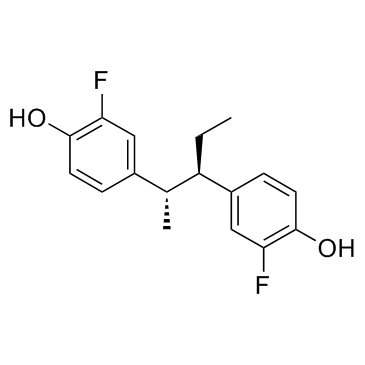
Cas No.: 34633-34-6
Sample solution is provided at 25 µL, 10mM.
_1-3.$$$39978408@51.jpg');)
_1-9.$$$38538795@65.jpg');)
_1-9.$$$39112701@51.jpg');)
_1-7.$$$37316672@70.jpg');)
_366-372.$$$36198801@70.jpg');)
.$$$38565142@65.jpg');)
_1867-1883.$$$33248023@67.jpg');)
_eads6055.$$$39977546@45.jpg');)
_eadm9805.$$$40080571@45.jpg');)
_eadj3020.$$$39666821@45.jpg');)
_1-20.$$$39757301@28.jpg');)
_1-24.$$$38898113@28.jpg');)
_273-287.$$$36806353@46.jpg');)
_1-16.$$$37156877@44.jpg');)
_1-19.$$$37460805@44.jpg');)
_1291-1307.$$$34518654@46.jpg');)
Bifluranol (BX341) is an anti-androgen.
The absorption, distribution and excretion of Bifluranol have been studied in mouse, rat, ferret and dog; Bifluranol is readily absorbed following oral administration, but blood concentrations of Bifluranol are low due to hepatic uptake and biliary excretion. After intravenous administration of [3H]Bifluranol to rats (200 μg/kg) and ferrets (60 μg/kg) the blood concentrations of 3H decreases rapidly for the first 2 to 3 h, with the decrease being more rapid in females ( 18 min for rat, 30 min for ferret) than males (1.0 h for rat, 1.4 h for ferret). This is followed by a much slower decline (40 h for rat, 20 h for ferret) to concentrations at 96 h of less than 15 ng Bifluranol equivalents mL-1 (rat) or 1 ng Bifluranol equivalents mL-1 (ferret)[1].
[1]. Pope DJ, et al. Bifluranol, a novel fluorinated bibenzyl anti-androgen, its chemistry and disposition in different animal species. J Pharm Pharmacol. 1981 May;33(5):297-301.
Animal experiment: | Mice, Rats, Dogs and Ferrets[1]Swiss albino mice (24-28 g, males age 4 weeks, females age 6 weeks; pregnant mice mated at 6 weeks, used at day 18 of pregnancy) and Wistar albino rats (200 g males age 6 weeks, females age 8 weeks; 350 g males age 10 weeks) are fed Dixon's mouse and rat diet and have free access to water. Albino ferrets (0.7-2.6 kg, age 9-15 months) are fed raw meat, bread and milk. Male beagles (10.8-12.3 kg, age 10-14 years) are fed Spratt's complete dog diet. [3H]Bifluranol administration is by intragastric intubation, in propylene glycol (mouse 0.1 ml, rat 0.1-0.2 mL, ferret 0.1-0.4 mL and dog 1 mL), except for the dog 96 h excretion study when the drug is absorbed onto starch and given in a gelatin capsule. Bifluranol is given intravenously in propylene glycol-0.9% NaCl (saline) (1 : 1 v/v) (0.1-0.2 mL), via a tail vein in mice and rats and the jugular vein in ferrets (under ether anaesthesia). [3H]Bifluranol (2 mg/kg, 1.1 mCi) is administered orally or intravenously to male, female and pregnant mice. After various time intervals they are killed under ether anaesthesia by immersion in solid CO2-hexane (-70°C). The tail, limbs and ears are removed. The animals shaved, embedded and frozen in 5 % aq. acacia wax. The animal blocks are cut using a Slee whole-body freezing microtome to obtain lateral sections (30 pm) which are exposed to X-ray film at 4°C and the auto-radiograms examined after 1,3 or 6 months. [3H]Bifluranol is adrninistered orally or intravenously to rats (200 μg/kg, 0.86-1.0 mCi) , ferrets (60 μg/kg, 5.0-10.6 mCi) and orally only to dogs (50 μg/kg, 70-76 mCi) . Blood samples (10-100 μL) are taken for radioactivity determination at time intervals up to 96 h (rat and ferret) or 6 h (dog). |
References: [1]. Pope DJ, et al. Bifluranol, a novel fluorinated bibenzyl anti-androgen, its chemistry and disposition in different animal species. J Pharm Pharmacol. 1981 May;33(5):297-301. | |
| Cas No. | 34633-34-6 | SDF | |
| Synonyms | BX341 | ||
| Canonical SMILES | C[C@H](C1=CC(F)=C(O)C=C1)[C@H](C2=CC(F)=C(O)C=C2)CC | ||
| Formula | C17H18F2O2 | M.Wt | 292.32 |
| Solubility | Soluble in DMSO | Storage | Store at -20°C |
| General tips | Please select the appropriate solvent to prepare the stock solution according to the
solubility of the product in different solvents; once the solution is prepared, please store it in
separate packages to avoid product failure caused by repeated freezing and thawing.Storage method
and period of the stock solution: When stored at -80°C, please use it within 6 months; when stored
at -20°C, please use it within 1 month. To increase solubility, heat the tube to 37°C and then oscillate in an ultrasonic bath for some time. |
||
| Shipping Condition | Evaluation sample solution: shipped with blue ice. All other sizes available: with RT, or with Blue Ice upon request. | ||
| Prepare stock solution | |||

|
1 mg | 5 mg | 10 mg |
| 1 mM | 3.4209 mL | 17.1045 mL | 34.2091 mL |
| 5 mM | 684.2 μL | 3.4209 mL | 6.8418 mL |
| 10 mM | 342.1 μL | 1.7105 mL | 3.4209 mL |
Step 1: Enter information below (Recommended: An additional animal making an allowance for loss during the experiment)
 g
μL
g
μL
Step 2: Enter the in vivo formulation (This is only the calculator, not formulation. Please contact us first if there is no in vivo formulation at the solubility Section.)
Calculation results:
Working concentration: mg/ml;
Method for preparing DMSO master liquid: mg drug pre-dissolved in μL DMSO ( Master liquid concentration mg/mL, Please contact us first if the concentration exceeds the DMSO solubility of the batch of drug. )
Method for preparing in vivo formulation: Take μL DMSO master liquid, next addμL PEG300, mix and clarify, next addμL Tween 80, mix and clarify, next add μL saline, mix and clarify.
Method for preparing in vivo formulation: Take μL DMSO master liquid, next add μL Corn oil, mix and clarify.
Note: 1. Please make sure the liquid is clear before adding the next solvent.
2. Be sure to add the solvent(s) in order. You must ensure that the solution obtained, in the previous addition, is a clear solution before proceeding to add the next solvent. Physical methods such as vortex, ultrasound or hot water bath can be used to aid dissolving.
3. All of the above co-solvents are available for purchase on the GlpBio website.
Quality Control & SDS
- View current batch:
- Purity: >98.50% Appearance: A solid
- COA (Certificate of Analysis)
- SDS (Safety Data Sheet)
- Datasheet
Average Rating: 5 (Based on Reviews and 34 reference(s) in Google Scholar.)