

BKM120 (Synonyms: BKM-120,Buparlisib,BKM 120,NVP-BKM120,NVP-BKM-120) |
Catalog No.GC11931
 One-Click Copy Product Info
|

An inhibitor of class I PI3K isoforms
Products are for research use only. Not for human use. We do not sell to patients.
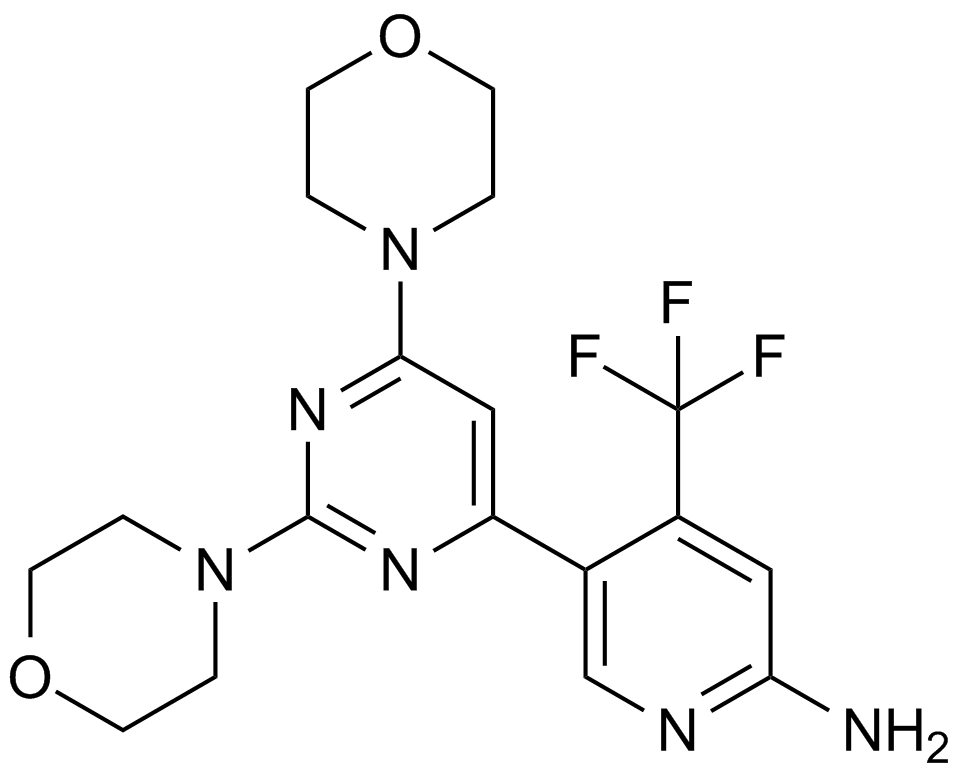
Cas No.: 944396-07-0
Sample solution is provided at 25 µL, 10mM.
_1-3.$$$39978408@51.jpg');)
_1-9.$$$38538795@65.jpg');)
_1-9.$$$39112701@51.jpg');)
_1-7.$$$37316672@70.jpg');)
_366-372.$$$36198801@70.jpg');)
.$$$38565142@65.jpg');)
_1867-1883.$$$33248023@67.jpg');)
_eads6055.$$$39977546@45.jpg');)
_eadm9805.$$$40080571@45.jpg');)
_eadj3020.$$$39666821@45.jpg');)
_1-20.$$$39757301@28.jpg');)
_1-24.$$$38898113@28.jpg');)
_273-287.$$$36806353@46.jpg');)
_1-16.$$$37156877@44.jpg');)
_1-19.$$$37460805@44.jpg');)
_1291-1307.$$$34518654@46.jpg');)
BKM120(NVP-BKM120, Buparlisib) is a selective PI3K inhibitor of p110α/β/δ/γ with IC50 of 52 nM/166 nM/116 nM/262 nM, respectively.
The intracellular phosphatidylinositol-3-kinase(PI3K) pathway regulates cellular functions incuding cell proliferation, growth, survival, apoptosis, protein synthesis, and glucose metabolism. BKM120, a biologic characterization of the 2-morpholino pyrimidine derivative, is a pan-PI3K inhibitor.
In vitro: NVP-BKM120 inhibits all four class I PI3K isoforms in biochemical assays with at least 50-fold selectivity against other protein kinases. NVP-BKM120 is also active against the most common somatic PI3Ka mutations but does not significantly inhibit the related class III (Vps34) and class IV (mTOR, DNA-PK) PI3K kinases. Consistent with its mechanism of action, NVP-BKM120 decreases the cellular p-Akt levels in mechanistic models and relevant tumor cell lines. In a panel of 353 cell lines test, NVP-BKM120 showed preferential inhibition of tumor cells with PIK3CA mutations, rather than either KRAS or PTEN mutant models [1].
In vivo: NVP-BKM120 shows dose-dependent in vivo pharmacodynamic activity as measured by significant inhibition of p-Akt and tumor growth inhibition in mechanistic xenograft models. In addition, NVP-BKM120 behaves synergistically when combined with either targeted agents such as MEK or HER2 inhibitors or with cytotoxic agents such as docetaxel or temozolomide [1].
Clinical trial: A phase I dose-escalation study investigated the maximum-tolerated dose (MTD), safety, preliminary activity, PK, and PD of BKM120. This study demonstrates feasibility and proof-of-concept of class I PI3K inhibition in cancer patients. BKM120 at the MTD of 100 mg d-1 is safe and well tolerated, with a good PK profile, clear evidence of target inhibition, and preliminary antitumor activity [2].
References:
[1] Maira SM, Pecchi S, Huang A, Burger M, Knapp M, Sterker D, Schnell C, Guthy D, Nagel T, Wiesmann M, Brachmann S, Fritsch C, Dorsch M, Chène P, Shoemaker K, De Pover A, Menezes D, Martiny-Baron G, Fabbro D, Wilson CJ, Schlegel R, Hofmann F, García-Echeverría C, Sellers WR, Voliva CF. Identification and characterization of NVP-BKM120, an orally available pan-class I PI3-kinase inhibitor. Mol Cancer Ther. 2012;11(2):317-28.
[2] Bendell JC, Rodon J, Burris HA, de Jonge M, Verweij J, Birle D, Demanse D, De Buck SS, Ru QC, Peters M, Goldbrunner M, Baselga J. Phase I, dose-escalation study of BKM120, an oral pan-Class I PI3K inhibitor, in patients with advanced solid tumors. J Clin Oncol. 2012;30(3):282-90.
| Cell experiment: [1] | |
|
Cell lines |
MM cell lines (RPMI-8226, OPM1, MM.1S, OPM2 and H929) |
|
Preparation method |
The solubility of this compound in DMSO is >10 mM. General tips for obtaining a higher concentration: Please warm the tube at 37 °C for 10 minutes and/or shake it in the ultrasonic bath for a while.Stock solution can be stored below -20°C for several months. |
|
Reaction Conditions |
IC50: 0.5-1μM, 48 hours |
|
Applications |
The effect of the pan-PI3K inhibition, mediated by increased concentrations of buparlisib on MM cell survival was tested by MTT assay. Buparlisib induced cell toxicity after 48 hr treatment in all MM cell lines tested; with an IC50 between 0.5 and 1 μM. In addition, buparlisib decreased the activation of signaling proteins downstream of PI3K including pAkt, pS6R, pP70S6K, and p-mTOR in MM.1S cells in a dose dependent manner. |
| Animal experiment: [1] | |
|
Animal models |
Female SCID-Bg mice injected with MM.1S-GFP+/luc+ cells |
|
Dosage form |
Oral administration, 50 mg/kg, once a day for 5 weeks |
|
Applications |
Treatment of mice with buparlisib significantly decreased the rate of tumor progression compared with the vehicle treated group, as shown in representative images of the BLI and quantification of the BLI. These results were further confirmed by fluorescence microscopy, showing that the number of MM.1S- GFP+/luc+ cells present in the BM of mice treated with buparlisib decreased significantly compared with those present in the BM of mice treated with vehicle, as shown in representative images of immunofluorescence. |
|
Other notes |
Please test the solubility of all compounds indoor, and the actual solubility may slightly differ with the theoretical value. This is caused by an experimental system error and it is normal. |
|
References: [1] Sahin I, Azab F, Mishima Y, Moschetta M, Tsang B, Glavey SV, Manier S, Zhang Y, Sacco A, Roccaro AM, Azab AK, Ghobrial IM. Targeting survival and cell trafficking in multiple myeloma and Waldenstrom macroglobulinemia using pan-class I PI3K inhibitor, buparlisib. Am J Hematol. 2014 Jul 24. | |
| Cas No. | 944396-07-0 | SDF | |
| Synonyms | BKM-120,Buparlisib,BKM 120,NVP-BKM120,NVP-BKM-120 | ||
| Chemical Name | 5-(2,6-dimorpholin-4-ylpyrimidin-4-yl)-4-(trifluoromethyl)pyridin-2-amine | ||
| Canonical SMILES | C1COCCN1C2=NC(=NC(=C2)C3=CN=C(C=C3C(F)(F)F)N)N4CCOCC4 | ||
| Formula | C18H21F3N6O2 | M.Wt | 410.39 |
| Solubility | ≥ 20.52mg/mL in DMSO | Storage | Store at -20°C |
| General tips | Please select the appropriate solvent to prepare the stock solution according to the
solubility of the product in different solvents; once the solution is prepared, please store it in
separate packages to avoid product failure caused by repeated freezing and thawing.Storage method
and period of the stock solution: When stored at -80°C, please use it within 6 months; when stored
at -20°C, please use it within 1 month. To increase solubility, heat the tube to 37°C and then oscillate in an ultrasonic bath for some time. |
||
| Shipping Condition | Evaluation sample solution: shipped with blue ice. All other sizes available: with RT, or with Blue Ice upon request. | ||
| Prepare stock solution | |||

|
1 mg | 5 mg | 10 mg |
| 1 mM | 2.4367 mL | 12.1835 mL | 24.3671 mL |
| 5 mM | 487.3 μL | 2.4367 mL | 4.8734 mL |
| 10 mM | 243.7 μL | 1.2184 mL | 2.4367 mL |
Step 1: Enter information below (Recommended: An additional animal making an allowance for loss during the experiment)
 g
μL
g
μL
Step 2: Enter the in vivo formulation (This is only the calculator, not formulation. Please contact us first if there is no in vivo formulation at the solubility Section.)
Calculation results:
Working concentration: mg/ml;
Method for preparing DMSO master liquid: mg drug pre-dissolved in μL DMSO ( Master liquid concentration mg/mL, Please contact us first if the concentration exceeds the DMSO solubility of the batch of drug. )
Method for preparing in vivo formulation: Take μL DMSO master liquid, next addμL PEG300, mix and clarify, next addμL Tween 80, mix and clarify, next add μL saline, mix and clarify.
Method for preparing in vivo formulation: Take μL DMSO master liquid, next add μL Corn oil, mix and clarify.
Note: 1. Please make sure the liquid is clear before adding the next solvent.
2. Be sure to add the solvent(s) in order. You must ensure that the solution obtained, in the previous addition, is a clear solution before proceeding to add the next solvent. Physical methods such as vortex, ultrasound or hot water bath can be used to aid dissolving.
3. All of the above co-solvents are available for purchase on the GlpBio website.
Quality Control & SDS
- View current batch:
- Purity: >99.50% Appearance: A solid
- COA (Certificate of Analysis)
- SDS (Safety Data Sheet)
- Datasheet
Average Rating: 5 (Based on Reviews and 30 reference(s) in Google Scholar.)