

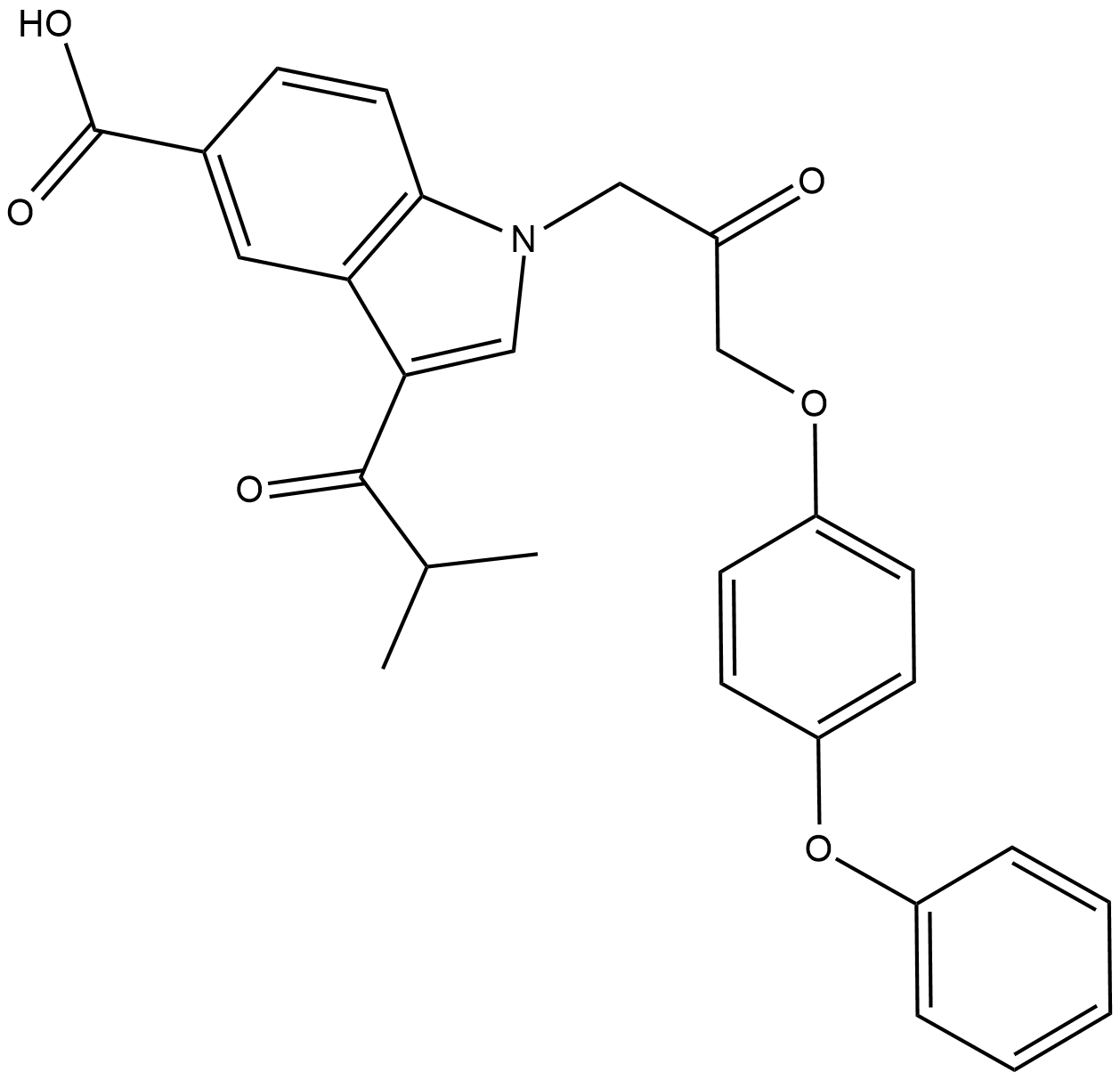
CAY10650 |
Catalog No.GC18305
 One-Click Copy Product Info
|

CAY10650 is a highly potent cytosolic phospholipase A2α (cPLA2α) inhibitor with an IC50 value of 12nM.
Products are for research use only. Not for human use. We do not sell to patients.
Cas No.: 1233706-88-1
Sample solution is provided at 25 µL, 10mM.
_1-3.$$$39978408@51.jpg');)
_1-9.$$$38538795@65.jpg');)
_1-9.$$$39112701@51.jpg');)
_1-7.$$$37316672@70.jpg');)
_366-372.$$$36198801@70.jpg');)
.$$$38565142@65.jpg');)
_1867-1883.$$$33248023@67.jpg');)
_eads6055.$$$39977546@45.jpg');)
_eadm9805.$$$40080571@45.jpg');)
_eadj3020.$$$39666821@45.jpg');)
_1-20.$$$39757301@28.jpg');)
_1-24.$$$38898113@28.jpg');)
_273-287.$$$36806353@46.jpg');)
_1-16.$$$37156877@44.jpg');)
_1-19.$$$37460805@44.jpg');)
_1291-1307.$$$34518654@46.jpg');)
CAY10650 is a highly potent cytosolic phospholipase A2α (cPLA2α) inhibitor with an IC50 value of 12nM[1]. cPLA2α is a crucial enzyme involved in the hydrolysis of phospholipids to release arachidonic acid and is essential for mediating inflammatory responses and cellular signaling pathways[2][3]. CAY10650 is typically used for studying inflammation and cellular signaling pathways related to phospholipase A2[4][5].
In vitro, CAY10650 (12nM; 30min) inhibit the phosphorylation of cPLA2α, and reduced lipid body formation and PGE2 secretion in human neutrophils stimulated with Cr-LAAO[1].
In vivo, CAY10650 (50μg in 5μl eye-drop) attenuated corneal inflammation and decreased neutrophil infiltration when applied topically three times daily for 6 days and then daily from days 7 to 15 post-infection in Chinese hamsters infected with Acanthamoeba castellanii in the eyes[6]. CAY10650 (20μg/ear/day) reduced ear thickness, epidermal thickness, and inflammatory infiltrates in an IMQ-induced psoriasis mouse model when applied topically for 5 days[7].
References:
[1] Paloschi MV, Lopes JA, Boeno CN, et al. Cytosolic phospholipase A2-α participates in lipid body formation and PGE2 release in human neutrophils stimulated with an L-amino acid oxidase from Calloselasma rhodostoma venom. Sci Rep. 2020;10(1):10976.
[2] Murakami M, Kudo I. Phospholipase A2. J Biochem. 2002;131(3):285-292.
[3] Yang D, Ji HF, Zhang XM, et al. Protective effect of cytosolic phospholipase A2 inhibition against inflammation and degeneration by promoting regulatory T cells in rats with experimental autoimmune encephalomyelitis. Mediators Inflamm. 2014;2014:890139.
[4] Lin CY, Xu WB, Li BZ, Shu MA, Zhang YM. Identification and functional analysis of cytosolic phospholipase A2 (cPLA2) from the red swamp crayfish Procambarus clarkii: The first evidence of cPLA2 involved in immunity in invertebrates. Fish Shellfish Immunol. 2023;140:108944.
[5] Wu CZ, Li X, Hong L, et al. NOX4/Src regulates ANP secretion through activating ERK1/2 and Akt/GATA4 signaling in beating rat hypoxic atria. Korean J Physiol Pharmacol. 2021;25(2):159-166.
[6] Tripathi T, Abdi M, Alizadeh H. Role of phospholipase A₂ (PLA₂) inhibitors in attenuating apoptosis of the corneal epithelial cells and mitigation of Acanthamoeba keratitis. Exp Eye Res. 2013;113:182-191.
[7] Shao S, Chen J, Swindell WR, et al. Phospholipase A2 enzymes represent a shared pathogenic pathway in psoriasis and pityriasis rubra pilaris. JCI Insight. 2021;6(20):e151911.
| Cell experiment [1]: | |
Cell lines | human neutrophils |
Preparation Method | Neutrophils isolated according to item above from 3 different donors, were suspended in a RPMI assay medium [RPMI-1640 medium supplemented with 100mg/mL of gentamicin, 2mM of l-glutamine and 2% of fetal bovine serum (FBS)]. 1×10⁷ isolated human neutrophils were plated and pre-treated with CAY10650 (cPLA2-α inhibitor, 12nM for 30min) or the same vehicle used to dissolve the inhibitors in RPMI (control). Then, they were incubated with RPMI (negative control), LPS (1µg/mL; positive control) or Cr-LAAO (50µg/mL) at 37°C, in a humidified atmosphere (5% CO2) for 1h. Lipid bodies were quantified with Oil Red O staining. PGE2 concentrations in the supernatant were determined by a specific enzymatic immunoassay (EIA). Proteins were extracted for western blot analysis. |
Reaction Conditions | 12nM; 30min |
Applications | CAY10650 inhibit the phosphorylation of cPLA2α, and reduced lipid body formation and PGE2 secretion in human neutrophils stimulated with Cr-LAAO. |
| Animal experiment [2]: | |
Animal models | Chinese hamsters |
Preparation Method | Chinese hamsters (n=9/group) were infected with Acanthamoeba castellanii-laden contact lenses. cPLA2α inhibitor (CAY10650; 50μg in 5μl) was injected with topical eye-drop under the contact lens of an infected cornea three times a day for 6 days and topically on days 7 to 20 postinfection. As a control infected animals were treated with 50μg/5μl of BSA. Lenses were removed 7 days postinfection, and corneas were scored for clinical severity for the period indicated. Each graph line represents the mean severity of the observed time points. The results shown are representative of three separate experiments. The infections were scored on a scale of 0 to 5 based on the following parameters: corneal infiltration, corneal neovascularization and corneal ulceration. The pathology was recorded as: 0=no pathology, 1=<10% of the cornea involved, 2=10 to 25% involved, 3=25 to 50% involved, 4=50 to 75% involved, and 5=75 to 100% involved. Any animals receiving a score of at least 1.0 for any parameter were scored as infected. Animals were anesthetized and sacrificed 15 days after application of CAY10650. Each animal’s right eye (uninfected and untreated) was used as negative control. As control, uninfected eyes of animals (n=6/group) were treated with CAY10650. Eyes were removed and used for histopathological examination. |
Dosage form | 50μg in 5μl eye-drop; topically three times daily for 6 days and then daily from days 7 to 15 post-infection |
Applications | CAY10650 attenuated corneal inflammation and decreased neutrophil infiltration when applied topically three times daily for 6 days and then daily from days 7 to 15 post-infection in Chinese hamsters infected with Acanthamoeba castellanii in the eyes. |
References: | |
| Cas No. | 1233706-88-1 | SDF | |
| Chemical Name | 3-(2-methyl-1-oxopropyl)-1-[2-oxo-3-(4-phenoxyphenoxy)propyl]-1H-indole-5-carboxylic acid | ||
| Canonical SMILES | O=C(CN1C(C=CC(C(O)=O)=C2)=C2C(C(C(C)C)=O)=C1)COC3=CC=C(OC4=CC=CC=C4)C=C3 | ||
| Formula | C28H25NO6 | M.Wt | 471.5 |
| Solubility | DMF: 20 mg/ml,DMSO: 20 mg/ml,DMSO:PBS (pH 7.2) (1:10): 0.1 mg/ml | Storage | Store at -20°C |
| General tips | Please select the appropriate solvent to prepare the stock solution according to the
solubility of the product in different solvents; once the solution is prepared, please store it in
separate packages to avoid product failure caused by repeated freezing and thawing.Storage method
and period of the stock solution: When stored at -80°C, please use it within 6 months; when stored
at -20°C, please use it within 1 month. To increase solubility, heat the tube to 37°C and then oscillate in an ultrasonic bath for some time. |
||
| Shipping Condition | Evaluation sample solution: shipped with blue ice. All other sizes available: with RT, or with Blue Ice upon request. | ||
| Prepare stock solution | |||

|
1 mg | 5 mg | 10 mg |
| 1 mM | 2.1209 mL | 10.6045 mL | 21.2089 mL |
| 5 mM | 424.2 μL | 2.1209 mL | 4.2418 mL |
| 10 mM | 212.1 μL | 1.0604 mL | 2.1209 mL |
Step 1: Enter information below (Recommended: An additional animal making an allowance for loss during the experiment)
 g
μL
g
μL
Step 2: Enter the in vivo formulation (This is only the calculator, not formulation. Please contact us first if there is no in vivo formulation at the solubility Section.)
Calculation results:
Working concentration: mg/ml;
Method for preparing DMSO master liquid: mg drug pre-dissolved in μL DMSO ( Master liquid concentration mg/mL, Please contact us first if the concentration exceeds the DMSO solubility of the batch of drug. )
Method for preparing in vivo formulation: Take μL DMSO master liquid, next addμL PEG300, mix and clarify, next addμL Tween 80, mix and clarify, next add μL saline, mix and clarify.
Method for preparing in vivo formulation: Take μL DMSO master liquid, next add μL Corn oil, mix and clarify.
Note: 1. Please make sure the liquid is clear before adding the next solvent.
2. Be sure to add the solvent(s) in order. You must ensure that the solution obtained, in the previous addition, is a clear solution before proceeding to add the next solvent. Physical methods such as vortex, ultrasound or hot water bath can be used to aid dissolving.
3. All of the above co-solvents are available for purchase on the GlpBio website.
Quality Control & SDS
- View current batch:
- Purity: >98.00% Appearance: A solid
- COA (Certificate of Analysis)
- SDS (Safety Data Sheet)
- Datasheet
Average Rating: 5 (Based on Reviews and 14 reference(s) in Google Scholar.)