

CC-115 |
Catalog No.GC16654
 One-Click Copy Product Info
|

mTOR/DNA-PK inhibitor
Products are for research use only. Not for human use. We do not sell to patients.
Cas No.: 1228013-15-7
Sample solution is provided at 25 µL, 10mM.
_1-3.$$$39978408@51.jpg');)
_1-9.$$$38538795@65.jpg');)
_1-9.$$$39112701@51.jpg');)
_1-7.$$$37316672@70.jpg');)
_366-372.$$$36198801@70.jpg');)
.$$$38565142@65.jpg');)
_1867-1883.$$$33248023@67.jpg');)
_eads6055.$$$39977546@45.jpg');)
_eadm9805.$$$40080571@45.jpg');)
_eadj3020.$$$39666821@45.jpg');)
_1-20.$$$39757301@28.jpg');)
_1-24.$$$38898113@28.jpg');)
_273-287.$$$36806353@46.jpg');)
_1-16.$$$37156877@44.jpg');)
_1-19.$$$37460805@44.jpg');)
_1291-1307.$$$34518654@46.jpg');)
IC50: 21/ 13 nM for mTOR/DNA-PK
CC-115 is a inhibitor of mTOR/DNA-PK.
The mammalian target of rapamycin (mTOR) kinase is a key mediator of the phosphoinositide 3-kinase /protein kinase B (AKT pathway). The DNA-dependent protein kinase (DNA-PK) is a critical component of the DNA repair machinery governings the response to DNA damage, which serves to maintain genome integrity.
In vitro: Previous study found that the proliferation induced by CD40(+) interleukin-21 stimulation could be completely blocked by CC-115, and CD40-mediated resistance to fludarabine and venetoclax could also be reverted by CC-115. Moreover, BCR-mediated signaling was blocked by CC-115 and in CLL samples from patients with acquired resistance to idelalisib treatment [1].
In vivo: Preclinical studies showed that CC-115 had good in vivo PK profiles across multiple species with 53%, 76%, and around100% oral bioavailability in mouse, rat, and dog, respectively [2].
Clinical trial: Clinical efficacy of CC-115 was studied in 8 patients with relapsed/refractory CLL/small lymphocytic lymphoma harboring ATM deletions/mutations. Results showed that all but one patient had a decrease in lymphadenopathy, leading to 1 IWCLL partial response (PR) and 3 PRs with lymphocytosis. These early promising clinical activity suggested that CC-115 might be developed further for treatment of CLL [1].
References:
[1] Thijssen R,et al. Dual TORK/DNA-PK inhibition blocks critical signaling pathways in chronic lymphocytic leukemia. Blood.2016 Jul 28;128(4):574-83.
[2] Mortensen DS, et al. Optimization of a Series of Triazole Containing Mammalian Target of Rapamycin (mTOR) Kinase Inhibitors and the Discovery of CC-115. J Med Chem. 2015 Jul 23;58(14):5599-5608.
Kinase experiment: | An HTR-FRET substrate phosphorylation assay is employed for mTOR kinase. PI3Kα IC50 determinations are outsourced using the mobility shift assay format. Compounds (e.g., CC-115) are assessed against concentrations of ATP at approximately the Km for the assay, with average ATP Km of 15 μM and 50 μM for the mTOR and PI3K assays, respectively[1]. |
Cell experiment: | PC-3 cells are cultured in growth media. For biomarker studies cells are treated for 1 h and then assayed for pS6 and pAkt levels using MesoScale technology. For proliferation experiments, cells are treated with compound (e.g., CC-115) and then allowed to grow for 72 h. All data are normalized and represented as a percentage of the DMSO-treated cells. Results are then expressed as IC50 values[1]. |
Animal experiment: | Mice[1]Encouraged by the observed exposures, CC-115 is advanced into single dose PK/PD studies assessing mTOR pathway biomarker inhibition in tumor bearing mice. PC-3 tumor-bearing mice are administered with a single dose of CC-115, dosed orally at either 1 or 10 mg/kg, and plasma and tumor samples are collected at various time points for analysis. Significant inhibition of both mTORC1 (pS6) and mTORC2 (pAktS473) is observed for all compounds and the level of biomarker inhibition correlated to plasma compound levels. |
References: [1]. Mortensen DS, et al. Optimization of a Series of Triazole Containing Mammalian Target of Rapamycin (mTOR) Kinase Inhibitors and the Discovery of CC-115. J Med Chem. 2015 Jul 23;58(14):5599-5608. | |
| Cas No. | 1228013-15-7 | SDF | |
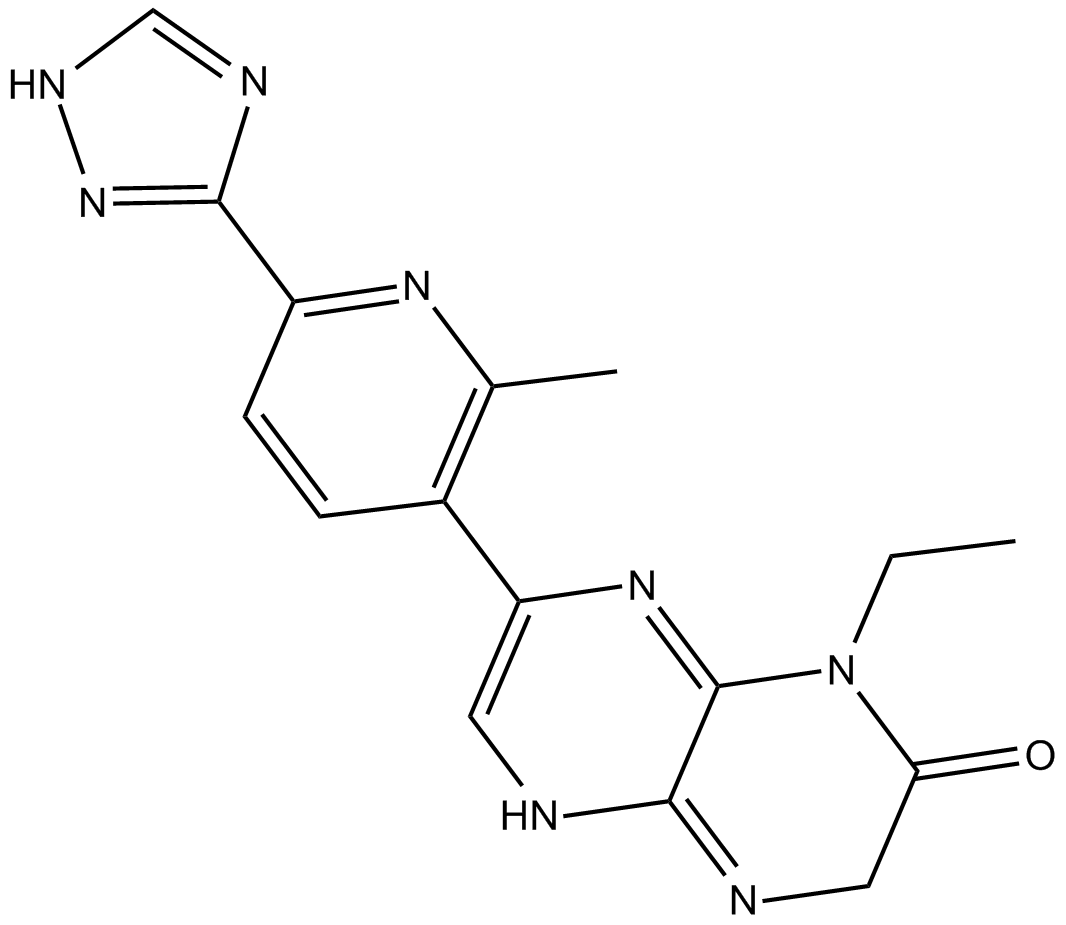
| Chemical Name | 1-ethyl-7-(2-methyl-6-(1H-1,2,4-triazol-3-yl)pyridin-3-yl)-3,5-dihydropyrazino[2,3-b]pyrazin-2(1H)-one | ||
| Canonical SMILES | CCN1C(CN=C2C1=NC(C(C=CC(C3=NNC=N3)=N4)=C4C)=CN2)=O | ||
| Formula | C16H16N8O | M.Wt | 336.35 |
| Solubility | ≥ 50mg/mL in DMSO | Storage | Store at -20°C |
| General tips | Please select the appropriate solvent to prepare the stock solution according to the
solubility of the product in different solvents; once the solution is prepared, please store it in
separate packages to avoid product failure caused by repeated freezing and thawing.Storage method
and period of the stock solution: When stored at -80°C, please use it within 6 months; when stored
at -20°C, please use it within 1 month. To increase solubility, heat the tube to 37°C and then oscillate in an ultrasonic bath for some time. |
||
| Shipping Condition | Evaluation sample solution: shipped with blue ice. All other sizes available: with RT, or with Blue Ice upon request. | ||
| Prepare stock solution | |||

|
1 mg | 5 mg | 10 mg |
| 1 mM | 2.9731 mL | 14.8655 mL | 29.7309 mL |
| 5 mM | 594.6 μL | 2.9731 mL | 5.9462 mL |
| 10 mM | 297.3 μL | 1.4865 mL | 2.9731 mL |
Step 1: Enter information below (Recommended: An additional animal making an allowance for loss during the experiment)
 g
μL
g
μL
Step 2: Enter the in vivo formulation (This is only the calculator, not formulation. Please contact us first if there is no in vivo formulation at the solubility Section.)
Calculation results:
Working concentration: mg/ml;
Method for preparing DMSO master liquid: mg drug pre-dissolved in μL DMSO ( Master liquid concentration mg/mL, Please contact us first if the concentration exceeds the DMSO solubility of the batch of drug. )
Method for preparing in vivo formulation: Take μL DMSO master liquid, next addμL PEG300, mix and clarify, next addμL Tween 80, mix and clarify, next add μL saline, mix and clarify.
Method for preparing in vivo formulation: Take μL DMSO master liquid, next add μL Corn oil, mix and clarify.
Note: 1. Please make sure the liquid is clear before adding the next solvent.
2. Be sure to add the solvent(s) in order. You must ensure that the solution obtained, in the previous addition, is a clear solution before proceeding to add the next solvent. Physical methods such as vortex, ultrasound or hot water bath can be used to aid dissolving.
3. All of the above co-solvents are available for purchase on the GlpBio website.
Quality Control & SDS
- View current batch:
- Purity: >98.00% Appearance: A solid
- COA (Certificate of Analysis)
- SDS (Safety Data Sheet)
- Datasheet
Average Rating: 5 (Based on Reviews and 33 reference(s) in Google Scholar.)