

Cefotaxime |
Catalog No.GC60685
 One-Click Copy Product Info
|

Cefotaxime is a third-generation cephalosporin antibiotic with broad-spectrum antibacterial activity. It is most commonly prescribed for the treatment of infectious diseases induced by Gram-positive or Gram-negative bacteria.
Products are for research use only. Not for human use. We do not sell to patients.
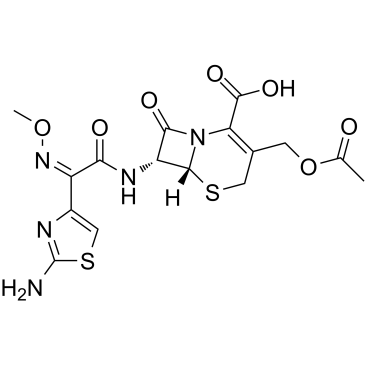
Cas No.: 63527-52-6
Sample solution is provided at 25 µL, 10mM.
_1-3.$$$39978408@51.jpg');)
_1-9.$$$38538795@65.jpg');)
_1-9.$$$39112701@51.jpg');)
_1-7.$$$37316672@70.jpg');)
_366-372.$$$36198801@70.jpg');)
.$$$38565142@65.jpg');)
_1867-1883.$$$33248023@67.jpg');)
_eads6055.$$$39977546@45.jpg');)
_eadm9805.$$$40080571@45.jpg');)
_eadj3020.$$$39666821@45.jpg');)
_1-20.$$$39757301@28.jpg');)
_1-24.$$$38898113@28.jpg');)
_273-287.$$$36806353@46.jpg');)
_1-16.$$$37156877@44.jpg');)
_1-19.$$$37460805@44.jpg');)
_1291-1307.$$$34518654@46.jpg');)
Cefotaxime is a third-generation cephalosporin antibiotic with broad-spectrum antibacterial activity. It is most commonly prescribed for the treatment of infectious diseases induced by Gram-positive or Gram-negative bacteria[1].
Cefotaxime (200, 400, 600, or 1000μg/mL; 24h) significantly promotes ROS generation in HT1080 cells[1]. Cefotaxime (0.02-2µg/ml, 5h) combined with Mecillinam could eliminate both cephalosporin-resistant bacteria harbouring CTX-M-15WT and mecillinam-resistant bacteria harbouring the mutant CTX-M-15N135D, thereby constraining resistance evolution of β-lactamase CTX-M-15[2].
Cefotaxime (200 or 400mg/kg/8h, 9 injections, subcutaneous injection) significantly increased bacterial clearance from the pneumonia model in leukopenic mice[3]. Cefotaxime (100mg/kg/4h, 24h, subcutaneous injections) combined with Amoxicillin-Clavulanate significantly reduces bacterial counts and achieves kidney sterilization in in a Murine Urinary Tract Infection Model[4].
References:
[1] Yamada M, Suzuki M, Noguchi T, et al. The antibiotic cefotaxime works as both an activator of Nrf2 and an inducer of HSP70 in mammalian cells. BPB reports. 2020;3(1):16-21.
[2] Rosenkilde CE, Munck C, Porse A, et al. Collateral sensitivity constrains resistance evolution of the CTX-M-15 β-lactamase. Nature communications. 2019 Feb 6;10(1):618.
[3] Sauve C, Azoulay-Dupuis E, Moine P, et al. Efficacies of cefotaxime and ceftriaxone in a mouse model of pneumonia induced by two penicillin-and cephalosporin-resistant strains of Streptococcus pneumoniae. Antimicrobial agents and chemotherapy. 1996 Dec;40(12):2829-34.
[4] Rossi B, Soubirou JF, Chau F, et al. Cefotaxime and amoxicillin-clavulanate synergism against extended-spectrum-β-lactamase-producing Escherichia coli in a murine model of urinary tract infection. Antimicrobial Agents and Chemotherapy. 2016 Jan;60(1):424-30.
| Cell experiment [1]: | |
Cell lines | Human fibrosarcoma HT1080 cells |
Preparation Method | HT1080 cells were seeded on glass plates and treated with the indicated concentrations (200, 400, 600, or 1000μg/mL) of Cefotaxime for 24h. After stimulation, cells were treated with 10µM DCFH-DA for 30min at 37°C. After washing with PBS, the intracellular ROS generation was observed under laser confocal microscope. |
Reaction Conditions | 200, 400, 600, or 1000μg/mL; 24h |
Applications | Cefotaxime significantly promotes ROS generation in HT1080 cells. |
| Animal experiment [2]: | |
Animal models | Pneumonia model in leukopenic mice |
Preparation Method | Amoxicillin (AMO) and Cefotaxime (CTX) were administered at 8-h intervals with a total of nine injections, and Ceftriaxone (CRO) was given at 12-h intervals with a total of six injections. The dose of each antibiotic varied with the infective strain. Mice infected with strain P40422 were treated with AMO or CTX at 200 or 400mg/kg or with CRO at 100mg/kg. Mice infected with P40984 were treated with AMO at 200 or 400mg/kg, CTX at 400mg/kg, or CRO at 100 or 200mg/kg. Each dose was administered subcutaneously (s.c.) in 0.5ml of sterile water. Control animals received the same volume of isotonic saline. |
Dosage form | 200 or 400mg/kg/8h, 9 injections, subcutaneous injection |
Applications | Cefotaxime significantly increased bacterial clearance from the pneumonia model in leukopenic mice. |
References: | |
| Cas No. | 63527-52-6 | SDF | |
| Canonical SMILES | O=C(C(N12)=C(COC(C)=O)CS[C@]2([H])[C@H](NC(/C(C3=CSC(N)=N3)=N\OC)=O)C1=O)O | ||
| Formula | C16H17N5O7S2 | M.Wt | 455.47 |
| Solubility | DMSO: 250 mg/mL (548.88 mM) | Storage | Store at 2-8°C |
| General tips | Please select the appropriate solvent to prepare the stock solution according to the
solubility of the product in different solvents; once the solution is prepared, please store it in
separate packages to avoid product failure caused by repeated freezing and thawing.Storage method
and period of the stock solution: When stored at -80°C, please use it within 6 months; when stored
at -20°C, please use it within 1 month. To increase solubility, heat the tube to 37°C and then oscillate in an ultrasonic bath for some time. |
||
| Shipping Condition | Evaluation sample solution: shipped with blue ice. All other sizes available: with RT, or with Blue Ice upon request. | ||
| Prepare stock solution | |||

|
1 mg | 5 mg | 10 mg |
| 1 mM | 2.1955 mL | 10.9777 mL | 21.9553 mL |
| 5 mM | 439.1 μL | 2.1955 mL | 4.3911 mL |
| 10 mM | 219.6 μL | 1.0978 mL | 2.1955 mL |
Step 1: Enter information below (Recommended: An additional animal making an allowance for loss during the experiment)
 g
μL
g
μL
Step 2: Enter the in vivo formulation (This is only the calculator, not formulation. Please contact us first if there is no in vivo formulation at the solubility Section.)
Calculation results:
Working concentration: mg/ml;
Method for preparing DMSO master liquid: mg drug pre-dissolved in μL DMSO ( Master liquid concentration mg/mL, Please contact us first if the concentration exceeds the DMSO solubility of the batch of drug. )
Method for preparing in vivo formulation: Take μL DMSO master liquid, next addμL PEG300, mix and clarify, next addμL Tween 80, mix and clarify, next add μL saline, mix and clarify.
Method for preparing in vivo formulation: Take μL DMSO master liquid, next add μL Corn oil, mix and clarify.
Note: 1. Please make sure the liquid is clear before adding the next solvent.
2. Be sure to add the solvent(s) in order. You must ensure that the solution obtained, in the previous addition, is a clear solution before proceeding to add the next solvent. Physical methods such as vortex, ultrasound or hot water bath can be used to aid dissolving.
3. All of the above co-solvents are available for purchase on the GlpBio website.
Quality Control & SDS
- View current batch:
- Purity: >99.50% Appearance: A solid
- COA (Certificate of Analysis)
- SDS (Safety Data Sheet)
- Datasheet
Average Rating: 5 (Based on Reviews and 15 reference(s) in Google Scholar.)