

CU-T12-9 |
Catalog No.GC39285
 One-Click Copy Product Info
|

CU-T12-9 is a small-molecule agonist that specifically targets the Toll-like receptor TLR1/TLR2 heterodimer, with an EC50 of 52.9nM. CU-T12-9 promotes the dimerization of TLR1 and TLR2, thereby activating the NF-κB signaling pathway.
Products are for research use only. Not for human use. We do not sell to patients.
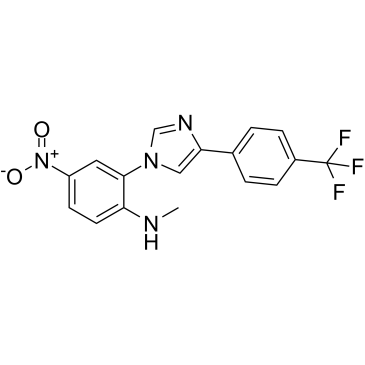
Cas No.: 1821387-73-8
Sample solution is provided at 25 µL, 10mM.
_1-3.$$$39978408@51.jpg');)
_1-9.$$$38538795@65.jpg');)
_1-9.$$$39112701@51.jpg');)
_1-7.$$$37316672@70.jpg');)
_366-372.$$$36198801@70.jpg');)
.$$$38565142@65.jpg');)
_1867-1883.$$$33248023@67.jpg');)
_eads6055.$$$39977546@45.jpg');)
_eadm9805.$$$40080571@45.jpg');)
_eadj3020.$$$39666821@45.jpg');)
_1-20.$$$39757301@28.jpg');)
_1-24.$$$38898113@28.jpg');)
_273-287.$$$36806353@46.jpg');)
_1-16.$$$37156877@44.jpg');)
_1-19.$$$37460805@44.jpg');)
_1291-1307.$$$34518654@46.jpg');)
CU-T12-9 is a small-molecule agonist that specifically targets the Toll-like receptor TLR1/TLR2 heterodimer, with an EC50 of 52.9nM. CU-T12-9 promotes the dimerization of TLR1 and TLR2, thereby activating the NF-κB signaling pathway[1-2]. CU-T12-9 is primarily used in research related to immune regulation, vaccine adjuvants, anti-tumor agents, and the development of therapeutics for inflammatory and infectious diseases[3-4].
In vitro, treatment of TREM1-knockdown human hepatocellular carcinoma Huh-7 and MHCC-97H cells with CU-T12-9 (1μM) activated the TLR2 signaling pathway and promoted the phosphorylation of PI3K-p85α and AKT, thereby rescuing the impairment in cell proliferation, invasion, and epithelial-mesenchymal transition (EMT) caused by TREM1 downregulation[5]. Treatment of LPS (100ng/mL) and IFN-γ (10ng/mL)-induced M1-type bone marrow-derived macrophages with CU-T12-9 (1μM) for 2 hours reversed the inhibitory effect of photobiomodulation (PBM) on the TLR2/NLRP3/Caspase-1/IL-1β signaling pathway, significantly suppressed the expression of autophagy-related proteins LC3B and Beclin-1, and enhanced inflammasome activity and pro-inflammatory cytokine secretion[6].
In vivo, intramuscular injection of CU-T12-9 (10mg/kg) in a diabetic hindlimb ischemia mouse model twice a week for six weeks (total of six injections), specifically activated the NF-κB signaling pathway and significantly inhibited the formation of new blood vessels from endothelial cells and smooth muscle cells in the ischemic muscle tissue[7].
References:
[1] Cheng K, Gao M, Godfroy JI, et al. Specific activation of the TLR1-TLR2 heterodimer by small-molecule agonists. Sci Adv. 2015;1(3):e1400139.
[2] Wang Z, Zhu D, Yang F, et al. POSTN knockdown suppresses IL-1β-induced inflammation and apoptosis of nucleus pulposus cells via inhibiting the NF-κB pathway and alleviates intervertebral disc degeneration. J Cell Commun Signal. 2024 May 7;18(2):e12030.
[3] Chen Y, Guo Y, Song Z, et al. Luteolin restricts ASFV replication by regulating the NF-κB/STAT3/ATF6 signaling pathway. Vet Microbiol. 2022 Oct;273:109527.
[4] Zhang W, Liu W, Hu X. Robinin inhibits pancreatic cancer cell proliferation, EMT and inflammation via regulating TLR2-PI3k-AKT signaling pathway. Cancer Cell Int. 2023 Dec 18;23(1):328.
[5] Ren L, Qiao GL, Zhang SX, et al. Pharmacological Inhibition or Silencing of TREM1 Restrains HCC Cell Metastasis by Inactivating TLR/PI3K/AKT Signaling. Cell Biochem Biophys. 2024 Sep;82(3):2673-2685.
[6] Zuo X, Ju C, Zhang Z, et al. Photobiomodulation regulates inflammation and autophagy in spinal cord injury through NLRP3/Caspase-1/IL-1β pathway by targeting TLR2. Mol Immunol. 2025 Jun;182:1-10.
[7] Wang J, Zhang L, Duan W, et al. Salidroside analogue C-30 promotes neovascularization in diabetic hindlimb ischemic mice by inducing macrophage M2 polarization. Int Immunopharmacol. 2025 Oct 22;167:115708.
| Cell experiment [1]: | |
Cell lines | Huh-7 and MHCC-97H cells (human hepatocellular carcinoma cell lines) |
Preparation Method | Huh-7 and MHCC-97H cells were maintained in RPMI-1640 medium supplemented with 10% fetal bovine serum (FBS) at 37°C, 5% CO₂. Cells were transfected with si-TREM1 or control siRNA (si-Con) for 48 hours and subsequently treated with the TLR2-specific agonist CU-T12-9 (1µM). |
Reaction Conditions | 1μM; 48h |
Applications | CU-T12-9 treatment significantly reversed the si-TREM1-induced suppression of cell proliferation, invasion, and epithelial-mesenchymal transition (EMT). CU-T12-9 also restored the protein expression levels of TLR2/4, MyD88, and the phosphorylation of PI3K/AKT, which were downregulated by TREM1 knockdown. |
| Animal experiment [2]: | |
Animal models | Diabetic C57BL/6 mice with hindlimb ischemia (HLI) |
Preparation Method | Diabetic HLI mice were intramuscularly administered CU-T12-9 (10mg/kg body weight) alone or in combination with C-30 (30mg/kg body weight) at indicated time points after femoral artery excision. Mice were sacrificed at day 21 after surgery for analysis. |
Dosage form | 10mg/kg; intramuscular injection; twice a week for three weeks, total of six injections. |
Applications | CU-T12-9 administration abolished C-30-mediated blood perfusion recovery and neovascularization in diabetic HLI mice. CU-T12-9 significantly reversed C-30-induced M2 macrophage polarization and suppressed therapeutic angiogenesis by activating the NF-κB signaling pathway. |
References: | |
| Cas No. | 1821387-73-8 | SDF | |
| Canonical SMILES | CNC1=CC=C(C=C1N2C=C(N=C2)C3=CC=C(C=C3)C(F)(F)F)[N+]([O-])=O | ||
| Formula | C17H13F3N4O2 | M.Wt | 362.31 |
| Solubility | DMSO: 250 mg/mL (690.02 mM) | Storage | Store at -20°C |
| General tips | Please select the appropriate solvent to prepare the stock solution according to the
solubility of the product in different solvents; once the solution is prepared, please store it in
separate packages to avoid product failure caused by repeated freezing and thawing.Storage method
and period of the stock solution: When stored at -80°C, please use it within 6 months; when stored
at -20°C, please use it within 1 month. To increase solubility, heat the tube to 37°C and then oscillate in an ultrasonic bath for some time. |
||
| Shipping Condition | Evaluation sample solution: shipped with blue ice. All other sizes available: with RT, or with Blue Ice upon request. | ||
| Prepare stock solution | |||

|
1 mg | 5 mg | 10 mg |
| 1 mM | 2.7601 mL | 13.8003 mL | 27.6007 mL |
| 5 mM | 552 μL | 2.7601 mL | 5.5201 mL |
| 10 mM | 276 μL | 1.38 mL | 2.7601 mL |
Step 1: Enter information below (Recommended: An additional animal making an allowance for loss during the experiment)
 g
μL
g
μL
Step 2: Enter the in vivo formulation (This is only the calculator, not formulation. Please contact us first if there is no in vivo formulation at the solubility Section.)
Calculation results:
Working concentration: mg/ml;
Method for preparing DMSO master liquid: mg drug pre-dissolved in μL DMSO ( Master liquid concentration mg/mL, Please contact us first if the concentration exceeds the DMSO solubility of the batch of drug. )
Method for preparing in vivo formulation: Take μL DMSO master liquid, next addμL PEG300, mix and clarify, next addμL Tween 80, mix and clarify, next add μL saline, mix and clarify.
Method for preparing in vivo formulation: Take μL DMSO master liquid, next add μL Corn oil, mix and clarify.
Note: 1. Please make sure the liquid is clear before adding the next solvent.
2. Be sure to add the solvent(s) in order. You must ensure that the solution obtained, in the previous addition, is a clear solution before proceeding to add the next solvent. Physical methods such as vortex, ultrasound or hot water bath can be used to aid dissolving.
3. All of the above co-solvents are available for purchase on the GlpBio website.
Quality Control & SDS
- View current batch:
- Purity: >98.00% Appearance: A solid
- COA (Certificate of Analysis)
- SDS (Safety Data Sheet)
- Datasheet
Average Rating: 5 (Based on Reviews and 39 reference(s) in Google Scholar.)