

DDD85646 (Synonyms: IMP-366) |
Catalog No.GC43386
 One-Click Copy Product Info
|

DDD85646 is a potent inhibitor of Trypanosoma brucei N-myristoyltransferase (NMT), exhibiting half-maximal inhibitory concentration (IC₅₀) values of 2nM against T. brucei NMT (TbNMT) and 4nM against human NMT (hNMT).
Products are for research use only. Not for human use. We do not sell to patients.
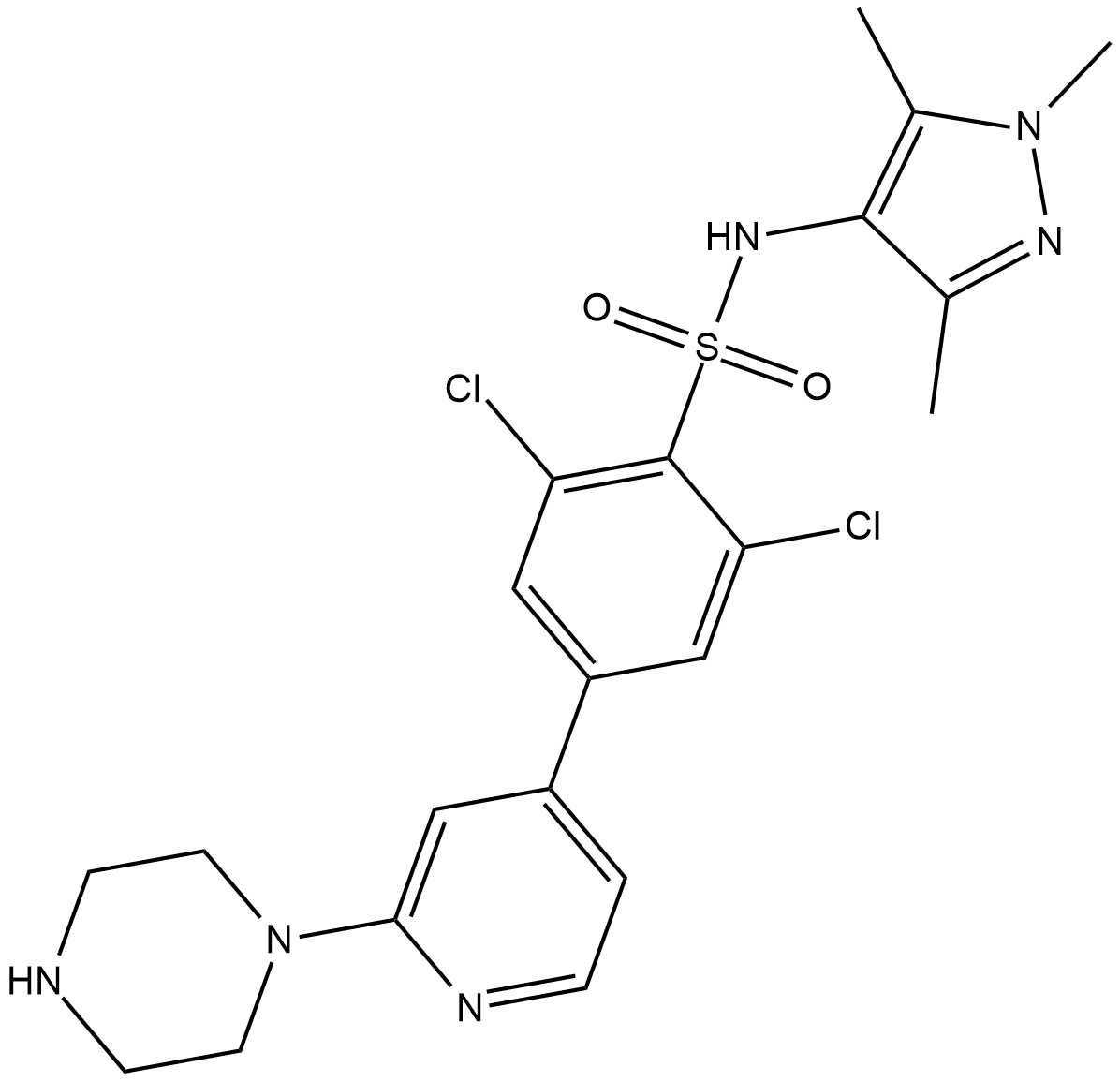
Cas No.: 1215010-55-1
Sample solution is provided at 25 µL, 10mM.
DDD85646 is a potent inhibitor of Trypanosoma brucei N-myristoyltransferase (NMT), exhibiting half-maximal inhibitory concentration (IC₅₀) values of 2nM against T. brucei NMT (TbNMT) and 4nM against human NMT (hNMT)[1]. DDD85646 effectively inhibits the proliferation of trypanosomes[2], and also demonstrates antiviral activity by suppressing viral replication[3-4].
In vitro, co-treatment of acute monocytic leukemia THP-1 cells with DDD85646 (10μM) and the ferroptosis inducer Erastin (10μM) for 36 hours enhanced susceptibility to ferroptosis—characterized by lipid peroxidation, glutathione depletion, and mitochondrial shrinkage—via inhibition of FSP1 localization to the cell membrane[5]. Pretreatment of A549, HEK293T, HAP1, and Vero E6 cells with DDD85646 (0.1–10μM) for 1–5 hours, followed by infection with lymphocytic choriomeningitis virus (LCMV; MOI=0.05–1) for 24–72 hours, significantly suppressed viral protein expression, reduced viral titers, and decreased the number of infected cells[6].
In vivo, oral administration of DDD85646 (12.5–50mg/kg) twice daily for 4 days to mice infected with Trypanosoma brucei strains S427 or STIB900 resulted in significant clearance of parasites from peripheral blood[7]. Subcutaneous injection of DDD85646 (20–60mg/kg) once daily or every other day for 7–16 days in mice bearing DOHH2 or BL2 lymphoma xenografts led to significant suppression of tumor growth and induction of complete tumor regression[8].
References:
[1] Spinks D, Smith V, Thompson S, et al. Development of Small-Molecule Trypanosoma brucei N-Myristoyltransferase Inhibitors: Discovery and Optimisation of a Novel Binding Mode. ChemMedChem. 2015 Nov;10(11):1821-36.
[2] Begolo D, Erben E, Clayton C. Drug target identification using a trypanosome overexpression library. Antimicrob Agents Chemother. 2014 Oct;58(10):6260-4.
[3] Carnec X, Borges-Cardoso V, Reynard S, et al. Targeting n-myristoyltransferases promotes a pan-Mammarenavirus inhibition through the degradation of the Z matrix protein. PLoS Pathog. 2024 Dec 3;20(12):e1012715.
[4] Xiao P, Meng L, Cui X, et al. VP0 Myristoylation Is Essential for Senecavirus A Replication. Pathogens. 2024 Jul 21;13(7):601.
[5] Tan X, He Y, Yu P, et al. The dual role of FSP1 in programmed cell death: resisting ferroptosis in the cell membrane and promoting necroptosis in the nucleus of THP-1 cells. Mol Med. 2024 Jul 15;30(1):102.
[6] Witwit H, Betancourt CA, Cubitt B, et al. Cellular N-Myristoyl Transferases Are Required for Mammarenavirus Multiplication. Viruses. 2024 Aug 26;16(9):1362.
[7] Brand S, Norcross NR, Thompson S, et al. Lead optimization of a pyrazole sulfonamide series of Trypanosoma brucei N-myristoyltransferase inhibitors: identification and evaluation of CNS penetrant compounds as potential treatments for stage 2 human African trypanosomiasis. J Med Chem. 2014 Dec 11;57(23):9855-69.
[8] Beauchamp E, Yap MC, Iyer A, et al. Targeting N-myristoylation for therapy of B-cell lymphomas. Nat Commun. 2020 Oct 22;11(1):5348.
| Cell experiment [1]: | |
Cell lines | THP-1 cells (human acute monocytic leukemia cell line) |
Preparation Method | THP-1 cells were cultured in RPMI-1640 medium supplemented with 10% fetal bovine serum (FBS), 2mM L-glutamine, and 1% penicillin-streptomycin at 37°C, 5% CO₂. Cells were treated with the ferroptosis inducer Erastin (10μM) and/or DDD85646 (10μM) for 36 hours. |
Reaction Conditions | 10μM; 36h |
Applications | Co-treatment with DDD85646 and Erastin significantly increased susceptibility to ferroptosis in THP-1 cells, characterized by elevated lipid peroxidation (increased MDA and 4-HNE levels), glutathione (GSH) depletion, and mitochondrial shrinkage observed via electron microscopy. |
| Animal experiment [2]: | |
Animal models | Female NMRI mice infected with Trypanosoma brucei brucei S427 |
Preparation Method | Mice were infected intraperitoneally with trypomastigotes. For the model (T. b. brucei S427), infected mice were treated orally (by gavage) with DDD85646 at a dose of 12.5mg/kg or 50mg/kg twice daily for 4 days. |
Dosage form | 12.5-50mg/kg; p.o.; twice daily for 4 days. |
Applications | DDD85646 demonstrated potent efficacy in the mouse model, achieving complete cure at 12.5mg/kg for 4 days against T. b. brucei S427 and at 50mg/kg for 4 days against T. b. rhodesiense STIB900. |
References: | |
| Cas No. | 1215010-55-1 | SDF | |
| Synonyms | IMP-366 | ||
| Chemical Name | 2,6-dichloro-4-[2-(1-piperazinyl)-4-pyridinyl]-N-(1,3,5-trimethyl-1H-pyrazol-4-yl)-benzenesulfonamide | ||
| Canonical SMILES | ClC1=CC(C2=CC=NC(N3CCNCC3)=C2)=CC(Cl)=C1S(NC4=C(C)N(C)N=C4C)(=O)=O | ||
| Formula | C21H24Cl2N6O2S | M.Wt | 495.4 |
| Solubility | 25mg/ml in DMSO & DMF | Storage | Store at -20°C |
| General tips | Please select the appropriate solvent to prepare the stock solution according to the
solubility of the product in different solvents; once the solution is prepared, please store it in
separate packages to avoid product failure caused by repeated freezing and thawing.Storage method
and period of the stock solution: When stored at -80°C, please use it within 6 months; when stored
at -20°C, please use it within 1 month. To increase solubility, heat the tube to 37°C and then oscillate in an ultrasonic bath for some time. |
||
| Shipping Condition | Evaluation sample solution: shipped with blue ice. All other sizes available: with RT, or with Blue Ice upon request. | ||
| Prepare stock solution | |||

|
1 mg | 5 mg | 10 mg |
| 1 mM | 2.0186 mL | 10.0929 mL | 20.1857 mL |
| 5 mM | 403.7 μL | 2.0186 mL | 4.0371 mL |
| 10 mM | 201.9 μL | 1.0093 mL | 2.0186 mL |
Step 1: Enter information below (Recommended: An additional animal making an allowance for loss during the experiment)
 g
μL
g
μL
Step 2: Enter the in vivo formulation (This is only the calculator, not formulation. Please contact us first if there is no in vivo formulation at the solubility Section.)
Calculation results:
Working concentration: mg/ml;
Method for preparing DMSO master liquid: mg drug pre-dissolved in μL DMSO ( Master liquid concentration mg/mL, Please contact us first if the concentration exceeds the DMSO solubility of the batch of drug. )
Method for preparing in vivo formulation: Take μL DMSO master liquid, next addμL PEG300, mix and clarify, next addμL Tween 80, mix and clarify, next add μL saline, mix and clarify.
Method for preparing in vivo formulation: Take μL DMSO master liquid, next add μL Corn oil, mix and clarify.
Note: 1. Please make sure the liquid is clear before adding the next solvent.
2. Be sure to add the solvent(s) in order. You must ensure that the solution obtained, in the previous addition, is a clear solution before proceeding to add the next solvent. Physical methods such as vortex, ultrasound or hot water bath can be used to aid dissolving.
3. All of the above co-solvents are available for purchase on the GlpBio website.
Quality Control & SDS
- View current batch:
- Purity: >98.00% Appearance: A solid
- COA (Certificate of Analysis)
- SDS (Safety Data Sheet)
- Datasheet
Average Rating: 5 (Based on Reviews and 4 reference(s) in Google Scholar.)