

AMY-101 (Synonyms: Cp40) |
Katalog-Nr.GC39697
 One-Click Copy Product Info
|

AMY-101 (Cp40), ein peptidischer Inhibitor des zentralen Komplementkomponente C3 (KD = 0,5 nM), hemmt natürlich auftretende Parodontitis bei nicht-menschlichen Primaten (NHPs).
Products are for research use only. Not for human use. We do not sell to patients.
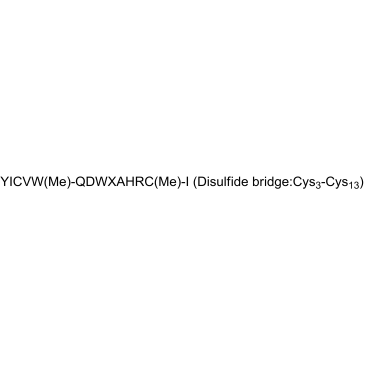
Cas No.: 1427001-89-5
Sample solution is provided at 25 µL, 10mM.
AMY-101 (Cp40) is the efficient inhibitor of the central complement component C3, with sub-nanomolar affinity for C3 (KD=0.5nmol/L)[1]. AMY-101 is involved in regulating the immune response, regulating the complement system and the release of inflammatory mediators[2]. AMY-101 has been used in immune response research, anti-inflammatory experiments and antiviral study[3].
In vitro, AMY-101 treatment (20μmol/L) for 72 hours significantly reduced the production of pro-inflammatory mediators in human THP-1 cells[4]. Treatment of SV40-immortalized porcine aortic endothelial cells with AMY-101 at 20μg/ml for 1 hour almost completely inhibited the deposition of C3 fragments and C5b-9 on the cells[5].
In vivo, AMY-101 treatment (4mg/kg; 28 days) via subcutaneous injection daily to adult cynomolgus monkeys can significantly reduce the clinical indices measured for periodontal inflammation and tissue destruction[1]. In sensitized male rhesus monkeys, intramuscular injection of AMY-101 (2mg/kg/day; I.M.) for 16 days can inhibit lymphocyte activation and proliferation, prevent antibody-mediated rejection reactions, and prolong the survival period of kidney transplantation[6].
References:
[1] Kajikawa T, Briones R A, Resuello R R G, et al. Safety and efficacy of the complement inhibitor AMY-101 in a natural model of periodontitis in non-human primates[J]. Molecular Therapy Methods & Clinical Development, 2017, 6: 207-215.
[2] Li J, Xu Z, Ayre W N, et al. AMY-101 as complement C3 inhibitor for periodontitis therapy: mechanisms, efficacy, and clinical translation[J]. Frontiers in Immunology, 2025, 16: 1587126.
[3] Mastaglio S, Ruggeri A, Risitano A M, et al. The first case of COVID-19 treated with the complement C3 inhibitor AMY-101[J]. Clinical immunology, 2020, 215: 108450.
[4] Fernandes D C, Silva-de-França F, Pohl P C, et al. Cp40-mediated complement C3 inhibition dampens inflammasome activation and inflammatory mediators storm induced by Bitis arietans venom[J]. International Immunopharmacology, 2025, 147: 113701.
[5] Wang J, Wang L, Xiang Y, et al. Using an in vitro xenoantibody-mediated complement-dependent cytotoxicity model to evaluate the complement inhibitory activity of the peptidic C3 inhibitor Cp40[J]. Clinical Immunology, 2016, 162: 37-44.
[6] Schmitz R, Fitch Z W, Schroder P M, et al. C3 complement inhibition prevents antibody-mediated rejection and prolongs renal allograft survival in sensitized non-human primates[J]. Nature Communications, 2021, 12(1): 5456.
| Cell experiment [1]: | |
Cell lines | THP-1 cells |
Preparation Method | THP-1 cells were seeded in 96-well plates at a density of 2.5 × 10⁴cells per well with 200μL of complete RPMI 1640 medium that contained 50nmol/L Phorbol 12-Myristate 13-Acetate (PMA). The cells remained in incubation for 48 hours with an atmosphere of 5% CO2 at 37°C. The medium containing PMA was exchanged with complete RPMI(200μL/well) and cells rested for another 24 hours before treatment. The medium was switched to complete RPMI with 1%FBS two hours before treatment. The cells received a treatment with LPS at concentrations of 0.01 or 0.10μg/mL or Bitis arietans venom(BVA) at 5.0, 6.25, 12.5, 25.0, or 50.0μg/mL concentrations and saline as a negative control. After incubating the cells at 24, 48, and 72 hours the supernatants were collected and stored at −80°C for subsequent examination. The experimental cells received treatments with BVA at 50μg/mL concentration, AMY-101 at 20μmol/L concentration, and saline solution for periods of 24, 48, 72h. The MTT assay determined cell viability while the inflammatory cytokine kit measured cytokine levels. |
Reaction Conditions | 20μmol/L; 24, 48, 72h |
Applications | AMY-101 significantly reduced the level of IL-1β for 72 hours and had an inhibitory effect on the activation of inflammasomes. |
| Animal experiment [2]: | |
Animal models | Adult cynomolgus monkeys |
Preparation Method | The research utilized adult cynomolgus monkeys which ranged from 7 to 10 years old and weighed between 5.0 and 7.6 kilograms. After four weeks of program adaptation scientists used socially-placed monkeys in stainless steel cages for experiments. Research animals gain environmental richness from daily care by technicians and environment-rich items combined with visual contact with other animals. The research animals received specific quantities of authorized feed mixture as part of their diet. The animals had unrestricted access to fresh drinking water. Deliver AMY-101 subcutaneously at a rate of 4mg/kg/day for 28 days through a 1mL insulin-safe syringe fitted with a 28G×1/2-inch needle. Conduct clinical examinations initially at week 0 and then at each of the subsequent study intervals of weeks 1 through 4 and at week 11. Samples were collected from both gingiva and bone tissue at the beginning of the study and again at 4 and 11 weeks. |
Dosage form | 4mg/kg /day for 28 days; s.c. |
Applications | AMY-101 treatment significantly reduced the inflammatory clinical parameters of naturally occurring chronic periodontitis in adult cynomolgus monkeys. |
References: | |
| Cas No. | 1427001-89-5 | SDF | |
| Überlieferungen | Cp40 | ||
| Formula | C83H117N23O18S2 | M.Wt | 1789.11 |
| Löslichkeit | 100mg/mL in Water | Storage | Store at -20°C, Protect from light |
| General tips | Please select the appropriate solvent to prepare the stock solution according to the
solubility of the product in different solvents; once the solution is prepared, please store it in
separate packages to avoid product failure caused by repeated freezing and thawing.Storage method
and period of the stock solution: When stored at -80°C, please use it within 6 months; when stored
at -20°C, please use it within 1 month. To increase solubility, heat the tube to 37°C and then oscillate in an ultrasonic bath for some time. |
||
| Shipping Condition | Evaluation sample solution: shipped with blue ice. All other sizes available: with RT, or with Blue Ice upon request. | ||
| Prepare stock solution | |||

|
1 mg | 5 mg | 10 mg |
| 1 mM | 558.9 μL | 2.7947 mL | 5.5894 mL |
| 5 mM | 111.8 μL | 558.9 μL | 1.1179 mL |
| 10 mM | 55.9 μL | 279.5 μL | 558.9 μL |
Step 1: Enter information below (Recommended: An additional animal making an allowance for loss during the experiment)
 g
μL
g
μL
Step 2: Enter the in vivo formulation (This is only the calculator, not formulation. Please contact us first if there is no in vivo formulation at the solubility Section.)
Calculation results:
Working concentration: mg/ml;
Method for preparing DMSO master liquid: mg drug pre-dissolved in μL DMSO ( Master liquid concentration mg/mL, Please contact us first if the concentration exceeds the DMSO solubility of the batch of drug. )
Method for preparing in vivo formulation: Take μL DMSO master liquid, next addμL PEG300, mix and clarify, next addμL Tween 80, mix and clarify, next add μL saline, mix and clarify.
Method for preparing in vivo formulation: Take μL DMSO master liquid, next add μL Corn oil, mix and clarify.
Note: 1. Please make sure the liquid is clear before adding the next solvent.
2. Be sure to add the solvent(s) in order. You must ensure that the solution obtained, in the previous addition, is a clear solution before proceeding to add the next solvent. Physical methods such as vortex, ultrasound or hot water bath can be used to aid dissolving.
3. All of the above co-solvents are available for purchase on the GlpBio website.
Quality Control & SDS
- View current batch:
- Purity: >98.00% Appearance: A solid
- COA (Certificate of Analysis)
- SDS (Safety Data Sheet)
- Datasheet
Average Rating: 5 (Based on Reviews and 5 reference(s) in Google Scholar.)