

BAPTA |
Katalog-Nr.GC17574
 One-Click Copy Product Info
|

BAPTA ist ein selektiver Chelatbildner fÜr Calcium.
Products are for research use only. Not for human use. We do not sell to patients.
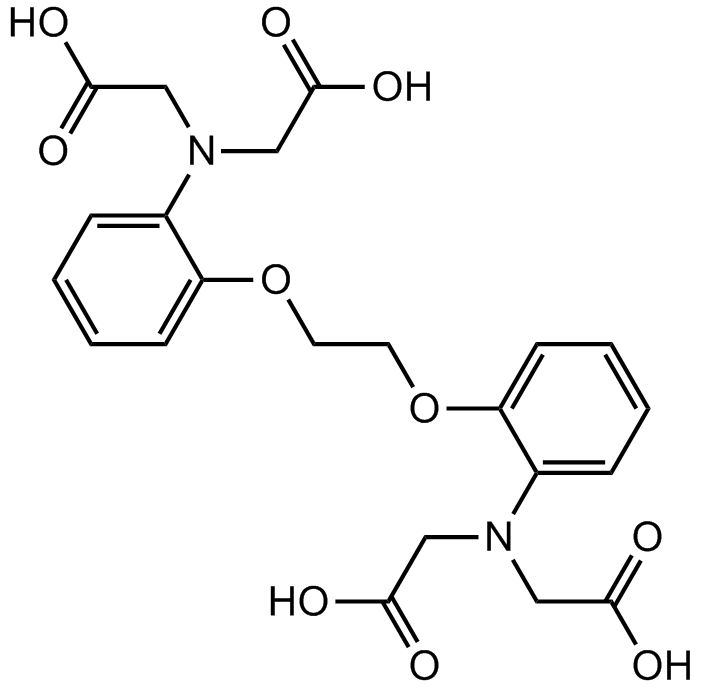
Cas No.: 85233-19-8
Sample solution is provided at 25 µL, 10mM.
BAPTA is a highly Ca2+-selective chelator used to dissect the roles of calcium in diverse cellular functions[1-2]. The affinity of BAPTA for Ca2+ can be strengthened or weakened by electron-donating or -withdrawing substituents on the aromatic rings, respectively. The Ca2+ binding to BAPTA is independent of pH within cells[3]. In addition, BAPTA can directly inhibited purified human 6-phosphofructo-2-kinase/fructose-2,6-bisphosphatase 3 (PFKFB3) activity[4].
In vitro, treatment of mechanically injured neurons with BAPTA at 10, 20, or 40μM resulted in a dose-dependent reduction in terminal deoxynucleotidyl transferase dUTP nick end labeling (TUNEL)-positive cells, with maximal protection observed at 40μM[5]. Treatment of HEK293T cells with increasing concentrations of BAPTA (0.1, 1, and 10mM) progressively elevated the open-channel probability of the endogenous calcium-activated chloride channel ANO6 (TMEM16F)[6]. BAPTA (0-10mM) inhibits phospholipase C (PLC) activity in a dose-dependent manner independently of Ca2+[7].
In vivo, following complete transection spinal cord injury, topical application of 10mM BAPTA to the lesion site in female BALB/c mice resulted in significantly higher body weight and Modified Basso Beattie Bresnahan (mBBB) scores than in vehicle-treated controls[4]. Iontophoresis of 150mM BAPTA into the endolymph of the bobtail skink in vivo caused a downward shift in the frequency of individual spontaneous otoacoustic emission (SOAE) peaks, with recovery requiring more than one hour[8].
References:
[1] Saoudi Y, Rousseau B, Doussière J, et al. Calcium-independent cytoskeleton disassembly induced by BAPTA. Eur J Biochem. 2004;271(15):3255-3264.
[2] Tsien RY. New calcium indicators and buffers with high selectivity against magnesium and protons: design, synthesis, and properties of prototype structures. Biochemistry. 1980;19(11):2396-2404.
[3] Sneyers F, Speelman-Rooms F, Verhelst SHL, Bootman MD, Bultynck G. Cellular effects of BAPTA: Are they only about Ca2+ chelation?. Biochim Biophys Acta Mol Cell Res. 2024;1871(2):119589.
[4] Sneyers F, Kerkhofs M, Speelman-Rooms F, et al. Intracellular BAPTA directly inhibits PFKFB3, thereby impeding mTORC1-driven Mcl-1 translation and killing MCL-1-addicted cancer cells. Cell Death Dis. 2023;14(9):600.
[5] Kang KR, Kim J, Ryu B, et al. BAPTA, a calcium chelator, neuroprotects injured neurons in vitro and promotes motor recovery after spinal cord transection in vivo. CNS Neurosci Ther. 2021;27(8):919-929.
[6] Kolesnikov DO, Nomerovskaya MA, Grigorieva ER, et al. Calcium chelation independent effects of BAPTA on endogenous ANO6 channels in HEK293T cells. Biochem Biophys Res Commun. 2024;693:149378.
[7] Hardie RC. Inhibition of phospholipase C activity in Drosophila photoreceptors by 1,2-bis(2-aminophenoxy)ethane N,N,N',N'-tetraacetic acid (BAPTA) and di-bromo BAPTA. Cell Calcium. 2005;38(6):547-556.
[8] Manley GA, Kirk DL. BAPTA induces frequency shifts in vivo of spontaneous otoacoustic emissions of the bobtail lizard. Audiol Neurootol. 2005;10(5):248-257.
| Kinase experiment [1]: | |
Preparation Method | Measured the kinase activity of the recombinant, purified human 6-phosphofructo-2-kinase/fructose-2,6-bisphosphatase 3 (PFKFB3) enzyme using a cell-free biochemical assay based on measuring the production of ADP in the presence of different concentrations of BAPTA (ranging from 1µM to 1mM). |
Reaction Conditions | 1µM-1mM |
Applications | BAPTA directly inhibited PFKFB3 activity. |
| Cell experiment [2]: | |
Cell lines | Neurons |
Preparation Method | For physically damaging neurons, 100mg of glass beads were mixed with differentiated neurons sunk with DPBS. The plates were gently rocked three times to let the beads roll over the cells. DPBS and the glass beads were removed by suction. Before the experiment, BAPTA was prepared by diluting in DMEM/F12 at final concentrations of 10μM, 20μM, and 40μM. Each of the prepared BAPTA (BAPTA group) or DPBS (vehicle control group) was gently treated on the cell. Then, the plate was incubated at 37°C for 30 minutes so that BAPTA could protect the damaged cells. During this process, the sham group was not damaged, and no specific substances were treated. Cells were detached by treatment with TrypLE and incubating the plate at 37°C for 5 minutes. Finally, the cells were collected in DMEM/F12. |
Reaction Conditions | 10, 20, and 40μM; 30min |
Applications | In the BAPTA-treated group, 5.3% of the cells had detached from the plate, versus 14.5% in the vehicle control group. Under SEM, neurons in the vehicle control group displayed apoptotic traits. The number of Terminal deoxynucleotidyl transferase dUTP nick end labeling (TUNEL)-positive cells was significantly decreased in a dose-dependent manner, and at 40μM, BAPTA was maximally effective. |
| Animal experiment [2]: | |
Animal models | BALB/c female mice |
Preparation Method | Six-week-old BALB/c female mice were anesthetized using Zoletil (1:1 composite of tiletamine and zolazepam) and xylazine (3:1 ratio, 1mL/kg). Spinal laminectomy was performed at the T9 level. For treatment, 20μL of 10mM BAPTA diluted in DPBS and DPBS were prepared. The BAPTA or DPBS was treated in drops on the full-transection spot with a pipette and was arranged into the BAPTA group and vehicle control group, respectively. The muscle and fascia were sutured, and the skin was closed. Following the surgery, additional water and crushed food were provided for the first 14 days after Spinal cord injury (SCI). Mice had their bladders expressed manually three times a day. Animals in a sham group were subjected to the same surgical procedures except that spinal cords were not injured. |
Dosage form | 20μL, 10mM; topical application |
Applications | The Modified Basso Beattie Bresnahan (mBBB) scores in the BAPTA group were significantly higher than the scores of the vehicle control from the 3rd day following SCI. The bodyweight of the BAPTA group was significantly higher than that of the vehicle control from the 23th day following SCI. |
References: | |
| Cas No. | 85233-19-8 | SDF | |
| Chemical Name | 2,2',2'',2'''-(((ethane-1,2-diylbis(oxy))bis(2,1-phenylene))bis(azanetriyl))tetraacetic acid | ||
| Canonical SMILES | OC(CN(CC(O)=O)C1=CC=CC=C1OCCOC2=CC=CC=C2N(CC(O)=O)CC(O)=O)=O | ||
| Formula | C22H24N2O10 | M.Wt | 476.23 |
| Löslichkeit | DMF: 20 mg/ml,DMSO: 20 mg/ml,DMSO:PBS (pH 7.2) (1:1): 0.5 mg/ml | Storage | Store at -20°C |
| General tips | Please select the appropriate solvent to prepare the stock solution according to the
solubility of the product in different solvents; once the solution is prepared, please store it in
separate packages to avoid product failure caused by repeated freezing and thawing.Storage method
and period of the stock solution: When stored at -80°C, please use it within 6 months; when stored
at -20°C, please use it within 1 month. To increase solubility, heat the tube to 37°C and then oscillate in an ultrasonic bath for some time. |
||
| Shipping Condition | Evaluation sample solution: shipped with blue ice. All other sizes available: with RT, or with Blue Ice upon request. | ||
| Prepare stock solution | |||

|
1 mg | 5 mg | 10 mg |
| 1 mM | 2.0998 mL | 10.4991 mL | 20.9983 mL |
| 5 mM | 420 μL | 2.0998 mL | 4.1997 mL |
| 10 mM | 210 μL | 1.0499 mL | 2.0998 mL |
Step 1: Enter information below (Recommended: An additional animal making an allowance for loss during the experiment)
 g
μL
g
μL
Step 2: Enter the in vivo formulation (This is only the calculator, not formulation. Please contact us first if there is no in vivo formulation at the solubility Section.)
Calculation results:
Working concentration: mg/ml;
Method for preparing DMSO master liquid: mg drug pre-dissolved in μL DMSO ( Master liquid concentration mg/mL, Please contact us first if the concentration exceeds the DMSO solubility of the batch of drug. )
Method for preparing in vivo formulation: Take μL DMSO master liquid, next addμL PEG300, mix and clarify, next addμL Tween 80, mix and clarify, next add μL saline, mix and clarify.
Method for preparing in vivo formulation: Take μL DMSO master liquid, next add μL Corn oil, mix and clarify.
Note: 1. Please make sure the liquid is clear before adding the next solvent.
2. Be sure to add the solvent(s) in order. You must ensure that the solution obtained, in the previous addition, is a clear solution before proceeding to add the next solvent. Physical methods such as vortex, ultrasound or hot water bath can be used to aid dissolving.
3. All of the above co-solvents are available for purchase on the GlpBio website.
Quality Control & SDS
- View current batch:
- Purity: >98.00% Appearance: A solid
- COA (Certificate of Analysis)
- SDS (Safety Data Sheet)
- Datasheet
Average Rating: 5 (Based on Reviews and 17 reference(s) in Google Scholar.)