

LEE011 (Synonyms: Ribociclib) |
Katalog-Nr.GC10842
 One-Click Copy Product Info
|

LEE011 (LEE01) ist ein hochspezifischer CDK4/6-Inhibitor mit IC50-Werten von 10 nM bzw. 39 nM und Über 1.000-mal weniger wirksam gegen den Cyclin B/CDK1-Komplex.
Products are for research use only. Not for human use. We do not sell to patients.
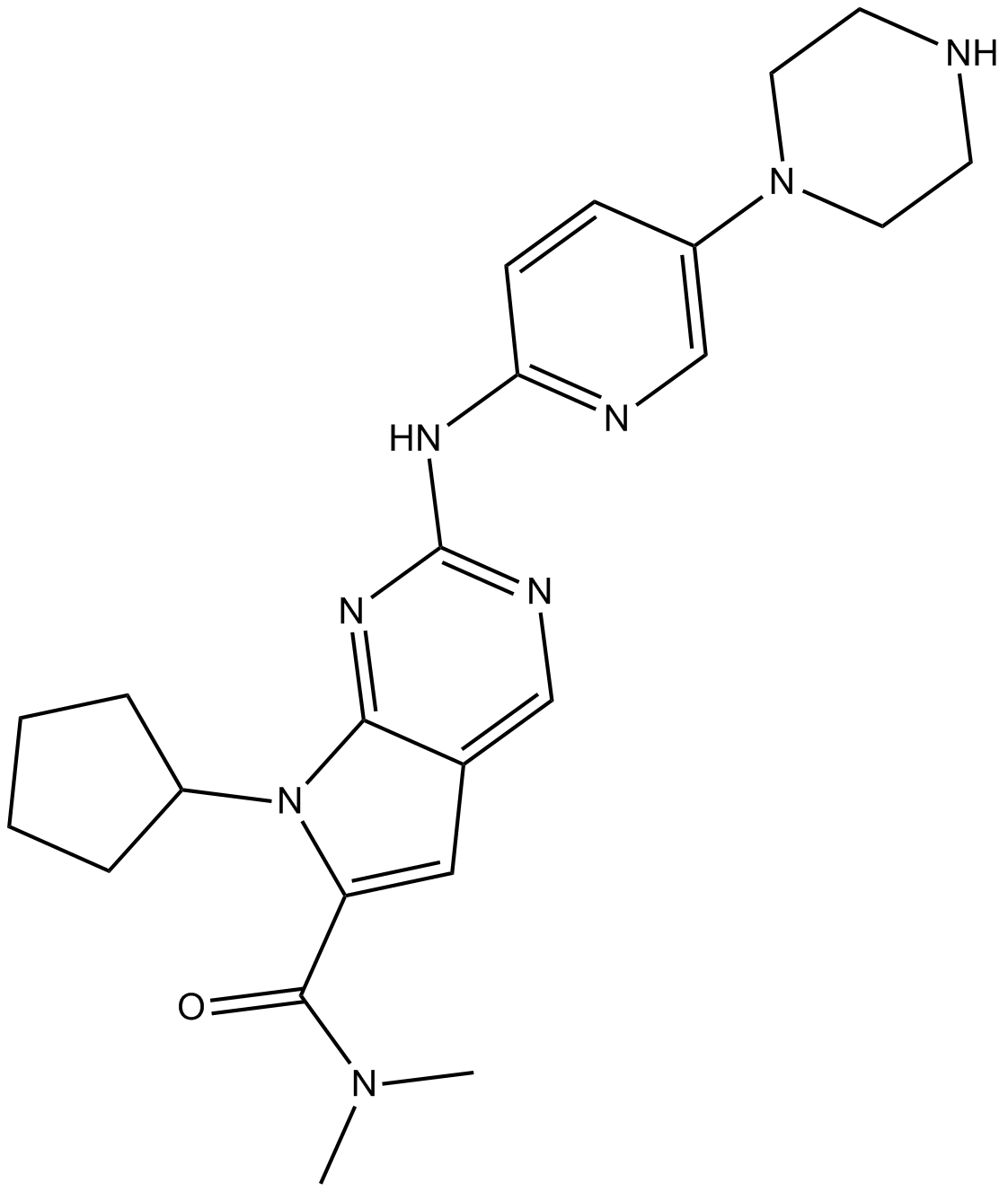
Cas No.: 1211441-98-3
Sample solution is provided at 25 µL, 10mM.
LEE011 is an ATP-competitive and orally active CDK4/6 inhibitor with IC50 values of 10nM and 39nM[1]. LEE011 inhibits the phosphorylation of retinoblastoma protein, thereby preventing CDK-mediated G1-S phase transition, causing cell cycle arrest in the G1 phase, inhibiting DNA synthesis, and suppressing cancer cell growth [2]. LEE011 is commonly used in targeted therapy research for hormone receptor-positive breast cancer and other solid tumors [3].
In three leukemia cell lines, MV4-11, HL-60, and NB4, LEE011(2-5μM;72-48h) significantly induced G1 phase cell cycle arrest in acute leukemia cells [4]. In neuroendocrine tumor cell lines (BON1, QGP1, NCI-H727, and GOT1), LEE011 (500nM; 72h) protects NET cells from DNA damage-induced apoptosis by blocking PARP cleavage and caspase-3/7 activity [5].
In the JeKo-1 xenograft model in nude mice, LEE011 (30-125mg/kg; po; 5d) induces robust inhibition of tumor growth in vivo, concomitant with on-target myelosuppression [6]. In the MOLT4 orthotopic mouse model, LEE011 (75mg/kg; po; 5d) showed a decrease in spleen weight after 5 days of treatment [7]. In patient-derived human liposarcoma xenograft models, oral administration of LEE011(250mg/kg; po; 21d) to mice bearing human liposarcoma xenografts resulted in an approximately 50% reduction in tumor uptake of 18F-fluorodeoxyglucose, accompanied by a decrease in tumor biomarkers (including RB phosphorylation and bromodeoxyuridine incorporation). Sustained treatment with LEE011 suppresses tumor growth or induces tumor regression while showing no adverse impact on body weight in mice. Following prolonged continuous administration, restoration of RB phosphorylation and cell cycle progression was observed [8].
References:
[1]. VanArsdale T, Boshoff C, Arndt K T, et al. Molecular pathways: targeting the cyclin D–CDK4/6 axis for cancer treatment[J]. Clinical cancer research, 2015, 21(13): 2905-2910.
[2]. Dickson M A. Molecular pathways: CDK4 inhibitors for cancer therapy[J]. Clinical cancer research, 2014, 20(13): 3379-3383.
[3]. Juric D, Munster P N, Campone M, et al. Ribociclib (LEE011) and letrozole in estrogen receptor-positive (ER+), HER2-negative (HER2–) advanced breast cancer (aBC): Phase Ib safety, preliminary efficacy and molecular analysis[J]. 2016.
[4].Tao Y F, Wang N N, Xu L X, et al. Molecular mechanism of G1 arrest and cellular senescence induced by LEE011, a novel CDK4/CDK6 inhibitor, in leukemia cells[J]. Cancer cell international, 2017, 17(1): 35.
[5]. Aristizabal Prada E T, Nölting S, Spoettl G, et al. The novel cyclin-dependent kinase 4/6 inhibitor ribociclib (LEE011) alone and in dual-targeting approaches demonstrates antitumoral efficacy in neuroendocrine tumors in vitro[J]. Neuroendocrinology, 2017, 106(1): 58-73.
[6]. Kim S, Tiedt R, Loo A, et al. The potent and selective cyclin-dependent kinases 4 and 6 inhibitor ribociclib (LEE011) is a versatile combination partner in preclinical cancer models[J]. Oncotarget, 2018, 9(81): 35226.
[7]. Pikman Y, Alexe G, Roti G, et al. Synergistic drug combinations with a CDK4/6 inhibitor in T-cell acute lymphoblastic leukemia[J]. Clinical Cancer Research, 2017, 23(4): 1012-1024.
[8]. Zhang Y X, Sicinska E, Czaplinski J T, et al. Antiproliferative effects of CDK4/6 inhibition in CDK4-amplified human liposarcoma in vitro and in vivo[J]. Molecular cancer therapeutics, 2014, 13(9): 2184-2193.
| Cell experiment [1]: | |
|
Cell lines |
liposarcoma cells |
|
Preparation Method |
Cells were collected after exposure to LEE011 or 0.1% DMSO for 24 hours. After washing with ice-cold PBS, the cells were fixed in 70% ethanol at 4°C for at least 2 hours. The fixed cells were then stained in the dark with a PBS solution containing 10μg/mL RNase A and 20μg/mL propidium iodide. |
|
Reaction Conditions |
0-3.33μM; 24h |
|
Applications |
LEE011 reduced RB phosphorylation at Ser780 and Ser807/811 in both a concentration- and time-dependent manner with complete inhibition at 3.33μM. |
| Animal experiment [1]: | |
|
Animal models |
Patient-derived human liposarcoma xenograft models |
|
Preparation Method |
Established LP6 cell line xenograft tumors in mice were randomly divided into statistically equivalent groups, and each group was orally administered 250mg/kg LEE011 or a vehicle control daily for 21 days. Tumor size was measured every 3 to 6 days using a caliper. Mouse body weight was recorded every 3 to 7 days. |
|
Dosage form |
250mg/kg; po; 21d |
|
Applications |
Oral administration of LEE011 to mice bearing human liposarcoma xenografts resulted in an approximately 50% reduction in tumor uptake of 18F-fluorodeoxyglucose, accompanied by a decrease in tumor biomarkers (including RB phosphorylation and bromodeoxyuridine incorporation). Continuous treatment inhibited tumor growth or induced tumor regression without adversely affecting the mice's body weight. After prolonged continuous administration, a restoration of normal RB phosphorylation and cell cycle progression was observed. |
|
References: |
|
| Cas No. | 1211441-98-3 | SDF | |
| Überlieferungen | Ribociclib | ||
| Chemical Name | 7-cyclopentyl-N,N-dimethyl-2-[(5-piperazin-1-ylpyridin-2-yl)amino]pyrrolo[2,3-d]pyrimidine-6-carboxamide | ||
| Canonical SMILES | CN(C)C(=O)C1=CC2=CN=C(N=C2N1C3CCCC3)NC4=NC=C(C=C4)N5CCNCC5 | ||
| Formula | C23H30N8O | M.Wt | 434.54 |
| Löslichkeit | ≥ 10.88mg/mL in DMSO | Storage | Store at -20°C |
| General tips | Please select the appropriate solvent to prepare the stock solution according to the
solubility of the product in different solvents; once the solution is prepared, please store it in
separate packages to avoid product failure caused by repeated freezing and thawing.Storage method
and period of the stock solution: When stored at -80°C, please use it within 6 months; when stored
at -20°C, please use it within 1 month. To increase solubility, heat the tube to 37°C and then oscillate in an ultrasonic bath for some time. |
||
| Shipping Condition | Evaluation sample solution: shipped with blue ice. All other sizes available: with RT, or with Blue Ice upon request. | ||
| Prepare stock solution | |||

|
1 mg | 5 mg | 10 mg |
| 1 mM | 2.3013 mL | 11.5064 mL | 23.0128 mL |
| 5 mM | 460.3 μL | 2.3013 mL | 4.6026 mL |
| 10 mM | 230.1 μL | 1.1506 mL | 2.3013 mL |
Step 1: Enter information below (Recommended: An additional animal making an allowance for loss during the experiment)
 g
μL
g
μL
Step 2: Enter the in vivo formulation (This is only the calculator, not formulation. Please contact us first if there is no in vivo formulation at the solubility Section.)
Calculation results:
Working concentration: mg/ml;
Method for preparing DMSO master liquid: mg drug pre-dissolved in μL DMSO ( Master liquid concentration mg/mL, Please contact us first if the concentration exceeds the DMSO solubility of the batch of drug. )
Method for preparing in vivo formulation: Take μL DMSO master liquid, next addμL PEG300, mix and clarify, next addμL Tween 80, mix and clarify, next add μL saline, mix and clarify.
Method for preparing in vivo formulation: Take μL DMSO master liquid, next add μL Corn oil, mix and clarify.
Note: 1. Please make sure the liquid is clear before adding the next solvent.
2. Be sure to add the solvent(s) in order. You must ensure that the solution obtained, in the previous addition, is a clear solution before proceeding to add the next solvent. Physical methods such as vortex, ultrasound or hot water bath can be used to aid dissolving.
3. All of the above co-solvents are available for purchase on the GlpBio website.
Quality Control & SDS
- View current batch:
- Purity: >99.50% Appearance: A solid
- COA (Certificate of Analysis)
- SDS (Safety Data Sheet)
- Datasheet
Average Rating: 5 (Based on Reviews and 15 reference(s) in Google Scholar.)