

Edoxudine (EUDR) |
Catalog No.GC32148
 One-Click Copy Product Info
|

Edoxudine (EUDR) is a deoxy-thymidine analog shown to be effective against herpes simplex virus type 1 and type 2.
Products are for research use only. Not for human use. We do not sell to patients.
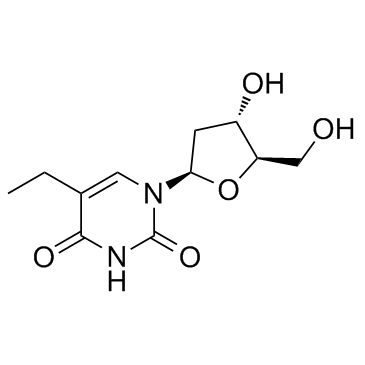
Cas No.: 15176-29-1
Sample solution is provided at 25 µL, 10mM.
_1-3.$$$39978408@51.jpg');)
_1-9.$$$38538795@65.jpg');)
_1-9.$$$39112701@51.jpg');)
_1-7.$$$37316672@70.jpg');)
_366-372.$$$36198801@70.jpg');)
.$$$38565142@65.jpg');)
_1867-1883.$$$33248023@67.jpg');)
_eads6055.$$$39977546@45.jpg');)
_eadm9805.$$$40080571@45.jpg');)
_eadj3020.$$$39666821@45.jpg');)
_1-20.$$$39757301@28.jpg');)
_1-24.$$$38898113@28.jpg');)
_273-287.$$$36806353@46.jpg');)
_1-16.$$$37156877@44.jpg');)
_1-19.$$$37460805@44.jpg');)
_1291-1307.$$$34518654@46.jpg');)
Edoxudine (EUDR) is a deoxy-thymidine analog shown to be effective against herpes simplex virus type 1 and type 2 [1]. Edoxudine has been shown in vertebrate systems to be phosphorylated preferentially by the thymidine kinase and incorporated into viral DNA, and inhibiting viral DNA synthesis[2]. Edoxudine disrupts the outer wall of Klebsiella pneumoniae and damages the protective effect of the LPS layer, making the cell membrane of Klebsiella pneumoniae accessible to antibacterial effectors[3]. Edoxudine has been widely used as a lead compound for the development of drugs targeting the surface protein of monkeypox virus E8 [4].
In vitro, Edoxudine treatment for 72 hours significantly inhibited the proliferation of human foreskin fibroblasts (HFFs), with an IC50 value of 115µM[5].
References:
[1] Sharma A, Tiwari V, Sowdhamini R. Computational search for potential COVID-19 drugs from FDA-approved drugs and small molecules of natural origin identifies several anti-virals and plant products[J]. Journal of biosciences, 2020, 45(1): 100.
[2] Mazzacano C A, Fallon A M. Evaluation of a viral thymidine kinase gene for suicide selection in transfected mosquito cells[J]. Insect molecular biology, 1995, 4(2): 125-134.
[3] Ifrid E, Ouertatani-Sakouhi H, Jauslin T, et al. 5-ethyl-2’-deoxyuridine fragilizes Klebsiella pneumoniae outer wall and facilitates intracellular killing by phagocytic cells[J]. Plos one, 2022, 17(10): e0269093.
[4] Podduturi S, Vemula D, Singothu S, et al. In-silico investigation of E8 surface protein of the monkeypox virus to identify potential therapeutic agents[J]. Journal of Biomolecular Structure and Dynamics, 2024, 42(16): 8242-8255.
[5] Kumar R, Wiebe L I, Knaus E E. Synthesis and antiviral activity of novel 5-(1-azido-2-haloethyl) and 5-(1-azido-, amino-, or methoxyethyl) analogs of 2'-deoxyuridine[J]. Journal of medicinal chemistry, 1993, 36(17): 2470-2474.
| Cell experiment [1]: | |
Cell lines | Human foreskin fibroblast (HFF) |
Preparation Method | 24h prior to assay, human foreskin fibroblasts (HFFs) were seeded in 6-well plates at a concentration of 2.5×10⁴ cells per well in MEM containing 10% FBS. The media from the wells was then aspirated with different concentrations of Edoxudine (1, 10, 100, and 1000µM). The cells were incubated in a CO2 incubator at 37°C for 72h. The media-drug solution was removed, and the cells were washed. 1ml of 0.25% trypsin was added to each well and incubated until the cells started to come off of the plate. The cell-media mixture was then pipetted up and down vigorously to break up the cell suspension, followed by cell counting. |
Reaction Conditions | 1, 10, 100, and 1000µM; 72h |
Applications | Edoxudine treatment decreased the cell viability of HFFs in a dose-dependent manner. |
References: | |
| Cas No. | 15176-29-1 | SDF | |
| Canonical SMILES | OC[C@@H]1[C@H](C[C@H](N2C(NC(C(CC)=C2)=O)=O)O1)O | ||
| Formula | C11H16N2O5 | M.Wt | 256.26 |
| Solubility | DMSO : ≥ 125 mg/mL (487.79 mM) | Storage | Store at -20°C |
| General tips | Please select the appropriate solvent to prepare the stock solution according to the
solubility of the product in different solvents; once the solution is prepared, please store it in
separate packages to avoid product failure caused by repeated freezing and thawing.Storage method
and period of the stock solution: When stored at -80°C, please use it within 6 months; when stored
at -20°C, please use it within 1 month. To increase solubility, heat the tube to 37°C and then oscillate in an ultrasonic bath for some time. |
||
| Shipping Condition | Evaluation sample solution: shipped with blue ice. All other sizes available: with RT, or with Blue Ice upon request. | ||
| Prepare stock solution | |||

|
1 mg | 5 mg | 10 mg |
| 1 mM | 3.9023 mL | 19.5114 mL | 39.0229 mL |
| 5 mM | 780.5 μL | 3.9023 mL | 7.8046 mL |
| 10 mM | 390.2 μL | 1.9511 mL | 3.9023 mL |
Step 1: Enter information below (Recommended: An additional animal making an allowance for loss during the experiment)
 g
μL
g
μL
Step 2: Enter the in vivo formulation (This is only the calculator, not formulation. Please contact us first if there is no in vivo formulation at the solubility Section.)
Calculation results:
Working concentration: mg/ml;
Method for preparing DMSO master liquid: mg drug pre-dissolved in μL DMSO ( Master liquid concentration mg/mL, Please contact us first if the concentration exceeds the DMSO solubility of the batch of drug. )
Method for preparing in vivo formulation: Take μL DMSO master liquid, next addμL PEG300, mix and clarify, next addμL Tween 80, mix and clarify, next add μL saline, mix and clarify.
Method for preparing in vivo formulation: Take μL DMSO master liquid, next add μL Corn oil, mix and clarify.
Note: 1. Please make sure the liquid is clear before adding the next solvent.
2. Be sure to add the solvent(s) in order. You must ensure that the solution obtained, in the previous addition, is a clear solution before proceeding to add the next solvent. Physical methods such as vortex, ultrasound or hot water bath can be used to aid dissolving.
3. All of the above co-solvents are available for purchase on the GlpBio website.
Quality Control & SDS
- View current batch:
- Purity: >99.00% Appearance: A solid
- COA (Certificate of Analysis)
- SDS (Safety Data Sheet)
- Datasheet
Average Rating: 5 (Based on Reviews and 26 reference(s) in Google Scholar.)