

Embelin (Synonyms: Embelic acid; Emberine; NSC 91874) |
Catalog No.GC13163
 One-Click Copy Product Info
|

Embelin is a non-peptidic, cell-permeable small inhibitor of the X-linked inhibitor of apoptosis protein (XIAP) with an IC₅₀ value of 4.1µM.
Products are for research use only. Not for human use. We do not sell to patients.
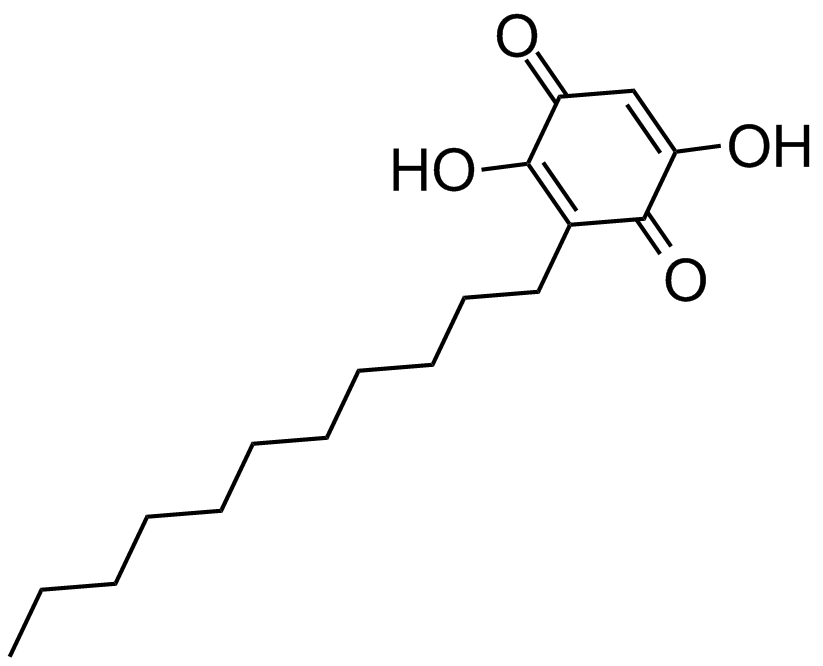
Cas No.: 550-24-3
Sample solution is provided at 25 µL, 10mM.
Embelin is a non-peptidic, cell-permeable small inhibitor of the X-linked inhibitor of apoptosis protein (XIAP) with an IC₅₀ value of 4.1µM[1].
In vitro, Embelin (6.25 or 12.5µM; 24h) reversed ethanol-induced inflammatory response in AML-12 cells[2]. Embelin (20µM; 2h) protects against apoptosis and inflammation by regulating PI3K/Akt signaling in IL-1β-stimulated human nucleus pulposus cells[3].
In vivo, Embelin (50 or 100mg/kg; 10 days; i.g.) ameliorates alcoholic steatohepatitis (ASH) by modulating the ATF6-P2×7r/NLRP3 signaling pathway in mice with alcoholic liver disease (ALD)[2]. Embelin (50μg/g; i.g.) can protect mice from thioacetamide-induced acute liver injury[4].
References:
[1] Sheng Z, Ge S, Gao M, et al. Synthesis and Biological Activity of Embelin and its Derivatives: An Overview. Mini Rev Med Chem. 2020;20(5):396-407.
[2] Zhang JJ, Zhong JT, Wang WL, et al. Embelin improves alcoholic steatohepatitis in alcohol-associated liver disease via ATF6-mediated P2X7r-NLRP3 signaling pathway. Phytomedicine. 2025 May;140:156638.
[3] Bai X, Wang J, Ding S, et al. Embelin protects against apoptosis and inflammation by regulating PI3K/Akt signaling in IL-1β-stimulated human nucleus pulposus cells. Tissue Cell. 2023 Jun;82:102089.
[4] Wang H, Zhang H, Wang Y, et al. Embelin can protect mice from thioacetamide-induced acute liver injury. Biomed Pharmacother. 2019 Oct;118:109360.
| Cell experiment [1]: | |
Cell lines | AML-12 cells |
Preparation Method | AML-12 cells were cultivated for 24h with Embelin (6.25, 12.5µM) for 24h, and then exposure to EtOH (50mM) for 24h. The IL-1β and IL-18 protein levels released from AML-12 cells into culture medium were determined by an ELISA assay. |
Reaction Conditions | 6.25 or 12.5µM; 24h |
Applications | Embelin reversed ethanol-induced inflammatory response in AML-12 cells. |
| Animal experiment [2]: | |
Animal models | C57BL/6 female mice |
Preparation Method | Acute liver injury was induced by a single intraperitoneal injection of 4% thioacetamide (TAA, 300µg/g). Embelin was administered via intragastric gavage at 50µg/g starting 2 days before TAA administration and continued throughout the study. The survival of TAA-treated mice was observed 4 days later, and the surviving mice were sacrificed. The acute liver injury protocol was repeated again 1, 2, and 3 days later, and the remaining mice were sacrificed at each time point. To estimate the pathophysiological values, the livers of the sacrificed mice were removed. |
Dosage form | 50µg/g; i.g. |
Applications | Embelin can protect mice from thioacetamide-induced acute liver injury. |
References: | |
| Cas No. | 550-24-3 | SDF | |
| Synonyms | Embelic acid; Emberine; NSC 91874 | ||
| Chemical Name | 2,5-dihydroxy-3-undecylcyclohexa-2,5-diene-1,4-dione | ||
| Canonical SMILES | CCCCCCCCCCCC1=C(C(=O)C=C(C1=O)O)O | ||
| Formula | C17H26O4 | M.Wt | 294.39 |
| Solubility | ≥ 9.6mg/mL in DMSO, ≥ 4.23 mg/mL in EtOH with ultrasonic | Storage | 4°C, protect from light |
| General tips | Please select the appropriate solvent to prepare the stock solution according to the
solubility of the product in different solvents; once the solution is prepared, please store it in
separate packages to avoid product failure caused by repeated freezing and thawing.Storage method
and period of the stock solution: When stored at -80°C, please use it within 6 months; when stored
at -20°C, please use it within 1 month. To increase solubility, heat the tube to 37°C and then oscillate in an ultrasonic bath for some time. |
||
| Shipping Condition | Evaluation sample solution: shipped with blue ice. All other sizes available: with RT, or with Blue Ice upon request. | ||
| Prepare stock solution | |||

|
1 mg | 5 mg | 10 mg |
| 1 mM | 3.3969 mL | 16.9843 mL | 33.9685 mL |
| 5 mM | 679.4 μL | 3.3969 mL | 6.7937 mL |
| 10 mM | 339.7 μL | 1.6984 mL | 3.3969 mL |
Step 1: Enter information below (Recommended: An additional animal making an allowance for loss during the experiment)
 g
μL
g
μL
Step 2: Enter the in vivo formulation (This is only the calculator, not formulation. Please contact us first if there is no in vivo formulation at the solubility Section.)
Calculation results:
Working concentration: mg/ml;
Method for preparing DMSO master liquid: mg drug pre-dissolved in μL DMSO ( Master liquid concentration mg/mL, Please contact us first if the concentration exceeds the DMSO solubility of the batch of drug. )
Method for preparing in vivo formulation: Take μL DMSO master liquid, next addμL PEG300, mix and clarify, next addμL Tween 80, mix and clarify, next add μL saline, mix and clarify.
Method for preparing in vivo formulation: Take μL DMSO master liquid, next add μL Corn oil, mix and clarify.
Note: 1. Please make sure the liquid is clear before adding the next solvent.
2. Be sure to add the solvent(s) in order. You must ensure that the solution obtained, in the previous addition, is a clear solution before proceeding to add the next solvent. Physical methods such as vortex, ultrasound or hot water bath can be used to aid dissolving.
3. All of the above co-solvents are available for purchase on the GlpBio website.
Quality Control & SDS
- View current batch:
- Purity: >98.50% Appearance: A solid
- COA (Certificate of Analysis)
- SDS (Safety Data Sheet)
- Datasheet
Average Rating: 5 (Based on Reviews and 30 reference(s) in Google Scholar.)