

Etazolate hydrochloride |
Catalog No.GC12771
 One-Click Copy Product Info
|

PDE-4 inhibitor and selective GABA-A receptor modulator
Products are for research use only. Not for human use. We do not sell to patients.
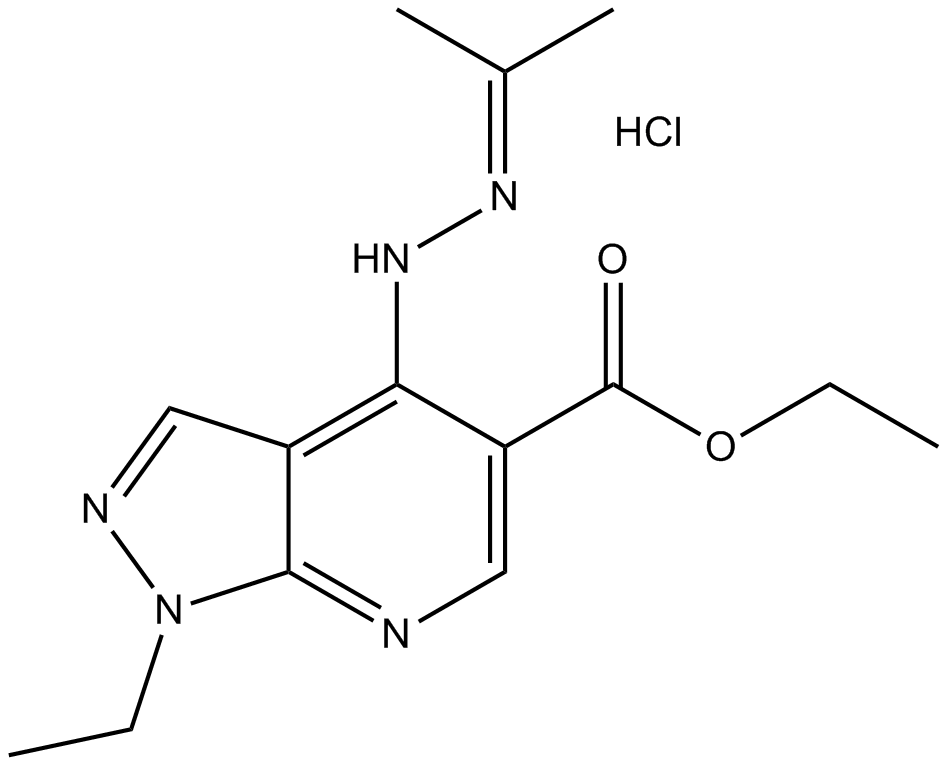
Cas No.: 35838-58-5
Sample solution is provided at 25 µL, 10mM.
_1-3.$$$39978408@51.jpg');)
_1-9.$$$38538795@65.jpg');)
_1-9.$$$39112701@51.jpg');)
_1-7.$$$37316672@70.jpg');)
_366-372.$$$36198801@70.jpg');)
.$$$38565142@65.jpg');)
_1867-1883.$$$33248023@67.jpg');)
_eads6055.$$$39977546@45.jpg');)
_eadm9805.$$$40080571@45.jpg');)
_eadj3020.$$$39666821@45.jpg');)
_1-20.$$$39757301@28.jpg');)
_1-24.$$$38898113@28.jpg');)
_273-287.$$$36806353@46.jpg');)
_1-16.$$$37156877@44.jpg');)
_1-19.$$$37460805@44.jpg');)
_1291-1307.$$$34518654@46.jpg');)
Etazolate hydrochloride is a PDE-4 inhibitor and selective GABA-A receptor modulator [3].
PDE-4 modulates the release of inflammatory mediators through cAMP-dependent and -independent mechanisms. Selective targeting PDE-4 is a novel therapeutic approach in the treatment of inflammation-associated respiratory diseases, such as asthma and COPD (chronic obstructive pulmonary disease) [1].
In rat neuronal cortical cells, etazolate hydrochloride (0.2 μM) induced sAPPα through the stimulation of the α-secretase pathway, and exerted a neuroprotective effect against Aβ which was associated with sAPPα induction via the GABA-A receptor [2].
In 159 Alzheimer’s Disease patients, etazolate hydrochloride in combination with one AchEI (acetycholinesterase inhibitor) was shown to be safe and generally well tolerated in the Phase IIA study over a 3-month treatment period [3].
References:
[1] Dastidar S G, Rajagopal D, Ray A. Therapeutic benefit of PDE4 inhibitors in inflammatory diseases.[J]. Current Opinion in Investigational Drugs, 2007, 8(5):364-72.
[2] Marcade M, Bourdin J, Loiseau N, et al. Etazolate, a neuroprotective drug linking GABA(A) receptor pharmacology to amyloid precursor protein processing.[J]. Journal of Neurochemistry, 2008, 106(1):392-404.
[3] Vellas B; Sol O; Snyder PJ; Ousset PJ; Haddad R; Maurin M; Lemarié JC; Désiré L; Pando MP; EHT0202/002 study group. EHT0202 in Alzheimer's disease: a 3-month, randomized, placebo-controlled, double-blind study.[J]. Current Alzheimer Research, 2011, 8(2):203-12.
| Cell experiment [1]: | |
|
Cell lines |
Neuronal cortical cells from Wistar rat embryos |
|
Preparation method |
The solubility of this compound in sterile water is 50 mM. General tips for obtaining a higher concentration: Please warm the tube at 37℃ for 10 minutes and/or shake it in the ultrasonic bath for a while. Stock solution can be stored below -20℃ for several months. |
|
Reacting condition |
48 h, 0~2 µM |
|
Applications |
In cortical neurons, 0~2 µM etazolate hydrochloride dose-dependently increased secreted levels of non-amyloidogenic sAPPα. etazolate hydrochloride (0.2 µM) prevented the neurotoxicity of Aβ on cortical neurons via the GABA-A receptor, which was associated with α-secretase activity and sAPPα induction. Etazolate hydrochloride induced sAPPα through the stimulation of the α-secretase pathway, and didn’t affect the amyloidogenic pathway. |
| Clinical experiment [2]: | |
|
Clinical models |
Alzheimer’s disease patients |
|
Dosage form |
40 and 80 mg bid for 3 month, oral administration |
|
Application |
Etazolate hydrochloride in combination with one AChEI ( acetycholinesterase inhibitor) was shown to be safe and generally well tolerated in this Phase IIA study in 159 Alzheimer’s Disease patients over a 3-month treatment period. Most of psychiatric and neurologic AEs (Adverse events) were observed in the high-dose (etazolate 80 mg bid) group, suggesting a potential dose-related effect. Gastrointestinal and cardiovascular related AEs were no more frequent in the etazolate groups compared to placebo, indicating the absence of a potential clinical adverse interaction between the AChEI and etazolate hydrochloride. |
|
Other notes |
Please test the solubility of all compounds indoor, and the actual solubility may slightly differ with the theoretical value. This is caused by an experimental system error and it is normal. |
|
References: [1] Marcade M, Bourdin J, Loiseau N, et al. Etazolate, a neuroprotective drug linking GABA(A) receptor pharmacology to amyloid precursor protein processing.[J]. Journal of Neurochemistry, 2008, 106(1):392-404. [2] Vellas B; Sol O; Snyder PJ; Ousset PJ; Haddad R; Maurin M; Lemarié JC; Désiré L; Pando MP; EHT0202/002 study group. EHT0202 in Alzheimer's disease: a 3-month, randomized, placebo-controlled, double-blind study.[J]. Current Alzheimer Research, 2011, 8(2):203-12. | |
| Cas No. | 35838-58-5 | SDF | |
| Chemical Name | ethyl 1-ethyl-4-(2-(propan-2-ylidene)hydrazinyl)-1H-pyrazolo[3,4-b]pyridine-5-carboxylate hydrochloride | ||
| Canonical SMILES | O=C(C1=CN=C2N(CC)N=CC2=C1N/N=C(C)\C)OCC.Cl | ||
| Formula | C14H19N5O2.HCl | M.Wt | 325.8 |
| Solubility | ≥ 3.9mg/mL in Water | Storage | Store at RT |
| General tips | Please select the appropriate solvent to prepare the stock solution according to the
solubility of the product in different solvents; once the solution is prepared, please store it in
separate packages to avoid product failure caused by repeated freezing and thawing.Storage method
and period of the stock solution: When stored at -80°C, please use it within 6 months; when stored
at -20°C, please use it within 1 month. To increase solubility, heat the tube to 37°C and then oscillate in an ultrasonic bath for some time. |
||
| Shipping Condition | Evaluation sample solution: shipped with blue ice. All other sizes available: with RT, or with Blue Ice upon request. | ||
| Prepare stock solution | |||

|
1 mg | 5 mg | 10 mg |
| 1 mM | 3.0694 mL | 15.3468 mL | 30.6937 mL |
| 5 mM | 613.9 μL | 3.0694 mL | 6.1387 mL |
| 10 mM | 306.9 μL | 1.5347 mL | 3.0694 mL |
Step 1: Enter information below (Recommended: An additional animal making an allowance for loss during the experiment)
 g
μL
g
μL
Step 2: Enter the in vivo formulation (This is only the calculator, not formulation. Please contact us first if there is no in vivo formulation at the solubility Section.)
Calculation results:
Working concentration: mg/ml;
Method for preparing DMSO master liquid: mg drug pre-dissolved in μL DMSO ( Master liquid concentration mg/mL, Please contact us first if the concentration exceeds the DMSO solubility of the batch of drug. )
Method for preparing in vivo formulation: Take μL DMSO master liquid, next addμL PEG300, mix and clarify, next addμL Tween 80, mix and clarify, next add μL saline, mix and clarify.
Method for preparing in vivo formulation: Take μL DMSO master liquid, next add μL Corn oil, mix and clarify.
Note: 1. Please make sure the liquid is clear before adding the next solvent.
2. Be sure to add the solvent(s) in order. You must ensure that the solution obtained, in the previous addition, is a clear solution before proceeding to add the next solvent. Physical methods such as vortex, ultrasound or hot water bath can be used to aid dissolving.
3. All of the above co-solvents are available for purchase on the GlpBio website.
Quality Control & SDS
- View current batch:
- Purity: >98.00% Appearance: A solid
- COA (Certificate of Analysis)
- SDS (Safety Data Sheet)
- Datasheet
Average Rating: 5 (Based on Reviews and 12 reference(s) in Google Scholar.)