

Fluensulfone |
Catalog No.GC10705
 One-Click Copy Product Info
|

Fluensulfone is a new nematicide for chemical control of plant parasitic nematodes.
Products are for research use only. Not for human use. We do not sell to patients.
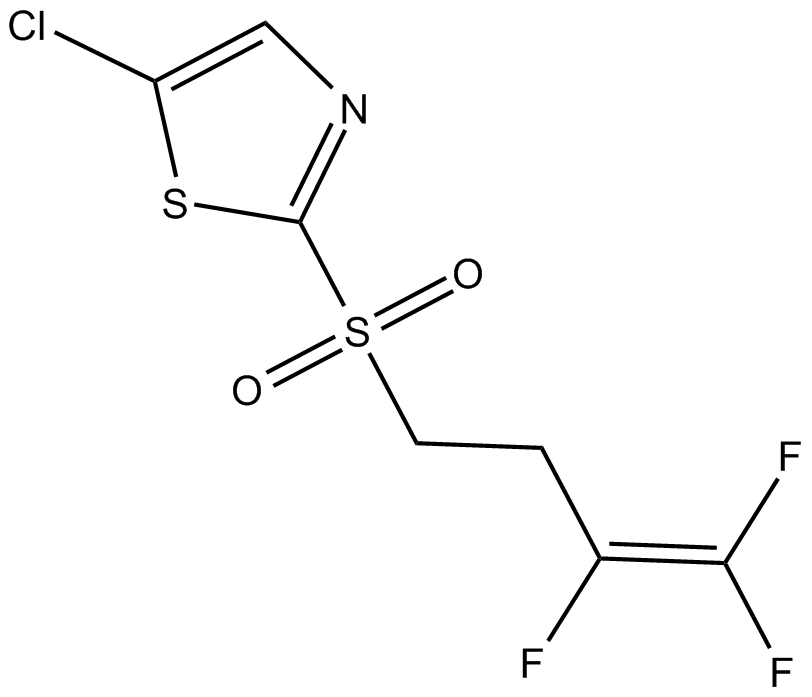
Cas No.: 318290-98-1
Sample solution is provided at 25 µL, 10mM.
_1-3.$$$39978408@51.jpg');)
_1-9.$$$38538795@65.jpg');)
_1-9.$$$39112701@51.jpg');)
_1-7.$$$37316672@70.jpg');)
_366-372.$$$36198801@70.jpg');)
.$$$38565142@65.jpg');)
_1867-1883.$$$33248023@67.jpg');)
_eads6055.$$$39977546@45.jpg');)
_eadm9805.$$$40080571@45.jpg');)
_eadj3020.$$$39666821@45.jpg');)
_1-20.$$$39757301@28.jpg');)
_1-24.$$$38898113@28.jpg');)
_273-287.$$$36806353@46.jpg');)
_1-16.$$$37156877@44.jpg');)
_1-19.$$$37460805@44.jpg');)
_1291-1307.$$$34518654@46.jpg');)
Fluensulfone is identified as a new nematicide for chemical control of plant parasitic nematodes.
Plant parasitic nematodes can infest crops and present a threat to food security. Currently available chemical controls such as methyl bromide, organophosphates as well as carbamates have an unacceptable toxicity level to non-target organisms and are being withdrawn.
In vitro: Previous study showed that the model genetic organism Caenorhabditis elegans was susceptible to the treatment of fluensulfone. While the required dose was higher than that which had nematicidal activity against Meloidogyne spp. In addition, the profile of effects on motility, egg-hatching and survival was similar to that reported for plant parasitic nematodes.C. elegans therefore provided a tractable paradigm to analyze the effects of fluensulfone on nematode behaviour. Moreover, it was also found that fluensulfone had pleiotropic actions and inhibited development, egg-laying, egg-hatching, feeding and locomotion [1].
In vivo: In mice, but not in rats, fluensulfone at high doses has shown an increased incidence of lung adenomas. Moreover, fluensulfone was not genotoxic. In addition, the administration of fluensulfone to mice resulted in an early increase in Clara cell proliferation [2].
Clinical trial: Up to now, fluensulfone is still in the preclinical development stage.
References:
[1] Kearn J,Ludlow E,Dillon J,O'Connor V,Holden-Dye L. Fluensulfone is a nematicide with a mode of action distinct from anticholinesterases and macrocyclic lactones. Pestic Biochem Physiol.2014 Feb;109:44-57.
[2] Strupp C,Banas DA,Cohen SM,Gordon EB,Jaeger M,Weber K. Relationship of metabolism and cell proliferation to the mode of action of fluensulfone-induced mouse lung tumors: analysis of their human relevance using the IPCS framework. Toxicol Sci.2012 Jul;128(1):284-94.
Cell experiment: | For these assays worms of different developmental stages are incubated in liquid with and without Fluensulfone for up to 24 h, and paralysis is scored. 400 μL of M9 phosphate buffer with either Fluensulfone (100 μM, 200 μM or 1 mM) or vehicle (0.5% acetone) is put into each well of a 24 well plate (5 replicates for each Fluensulfone concentration). 5 μL suspension of age synchronised C. elegans (L1, L2/3, L4 or one day old adult) is added to each well. Each well contains approximately 50 to100 worms. The number of worms not moving at 1, 2, 3, 4, 5, 6 and 24 h is determined. The experiment is conducted on two separate occasions with five replicates[1]. |
Animal experiment: | Groups of 10 female specific pathogen-free CD-1 mice each are treated with untreated diet, diet containing 1200 mg/kg Fluensulfone (high dose in carcinogenicity study), or 1305 mg/kg of isoniazid as a positive control substance for 3 or 7 days, respectively. Two and 14 h before sacrifice, the animals are injected ip with 100 μL of a 10 mg/mL aqueous bromodeoxyuridine (BrdU)-solution. Sacrifice by exsanguination under deep irreversible pentobarbital narcosis is performed early in the morning to assure that the animals are exposed to the test item until shortly before sacrifice[2]. |
References: [1]. Kearn J, et al. Fluensulfone is a nematicide with a mode of action distinct from anticholinesterases and macrocyclic lactones. Pestic Biochem Physiol. 2014 Feb;109:44-57. | |
| Cas No. | 318290-98-1 | SDF | |
| Chemical Name | 5-chloro-2-((3,4,4-trifluorobut-3-en-1-yl)sulfonyl)thiazole | ||
| Canonical SMILES | ClC1=CN=C(S(CC/C(F)=C(F)\F)(=O)=O)S1 | ||
| Formula | C7H5ClF3NO2S2 | M.Wt | 291.7 |
| Solubility | ≥ 29.2mg/mL in DMSO | Storage | Store at -20°C |
| General tips | Please select the appropriate solvent to prepare the stock solution according to the
solubility of the product in different solvents; once the solution is prepared, please store it in
separate packages to avoid product failure caused by repeated freezing and thawing.Storage method
and period of the stock solution: When stored at -80°C, please use it within 6 months; when stored
at -20°C, please use it within 1 month. To increase solubility, heat the tube to 37°C and then oscillate in an ultrasonic bath for some time. |
||
| Shipping Condition | Evaluation sample solution: shipped with blue ice. All other sizes available: with RT, or with Blue Ice upon request. | ||
| Prepare stock solution | |||

|
1 mg | 5 mg | 10 mg |
| 1 mM | 3.4282 mL | 17.1409 mL | 34.2818 mL |
| 5 mM | 685.6 μL | 3.4282 mL | 6.8564 mL |
| 10 mM | 342.8 μL | 1.7141 mL | 3.4282 mL |
Step 1: Enter information below (Recommended: An additional animal making an allowance for loss during the experiment)
 g
μL
g
μL
Step 2: Enter the in vivo formulation (This is only the calculator, not formulation. Please contact us first if there is no in vivo formulation at the solubility Section.)
Calculation results:
Working concentration: mg/ml;
Method for preparing DMSO master liquid: mg drug pre-dissolved in μL DMSO ( Master liquid concentration mg/mL, Please contact us first if the concentration exceeds the DMSO solubility of the batch of drug. )
Method for preparing in vivo formulation: Take μL DMSO master liquid, next addμL PEG300, mix and clarify, next addμL Tween 80, mix and clarify, next add μL saline, mix and clarify.
Method for preparing in vivo formulation: Take μL DMSO master liquid, next add μL Corn oil, mix and clarify.
Note: 1. Please make sure the liquid is clear before adding the next solvent.
2. Be sure to add the solvent(s) in order. You must ensure that the solution obtained, in the previous addition, is a clear solution before proceeding to add the next solvent. Physical methods such as vortex, ultrasound or hot water bath can be used to aid dissolving.
3. All of the above co-solvents are available for purchase on the GlpBio website.
Quality Control & SDS
- View current batch:
- Purity: >98.50% Appearance: A solid
- COA (Certificate of Analysis)
- SDS (Safety Data Sheet)
- Datasheet
Average Rating: 5 (Based on Reviews and 31 reference(s) in Google Scholar.)