

Gardiquimod |
Catalog No.GC14864
 One-Click Copy Product Info
|

Gardiquimod is a Toll-like receptor 7 (TLR7) agonist that inhibits HIV-1 infection of human macrophages and activation of T cells.
Products are for research use only. Not for human use. We do not sell to patients.
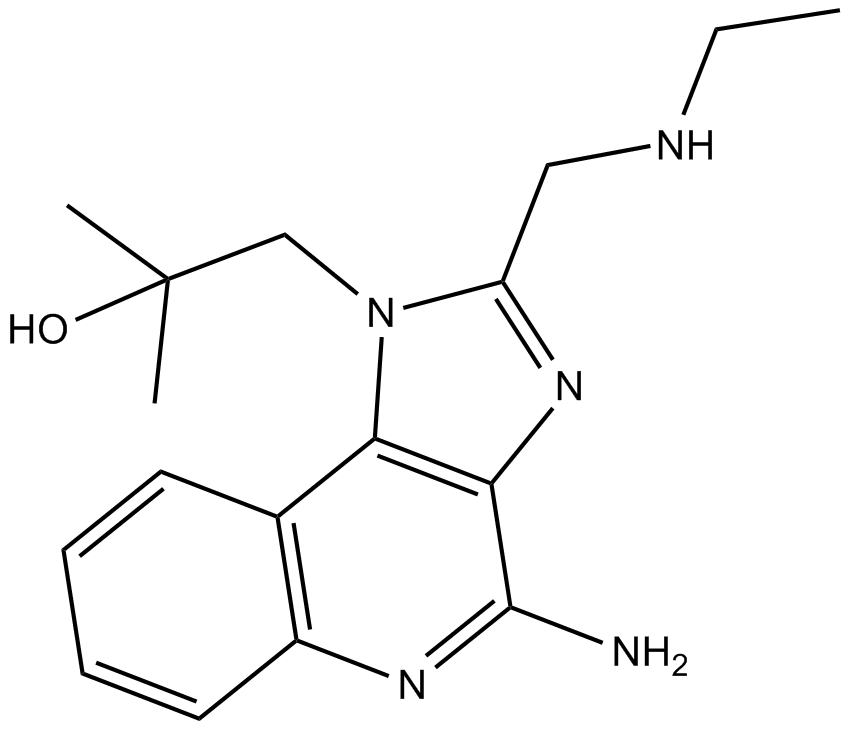
Cas No.: 1020412-43-4
Sample solution is provided at 25 µL, 10mM.
_1-3.$$$39978408@51.jpg');)
_1-9.$$$38538795@65.jpg');)
_1-9.$$$39112701@51.jpg');)
_1-7.$$$37316672@70.jpg');)
_366-372.$$$36198801@70.jpg');)
.$$$38565142@65.jpg');)
_1867-1883.$$$33248023@67.jpg');)
_eads6055.$$$39977546@45.jpg');)
_eadm9805.$$$40080571@45.jpg');)
_eadj3020.$$$39666821@45.jpg');)
_1-20.$$$39757301@28.jpg');)
_1-24.$$$38898113@28.jpg');)
_273-287.$$$36806353@46.jpg');)
_1-16.$$$37156877@44.jpg');)
_1-19.$$$37460805@44.jpg');)
_1291-1307.$$$34518654@46.jpg');)
Gardiquimod is a Toll-like receptor 7 (TLR7) agonist that inhibits HIV-1 infection of human macrophages and activation of T cells[1, 2]. When combined with plant-derived norovirus virus-like particles (NVVLPs) and administered intranasally, Gardiquimod induces NVVLP-specific serum IgG and its subtype responses and mucosal IgA responses in the gastrointestinal, respiratory, and reproductive tracts[3].
In vitro, treatment of mouse spleen cells with Gardiquimod (0-2.5µg/mL) for 48h significantly induced cell proliferation[4]. Treatment of RAW264.7 mouse macrophages with Gardiquimod (1µg/mL) for 24h significantly induced the expression of CD40, CD80, and CD86[4]. Pretreatment of HaCaT cells with Gardiquimod (2µg/mL) for 2h downregulated the expression of Ca2+-induced differentiation markers and activated the Raf-MEK-ERK and PI3K-AKT signaling pathways in HaCaT cells[5]. Gardiquimod (3µg/mL) treatment of the human pancreatic adenocarcinoma cell line BxPC-3 inhibited cell proliferation and migration, induced apoptosis, downregulated the expression levels of cyclin B1, cyclin E, and B-cell lymphoma 2, and upregulated the expression of B-cell-associated X protein[6].
In vivo, subcutaneous B16 melanoma model mice treated with Gardiquimod (1mg/kg) via peritumoral injection twice, combined with a dendritic cell (DC) vaccine, significantly inhibited tumor growth[4].
References:
[1] Buitendijk M, Eszterhas S K, Howell A L. Gardiquimod: a Toll-like receptor-7 agonist that inhibits HIV type 1 infection of human macrophages and activated T cells[J]. AIDS research and human retroviruses, 2013, 29(6): 907-918.
[2] Goyal D K, Keshav P, Kaur S. Adjuvant effects of TLR agonist gardiquimod admixed with Leishmania vaccine in mice model of visceral leishmaniasis[J]. Infection, Genetics and Evolution, 2021, 93: 104947.
[3] Velasquez L S, Hjelm B E, Arntzen C J, et al. An intranasally delivered Toll-like receptor 7 agonist elicits robust systemic and mucosal responses to Norwalk virus-like particles[J]. Clinical and Vaccine Immunology, 2010, 17(12): 1850-1858.
[4] Ma F, Zhang J, Zhang J, et al. The TLR7 agonists imiquimod and gardiquimod improve DC-based immunotherapy for melanoma in mice[J]. Cellular & molecular immunology, 2010, 7(5): 381-388.
[5] Jia B, Luo X, Cheng F W, et al. Gardiquimod inhibits the expression of calcium-induced differentiation markers in HaCaT cells[J]. Molecular biology reports, 2013, 40(11): 6363-6369.
[6] Zou B B, Wang F, Li L, et al. Activation of Toll-like receptor 7 inhibits the proliferation and migration, and induces the apoptosis of pancreatic cancer cells[J]. Molecular medicine reports, 2015, 12(4): 6079-6085.
| Cell experiment [1]: | |
Cell lines | Splenocytes from C57BL/6 mice |
Preparation Method | Proliferation was determined by culturing 5×10⁴ freshly isolated splenocytes from C57BL/6 mice with 0-2.5µg/mL imiquimod or Gardiquimod in 96-well plates for 48h. MTT (20mL, 5mg/mL) was added 4h before the end of the incubation period. DMSO was used to dissolve granules, and the absorbance at 570nm of each sample was determined with a microplate autoreader. |
Reaction Conditions | 0-2.5µg/mL; 48h |
Applications | Both agonists promoted the proliferation of lymphocytes with a greater effect at the dosage of 1.25mg/ml, and Gardiquimod seemed to be more efficient than imiquimod. |
| Animal experiment [1]: | |
Animal models | C57BL/6 mice |
Preparation Method | C57BL/6 mice were inoculated with 53104 B16 cells. On day 7, mice received an intravenous infusion of 4×10⁴ dendritic cells (DCs), and on days 8 and 10, mice received 1mg/kg of either Gardiquimod or imiquimod by peritumoral injection. Control mice were injected with an equivalent volume of PBS. The tumor volumes were calculated and the growth curves of melanomas in treated mice were determined. The treated mice were killed on day 13, and tumors were weighed. The tumor tissues were analyzed by hematoxylin and eosin staining. |
Dosage form | 1mg/kg; peritumoral injection |
Applications | Combination therapy with Gardiquimod or imiquimod and DC vaccine inhibits the growth of subcutaneous B16 melanomas. |
References: | |
| Cas No. | 1020412-43-4 | SDF | |
| Chemical Name | 4-amino-2-[(ethylamino)methyl]-α,α-dimethyl-1H-imidazo[4,5-c]quinoline-1-ethanol | ||
| Canonical SMILES | NC1=NC2=C(C3=C1N=C(CNCC)N3CC(C)(O)C)C=CC=C2 | ||
| Formula | C17H23N5O | M.Wt | 313.4 |
| Solubility | ≤12mg/ml in ethanol;20mg/ml in DMSO;20mg/ml in dimethyl formamide | Storage | Store at -20°C |
| General tips | Please select the appropriate solvent to prepare the stock solution according to the
solubility of the product in different solvents; once the solution is prepared, please store it in
separate packages to avoid product failure caused by repeated freezing and thawing.Storage method
and period of the stock solution: When stored at -80°C, please use it within 6 months; when stored
at -20°C, please use it within 1 month. To increase solubility, heat the tube to 37°C and then oscillate in an ultrasonic bath for some time. |
||
| Shipping Condition | Evaluation sample solution: shipped with blue ice. All other sizes available: with RT, or with Blue Ice upon request. | ||
| Prepare stock solution | |||

|
1 mg | 5 mg | 10 mg |
| 1 mM | 3.1908 mL | 15.9541 mL | 31.9081 mL |
| 5 mM | 638.2 μL | 3.1908 mL | 6.3816 mL |
| 10 mM | 319.1 μL | 1.5954 mL | 3.1908 mL |
Step 1: Enter information below (Recommended: An additional animal making an allowance for loss during the experiment)
 g
μL
g
μL
Step 2: Enter the in vivo formulation (This is only the calculator, not formulation. Please contact us first if there is no in vivo formulation at the solubility Section.)
Calculation results:
Working concentration: mg/ml;
Method for preparing DMSO master liquid: mg drug pre-dissolved in μL DMSO ( Master liquid concentration mg/mL, Please contact us first if the concentration exceeds the DMSO solubility of the batch of drug. )
Method for preparing in vivo formulation: Take μL DMSO master liquid, next addμL PEG300, mix and clarify, next addμL Tween 80, mix and clarify, next add μL saline, mix and clarify.
Method for preparing in vivo formulation: Take μL DMSO master liquid, next add μL Corn oil, mix and clarify.
Note: 1. Please make sure the liquid is clear before adding the next solvent.
2. Be sure to add the solvent(s) in order. You must ensure that the solution obtained, in the previous addition, is a clear solution before proceeding to add the next solvent. Physical methods such as vortex, ultrasound or hot water bath can be used to aid dissolving.
3. All of the above co-solvents are available for purchase on the GlpBio website.
Quality Control & SDS
- View current batch:
- Purity: >95.00% Appearance: A solid
- COA (Certificate of Analysis)
- SDS (Safety Data Sheet)
- Datasheet
Average Rating: 5 (Based on Reviews and 26 reference(s) in Google Scholar.)