

CC0651 |
Catalog No.GC35625
 One-Click Copy Product Info
|

CC0651 is an allosteric inhibitor of the human Cdc34 ubiquitin-conjugating enzyme. CC0651 potently (IC50=1.72 μM) inhibits the ubiquitination of p27Kip1, as confirmed by dose-response analysis.
Products are for research use only. Not for human use. We do not sell to patients.
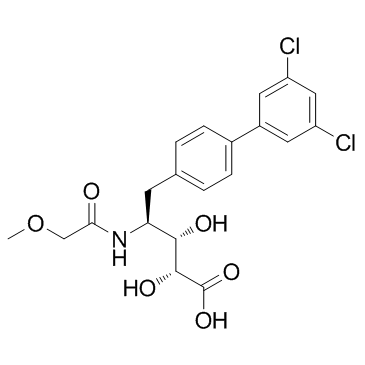
Cas No.: 1319207-44-7
Sample solution is provided at 25 µL, 10mM.
_1-3.$$$39978408@51.jpg');)
_1-9.$$$38538795@65.jpg');)
_1-9.$$$39112701@51.jpg');)
_1-7.$$$37316672@70.jpg');)
_366-372.$$$36198801@70.jpg');)
.$$$38565142@65.jpg');)
_1867-1883.$$$33248023@67.jpg');)
_eads6055.$$$39977546@45.jpg');)
_eadm9805.$$$40080571@45.jpg');)
_eadj3020.$$$39666821@45.jpg');)
_1-20.$$$39757301@28.jpg');)
_1-24.$$$38898113@28.jpg');)
_273-287.$$$36806353@46.jpg');)
_1-16.$$$37156877@44.jpg');)
_1-19.$$$37460805@44.jpg');)
_1291-1307.$$$34518654@46.jpg');)
CC0651 is an allosteric inhibitor of the human Cdc34 ubiquitin-conjugating enzyme. CC0651 potently (IC50=1.72 μM) inhibits the ubiquitination of p27Kip1, as confirmed by dose-response analysis. IC50: 1.72 μM (p27Kip1 ubiquitination)[1]
CC0651 strongly impairs the rate of ubiquitin chain initiation on substrate by SCFCdc4, as measured by the monoubiquitination of Sic1 by K0 ubiquitin. CC0651 actually potentiates the formation of both ubiquitin dimers and monoubiquitinated hCdc34, concordant with the observed accumulation of the hCdc34 conjugate in cells treated with the ester derivative of CC0651. CC0651 completely inhibits the assembly of polyubiquitin chains and decreased formation of free triubiquitin and, to a lesser extent, hCdc34 monoubiquitin, but has no effect on production of diubiquitin[1]. CC0651 is an inhibitor of the E2 ubiquitin conjugating enzyme Cdc34A, acts by trapping a weak interaction between ubiquitin and the E2 donor ubiquitin binding site. A quantitative SCF ubiquitination assay with a β-Catenin substrate peptide yields a value of IC50 of 18±1 μM for CC0651 inhibition, similar to the effective concentrations observed in the NMR and TR-FRET assays[2].
[1]. Ceccarelli DF, et al. An allosteric inhibitor of the human Cdc34 ubiquitin-conjugating enzyme. Cell. 2011 Jun 24;145(7):1075-87. [2]. Huang H, et al. E2 enzyme inhibition by stabilization of a low-affinity interface with ubiquitin. Nat Chem Biol. 2014 Feb;10(2):156-63.
Kinase experiment: | For small-molecule screens, p27Kip1 is ubiquitinated in a 15 μL reaction with 40 nM phospho-p27, 40 nM E1, 5 μM E2, 25 nM SCFSkp2, 25 nM Cks1, and 27.8 μM biotinylated ubiquitin in 40 mM Tris-HCl [pH 7.5], 5 mM MgCl2, 1 mM DTT, and 0.5 mM ATP at 23°C for 3 hr. The reaction is terminated with assay diluent, transferred to 384-well protein A plates coated with 62 ng SC528 antibody, incubated for 1 hr, and washed six times with 10 mM Tris-HCl [pH 7.6], 0.05% Tween20 prior to addition of 25 μL of 0.4 mg/mL europium streptavidin in HEPES [pH 7.6], 1% BSA, 0.2% Tween20 per well. Plates are incubated for 1 hr, washed, and read for Eu-time-resolved fluorescence after addition of 25 μL enhancement solution. For gel-based ubiquitination assays, CC0651 and its analogs are preincubated at the indicated concentrations with 0.5 μg E1, 1-4 μg hCdc34, and 50 ng SCFCdc4, 100 ng SCFFbw7, 150 ng SCFβTrCP, or 50 ng SCFSkp2 for 10-45 min at 4°C in 20 μL reaction buffer (50 mM HEPES [pH 7.5], 10 mM MgCl2, 2 mM ATP, and 50μM DTT). Reactions are initiated by addition of 1μg ubiquitin and respective SCF substrates (50 ng HisSic1 phosphorylated by Cln2-Cdc28, 50ng cyclin E phosphorylated by Cdk2, 25 ng biotinylated IκBα phosphopeptide [KKERLLDDHDpSGLDpSMKDEE], or 50 ng p27Kip1 phosphorylated by cyclin E-Cdk2), incubated at 30°C for 1-3 hr, and products visualized by immunoblot[1]. |
Cell experiment: | PC-3 and HCT116 cell lines are grown in DMEM supplemented with Penicillin/Streptomycin, 2 mM glutamine, and 10% fetal bovine serum (FBS). Lentiviral shRNA constructs for human CDC34, UBE2R2, and nontarget control are used. For proliferation assays, PC-3 cultures are seeded at 5000 cells/well in quadruplicate in 24-well plates, grown for 24 hr, and then infected with lentiviral supernatant. For small-molecule inhibition, cells are seeded in quadruplicate at 500 cells/well in 96-well plates, grown for 24 hr, and treated with compound. Proliferation is measured by MTT assay. PC-3 or HCT 116 cultures are synchronized in G0/G1 by serum starvation for 30 hr and then released by addition of 10% serum. For epistasis experiments, PC-3 cells are infected with CDC34 shRNA for 24 hr, followed by addition of inhibitor and assessment of proliferation after 4 days. Anti-Cdc34, anti-p27, anti-α-tubulin, anti-ubiquitin, and anti-cyclin E antibodies are used[1]. |
References: [1]. Ceccarelli DF, et al. An allosteric inhibitor of the human Cdc34 ubiquitin-conjugating enzyme. Cell. 2011 Jun 24;145(7):1075-87. | |
| Cas No. | 1319207-44-7 | SDF | |
| Canonical SMILES | ClC1=CC(Cl)=CC(C2=CC=C(C=C2)C[C@@H]([C@@H]([C@H](C(O)=O)O)O)NC(COC)=O)=C1 | ||
| Formula | C20H21Cl2NO6 | M.Wt | 442.29 |
| Solubility | DMSO: ≥ 56 mg/mL (126.61 mM) | Storage | Store at -20°C |
| General tips | Please select the appropriate solvent to prepare the stock solution according to the
solubility of the product in different solvents; once the solution is prepared, please store it in
separate packages to avoid product failure caused by repeated freezing and thawing.Storage method
and period of the stock solution: When stored at -80°C, please use it within 6 months; when stored
at -20°C, please use it within 1 month. To increase solubility, heat the tube to 37°C and then oscillate in an ultrasonic bath for some time. |
||
| Shipping Condition | Evaluation sample solution: shipped with blue ice. All other sizes available: with RT, or with Blue Ice upon request. | ||
| Prepare stock solution | |||

|
1 mg | 5 mg | 10 mg |
| 1 mM | 2.261 mL | 11.3048 mL | 22.6096 mL |
| 5 mM | 452.2 μL | 2.261 mL | 4.5219 mL |
| 10 mM | 226.1 μL | 1.1305 mL | 2.261 mL |
Step 1: Enter information below (Recommended: An additional animal making an allowance for loss during the experiment)
 g
μL
g
μL
Step 2: Enter the in vivo formulation (This is only the calculator, not formulation. Please contact us first if there is no in vivo formulation at the solubility Section.)
Calculation results:
Working concentration: mg/ml;
Method for preparing DMSO master liquid: mg drug pre-dissolved in μL DMSO ( Master liquid concentration mg/mL, Please contact us first if the concentration exceeds the DMSO solubility of the batch of drug. )
Method for preparing in vivo formulation: Take μL DMSO master liquid, next addμL PEG300, mix and clarify, next addμL Tween 80, mix and clarify, next add μL saline, mix and clarify.
Method for preparing in vivo formulation: Take μL DMSO master liquid, next add μL Corn oil, mix and clarify.
Note: 1. Please make sure the liquid is clear before adding the next solvent.
2. Be sure to add the solvent(s) in order. You must ensure that the solution obtained, in the previous addition, is a clear solution before proceeding to add the next solvent. Physical methods such as vortex, ultrasound or hot water bath can be used to aid dissolving.
3. All of the above co-solvents are available for purchase on the GlpBio website.
Quality Control & SDS
- View current batch:
- Purity: >99.50% Appearance: A solid
- COA (Certificate of Analysis)
- SDS (Safety Data Sheet)
- Datasheet
Average Rating: 5 (Based on Reviews and 29 reference(s) in Google Scholar.)