

Isorhapontigenin |
Catalog No.GC36339
 One-Click Copy Product Info
|

Isorhapontigenin, a naturally-occurring stilbene derivative, exhibits potent antioxidant and anti-inflammatory properties.
Products are for research use only. Not for human use. We do not sell to patients.
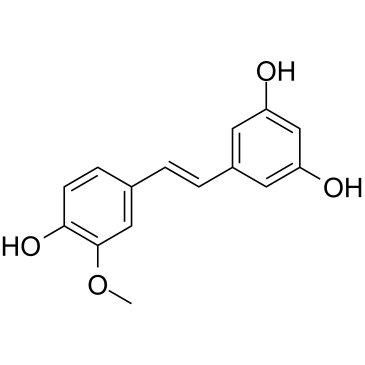
Cas No.: 32507-66-7
Sample solution is provided at 25 µL, 10mM.
_1-3.$$$39978408@51.jpg');)
_1-9.$$$38538795@65.jpg');)
_1-9.$$$39112701@51.jpg');)
_1-7.$$$37316672@70.jpg');)
_366-372.$$$36198801@70.jpg');)
.$$$38565142@65.jpg');)
_1867-1883.$$$33248023@67.jpg');)
_eads6055.$$$39977546@45.jpg');)
_eadm9805.$$$40080571@45.jpg');)
_eadj3020.$$$39666821@45.jpg');)
_1-20.$$$39757301@28.jpg');)
_1-24.$$$38898113@28.jpg');)
_273-287.$$$36806353@46.jpg');)
_1-16.$$$37156877@44.jpg');)
_1-19.$$$37460805@44.jpg');)
_1291-1307.$$$34518654@46.jpg');)
Isorhapontigenin, a naturally-occurring stilbene derivative, exhibits potent antioxidant and anti-inflammatory properties [1]. Isorhapontigenin inhibits the EGFR-mediated pathways, including the ERK1/2 and PI3K/Akt signaling pathways, and regulates the activities of transcription factors such as FOXO1, STAT1, and Sp1[2]. Isorhapontigenin affects epigenetic regulation by altering the expression of microRNAs, particularly miR-137 and miR-145[2]. Isorhapontigenin has been widely used to inhibit Fe2+-Cys-induced malondialdehyde (MDA) generation in rat liver microsomes, brain mitochondria, and synaptosomes[3].
In vitro, Isorhapontigenin treatment for 24 hours significantly inhibited the release of IL-6 and CXCL8 in primary airway epithelial cells stimulated by 1ng/ml IL-1β + 50% cigarette smoke extract (CSE), with IC50 values of 17.3μM and 33.4μM, respectively[4]. Treatment with 100μM Isorhapontigenin for 24 hours significantly induced apoptosis in LNCaP and CWR22Rv1 cells, accompanied by nuclear fragmentation and cell rupture[5]. Treatment with 40μM Isorhapontigenin for 24 hours significantly reduced the expression level of HIF-1α protein in A549 cells and inhibited cell invasion[6].
In vivo, Isorhapontigenin treatment via intraperitoneal injection at a dose of 50mg/kg/day for 21 days significantly inhibited cardiac hypertrophy in the aortic-banded rat model, and decreased posterior wall thickness and left ventricle diastolic and systolic diameters [7]. Oral administration of Isorhapontigenin at a dose of 51.6mg/kg/day for 7 consecutive days prevented lipopolysaccharide (LPS)-induced acute lung injury in mice and reduced inflammatory response and oxidative stress[8].
References:
[1] Fernández-Marín M I, Guerrero R F, García-Parrilla M C, et al. Isorhapontigenin: a novel bioactive stilbene from wine grapes[J]. Food chemistry, 2012, 135(3): 1353-1359.
[2] Kowalczyk T, Piekarski J, Merecz-Sadowska A, et al. Investigation of the molecular mechanisms underlying the anti-inflammatory and antitumour effects of isorhapontigenin: Insights from in vitro and in vivo studies[J]. Biomedicine & Pharmacotherapy, 2024, 180: 117479.
[3] Wang Q L, Lin M, Liu G T. Antioxidative activity of natural isorhapontigenin[J]. The Japanese Journal of Pharmacology, 2001, 87(1): 61-66.
[4] Yeo S C M, Fenwick P S, Barnes P J, et al. Isorhapontigenin, a bioavailable dietary polyphenol, suppresses airway epithelial cell inflammation through a corticosteroid‐independent mechanism[J]. British journal of pharmacology, 2017, 174(13): 2043-2059.
[5] Zhu C, Zhu Q, Wu Z, et al. Isorhapontigenin induced cell growth inhibition and apoptosis by targeting EGFR‐related pathways in prostate cancer[J]. Journal of Cellular Physiology, 2018, 233(2): 1104-1119.
[6] Zhang Z, Li J, Willis D, et al. Isorhapontigenin Inhibits Cell Growth, Angiogenesis, Migration, and Invasion of Non-Small-Cell Lung Cancer Cells Through NEDD9 Signaling[J]. International Journal of Molecular Sciences, 2025, 26(9): 4207.
[7] Li H L, Wang A B, Huang Y, et al. Isorhapontigenin, a new resveratrol analog, attenuates cardiac hypertrophy via blocking signaling transduction pathways[J]. Free Radical Biology and Medicine, 2005, 38(2): 243-257.
[8] Yao P, Zhang Z, Cao J. Isorhapontigenin alleviates lipopolysaccharide-induced acute lung injury via modulating Nrf2 signaling[J]. Respiratory Physiology & Neurobiology, 2021, 289: 103667.
| Cell experiment [1]: | |
Cell lines | LNCaP cells |
Preparation Method | LNCaP cells were grown in RPMI-1640 medium supplemented with 1% penicillin/streptomycin, and 10% heat-inactivated fetal bovine serum (FBS) at 37°C in an incubator with 5% CO2. LNCaP cells were cultured in 96-well plates in culture medium at 5000 cells/well. Different concentrations of Isorhapontigenin (0, 1, 10, 20, 50 and 100μM) were added and incubated at 37°C with 5% CO2 for 24h. Cell viability was measured. |
Reaction Conditions | 0, 1, 10, 20, 50 and 100μM; 24h |
Applications | Isorhapontigenin treatment significantly reduced cell viability of LNCaP cells in a dose-dependent manner. |
| Animal experiment [2]: | |
Animal models | Male C57BL/6 mice |
Preparation Method | Male C57BL/6 mice (6 weeks old) weighing 20-25g, were housed in an environmentally controlled room (12h light–dark cycle, 50%±10% relative humidity) at 23±2°C at a facility with free access to food and water. The mice (n = 60) were randomly divided into six groups. (1) Control group (n=10): sterile water via intraperitoneal injection 12h before sacrifice; (2) LPS + Isorhapontigenin group: oral administration with Isorhapontigenin (51.6mg/kg) daily for 7 days, and after 1h of the last administration, the mice were intraperitoneally injected with LPS (15mg/kg) and euthanized after 12h. The lung tissues of mice were fixed and embedded in paraffin, and the sections were stained with hematoxylin and eosin. |
Dosage form | 51.6mg/kg/day for 7 days; p.o. |
Applications | Isorhapontigenin treatment reduced LPS-induced acute lung injury and decreased inflammatory cell infiltration in mice. |
References: | |
| Cas No. | 32507-66-7 | SDF | |
| Canonical SMILES | OC1=CC(O)=CC(/C=C/C2=CC(OC)=C(O)C=C2)=C1 | ||
| Formula | C15H14O4 | M.Wt | 258.27 |
| Solubility | DMSO: 100 mg/mL (387.19 mM) | Storage | 4°C, away from moisture and light |
| General tips | Please select the appropriate solvent to prepare the stock solution according to the
solubility of the product in different solvents; once the solution is prepared, please store it in
separate packages to avoid product failure caused by repeated freezing and thawing.Storage method
and period of the stock solution: When stored at -80°C, please use it within 6 months; when stored
at -20°C, please use it within 1 month. To increase solubility, heat the tube to 37°C and then oscillate in an ultrasonic bath for some time. |
||
| Shipping Condition | Evaluation sample solution: shipped with blue ice. All other sizes available: with RT, or with Blue Ice upon request. | ||
| Prepare stock solution | |||

|
1 mg | 5 mg | 10 mg |
| 1 mM | 3.8719 mL | 19.3596 mL | 38.7192 mL |
| 5 mM | 774.4 μL | 3.8719 mL | 7.7438 mL |
| 10 mM | 387.2 μL | 1.936 mL | 3.8719 mL |
Step 1: Enter information below (Recommended: An additional animal making an allowance for loss during the experiment)
 g
μL
g
μL
Step 2: Enter the in vivo formulation (This is only the calculator, not formulation. Please contact us first if there is no in vivo formulation at the solubility Section.)
Calculation results:
Working concentration: mg/ml;
Method for preparing DMSO master liquid: mg drug pre-dissolved in μL DMSO ( Master liquid concentration mg/mL, Please contact us first if the concentration exceeds the DMSO solubility of the batch of drug. )
Method for preparing in vivo formulation: Take μL DMSO master liquid, next addμL PEG300, mix and clarify, next addμL Tween 80, mix and clarify, next add μL saline, mix and clarify.
Method for preparing in vivo formulation: Take μL DMSO master liquid, next add μL Corn oil, mix and clarify.
Note: 1. Please make sure the liquid is clear before adding the next solvent.
2. Be sure to add the solvent(s) in order. You must ensure that the solution obtained, in the previous addition, is a clear solution before proceeding to add the next solvent. Physical methods such as vortex, ultrasound or hot water bath can be used to aid dissolving.
3. All of the above co-solvents are available for purchase on the GlpBio website.
Quality Control & SDS
- View current batch:
- Purity: >99.50% Appearance: A solid
- COA (Certificate of Analysis)
- SDS (Safety Data Sheet)
- Datasheet
Average Rating: 5 (Based on Reviews and 13 reference(s) in Google Scholar.)