

NBI-74330 |
Catalog No.GC36704
 One-Click Copy Product Info
|

A CXCR3 antagonist
Products are for research use only. Not for human use. We do not sell to patients.
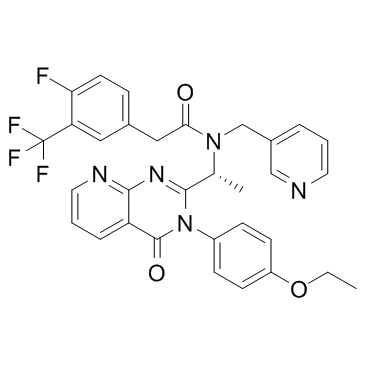
Cas No.: 855527-92-3
Sample solution is provided at 25 µL, 10mM.
_1-3.$$$39978408@51.jpg');)
_1-9.$$$38538795@65.jpg');)
_1-9.$$$39112701@51.jpg');)
_1-7.$$$37316672@70.jpg');)
_366-372.$$$36198801@70.jpg');)
.$$$38565142@65.jpg');)
_1867-1883.$$$33248023@67.jpg');)
_eads6055.$$$39977546@45.jpg');)
_eadm9805.$$$40080571@45.jpg');)
_eadj3020.$$$39666821@45.jpg');)
_1-20.$$$39757301@28.jpg');)
_1-24.$$$38898113@28.jpg');)
_273-287.$$$36806353@46.jpg');)
_1-16.$$$37156877@44.jpg');)
_1-19.$$$37460805@44.jpg');)
_1291-1307.$$$34518654@46.jpg');)
NBI-74330 is a potent antagonist for CXCR3, and exhibits potent inhibition of (125I)CXCL10 and (125I)CXCL11 specific binding with Ki of 1.5 and 3.2 nM, respectively. [125I]CXCL10-CXCR3|1.5 nM (Ki, in CXCR3-CHO cell membranes)|[125I]CXCL11-CXCR3|3.2 nM (Ki, in CXCR3-CHO cell membranes)
BI-74330 demonstrates potent inhibition of [125I]CXCL11 specific binding to membranes prepared from transfected CHO cells expressing CXCR3 (CXCR3-CHO) (Ki=3.6 nM). NBI-74330 is 12- and 3.5-fold more potent than CXCL9 (Ki=45.2 nM) and CXCL10 (Ki=12.5 nM), respectively, at inhibiting [125I]CXCL11 binding to CXCR3-CHO cell membranes. NBI-74330 inhibits calcium mobilization in response to CXCL11 and CXCL10 with an IC50 value of 7 nM for both ligands used at their EC80 concentrations (1 nM for CXCL11 and 30 nM for CXCL10). NBI-74330 specifically inhibits CXCR3-mediated calcium mobilization. NBI-74330 also dose-dependently inhibits CXCL11-induced [35S]GTPγS binding in membranes of cells endogenously expressing CXCR3 (H9 cells, IC50 value 5.5 nM). BI-74330 inhibits CXCL11-induced chemotaxis in these cells with an IC50 of 3.9 nM[1]. NBI-74330 (30-300 nm, 1-10 μM) produces concentration-dependent, parallel rightward shifts of the CXCL11 E/[A] curve with no significant change in the E/[A] curve maximal response[2].
NBI-74330 (100 mg/kg) results in the formation of an N-oxide metabolite, also an antagonist of CXCR3, in mice[2]. Mice treated with 100 mg/kg NBI-74330 (in 1% Na Doc in 0.5% 400Cp Methylcellulose) result in serum concentrations of approximately 1 μM. This concentration is sufficient to fully block the CXCR3 receptor in vivo[3].
[1]. Heise CE, et al. Pharmacological characterization of CXC chemokine receptor 3 ligands and a small molecule antagonist. J Pharmacol Exp Ther. 2005 Jun;313(3):1263-71. [2]. Jopling LA, et al. Analysis of the pharmacokinetic/pharmacodynamic relationship of a small molecule CXCR3 antagonist, NBI-74330, using a murine CXCR3 internalization assay. Br J Pharmacol. 2007 Dec;152(8):1260-71. [3]. van Wanrooij EJ, et al. CXCR3 antagonist NBI-74330 attenuates atherosclerotic plaque formation in LDL receptor-deficient mice. Arterioscler Thromb Vasc Biol. 2008 Feb;28(2):251-7.
Kinase experiment: | Cell membrane fractions are resuspended in 50 mM HEPES, 10 mM MgCl2, 100 mM NaCl, and 1 mM CaCl2, pH 7.2 for use in competitive radioligand binding reactions. Reactions are performed in duplicate and consisted of 25-μL unlabeled chemokine at indicated concentrations, 25-μL radiolabeled chemokine ligand (appr 70 nM; [125I]CXCL11 and [125I]CXCL10 with specific activities of 1500 and 2200 Ci/mmol, respectively; Fifty-μL membrane protein (5 μg) are added sequentially in assay buffer (50 mM HEPES, 10 mM MgCl2, 100 mM NaCl, 1 mM CaCl2, and 0.1% BSA, pH 7.2) to low-binding 96-well plates. The reaction is allowed to reach equilibrium by incubation at room temperature for 45 min while shaking. The amount of bound radioligand is determined by harvesting membranes via filtration through a UniFilter GF/C filter plate using a UniFilter-96 vacuum manifold (filters are pretreated with 1% polyethylenimine), washing twice with 400-μL wash buffer (10 mM HEPES, 5 mM MgCl2, 1 mM CaCl2, and 500 mM NaCl, pH 7.3), and measuring radioactivity by liquid scintillation using a TopCount NXT. The dissociation half-life of [125I]CXCL11 is measured using CXCR3-CHO membranes that are allowed to equilibrate with radiolabel (appr 70 nM) for 30 min prior to the addition of excess cold CXCL11 (31 nM final) in the presence or absence of different concentrations of NBI-74330. Membrane-bound [125I]CXCL11 is assessed in duplicate along with nonspecific binding ([125I]CXCL11 plus excess cold CXCL11 added at the same) and total binding ([125I]CXCL11 without inhibitors) at each time point on the same plate. |
Animal experiment: | Female LDLr−/− mice, 10 weeks old (n=8 to 12 per group), are fed a Western-type diet containing 0.25% cholesterol and 15% cocoa butter 2 weeks before collar placement. 20 Mice are treated with a subcutaneous injection of 100 mg/kg NBI-74330 every day during the entire experiment. After 8 weeks of Western-type diet and treatment, the mice are euthanized and organs are harvested for histology, fluorescence-activated-cell sorter (FACS) analysis, and RNA isolation. Blood samples are collected by tail bleeding from nonfasted animals, and concentrations of serum cholesterol and triglycerides are determined using enzymatic colorimetric procedures. |
References: [1]. Heise CE, et al. Pharmacological characterization of CXC chemokine receptor 3 ligands and a small molecule antagonist. J Pharmacol Exp Ther. 2005 Jun;313(3):1263-71. | |
| Cas No. | 855527-92-3 | SDF | |
| Canonical SMILES | O=C(N([C@@H](C1=NC2=NC=CC=C2C(N1C3=CC=C(OCC)C=C3)=O)C)CC4=CC=CN=C4)CC5=CC=C(F)C(C(F)(F)F)=C5 | ||
| Formula | C32H27F4N5O3 | M.Wt | 605.58 |
| Solubility | DMSO: ≥ 35 mg/mL (57.80 mM) | Storage | Store at -20°C |
| General tips | Please select the appropriate solvent to prepare the stock solution according to the
solubility of the product in different solvents; once the solution is prepared, please store it in
separate packages to avoid product failure caused by repeated freezing and thawing.Storage method
and period of the stock solution: When stored at -80°C, please use it within 6 months; when stored
at -20°C, please use it within 1 month. To increase solubility, heat the tube to 37°C and then oscillate in an ultrasonic bath for some time. |
||
| Shipping Condition | Evaluation sample solution: shipped with blue ice. All other sizes available: with RT, or with Blue Ice upon request. | ||
| Prepare stock solution | |||

|
1 mg | 5 mg | 10 mg |
| 1 mM | 1.6513 mL | 8.2565 mL | 16.5131 mL |
| 5 mM | 330.3 μL | 1.6513 mL | 3.3026 mL |
| 10 mM | 165.1 μL | 825.7 μL | 1.6513 mL |
Step 1: Enter information below (Recommended: An additional animal making an allowance for loss during the experiment)
 g
μL
g
μL
Step 2: Enter the in vivo formulation (This is only the calculator, not formulation. Please contact us first if there is no in vivo formulation at the solubility Section.)
Calculation results:
Working concentration: mg/ml;
Method for preparing DMSO master liquid: mg drug pre-dissolved in μL DMSO ( Master liquid concentration mg/mL, Please contact us first if the concentration exceeds the DMSO solubility of the batch of drug. )
Method for preparing in vivo formulation: Take μL DMSO master liquid, next addμL PEG300, mix and clarify, next addμL Tween 80, mix and clarify, next add μL saline, mix and clarify.
Method for preparing in vivo formulation: Take μL DMSO master liquid, next add μL Corn oil, mix and clarify.
Note: 1. Please make sure the liquid is clear before adding the next solvent.
2. Be sure to add the solvent(s) in order. You must ensure that the solution obtained, in the previous addition, is a clear solution before proceeding to add the next solvent. Physical methods such as vortex, ultrasound or hot water bath can be used to aid dissolving.
3. All of the above co-solvents are available for purchase on the GlpBio website.
Quality Control & SDS
- View current batch:
- Purity: >99.00% Appearance: A solid
- COA (Certificate of Analysis)
- SDS (Safety Data Sheet)
- Datasheet
Average Rating: 5 (Based on Reviews and 39 reference(s) in Google Scholar.)