

KC7F2 |
Catalog No.GC13141
 One-Click Copy Product Info
|

KC7F2 is an inhibitor of the transcription factor HIF-1 (hypoxia-inducible factor-1), with an IC₅₀ of 20μM, KC7F2 is commonly used in research on tumor development and angiogenesis.
Products are for research use only. Not for human use. We do not sell to patients.
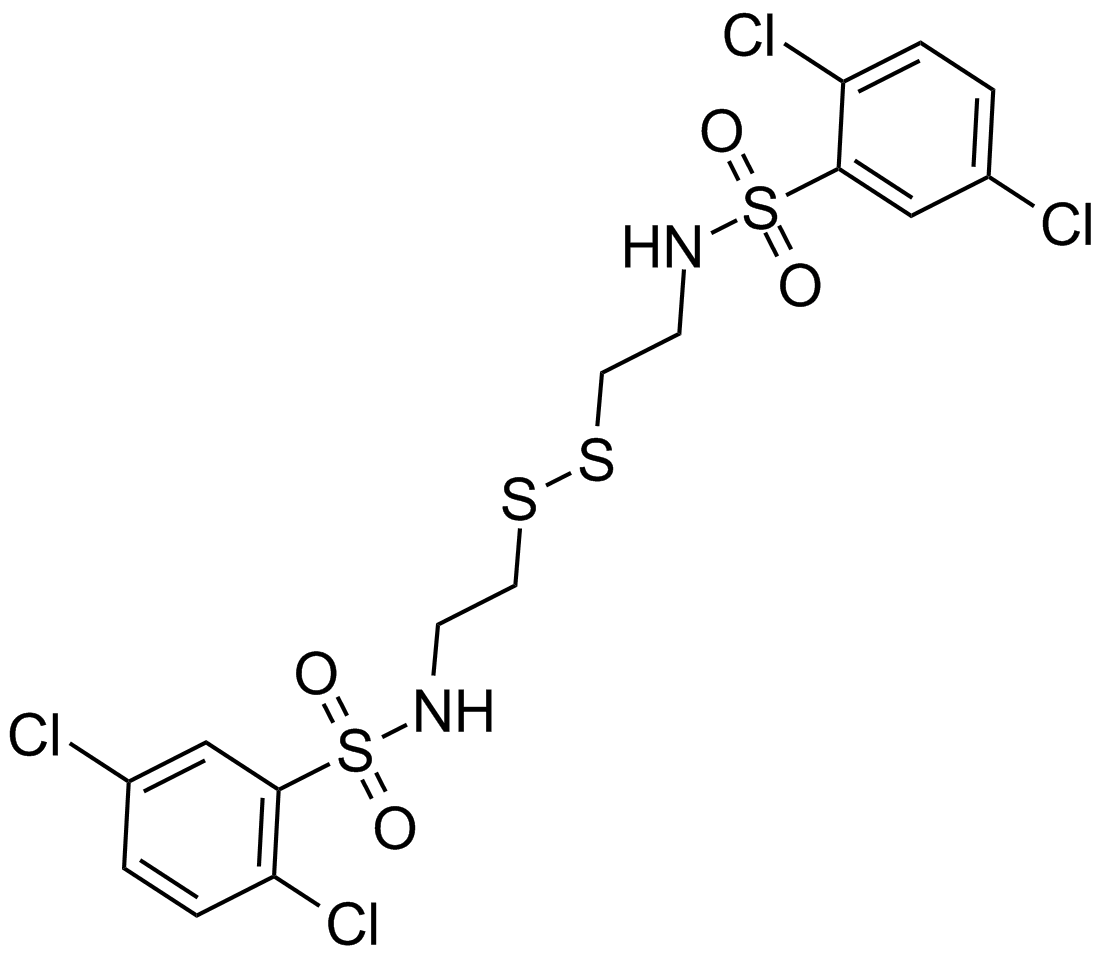
Cas No.: 927822-86-4
Sample solution is provided at 25 µL, 10mM.
KC7F2 is an inhibitor of the transcription factor HIF-1 (hypoxia-inducible factor-1), with an IC₅₀ of 20μM[1], KC7F2 is commonly used in research on tumor development and angiogenesis[2]. In addition, KC7F2 has also been shown to improve conditions such as ulcerative colitis and pulmonary fibrosis[3-4].
In vitro, pretreatment of U87MG glioma cells with KC7F2 (19–22μM) for 48 hours, followed by combined treatment with temozolomide (TMZ, 208.71μM), significantly inhibits cell proliferation, induces apoptosis, and reduces HIF-1α protein levels. KC7F2 also suppresses the expression of genes related to energy metabolism, thereby enhancing the therapeutic effect on glioma cells[5]. Pretreatment of human umbilical vein endothelial cells (HUVECs) with KC7F2 (20μM) for 4 hours, followed by culture under hypoxic conditions (1% O₂) for 6 hours, significantly inhibits cell viability and tube formation, while reducing the expression of HIF-1, reactive oxygen species (ROS), and vascular endothelial growth factor (VEGF)[6].
In vivo, C57BL/6J male mice were treated with KC7F2 (10mg/kg) in combination with GW9662 (1mg/kg) and exposed to hypoxia for 4 weeks. KC7F2 significantly prevented hypoxia-induced cardiac dysfunction, reduced HIF-1 expression in the heart, and improved cardiac glucose metabolism[7]. In a mouse model of retinal dysfunction induced by HTRA1, KC7F2 (10mg/kg) administered via intraperitoneal injection significantly inhibited HTRA1-induced retinal pigment epithelial cell senescence and improved retinal dysfunction[8].
References:
[1] Narita T, Yin S, Gelin CF, et al. Identification of a novel small molecule HIF-1alpha translation inhibitor. Clin Cancer Res. 2009 Oct 1;15(19):6128-36.
[2] Chen X, Kou Y, Lu Y, et al. Salidroside ameliorated hypoxia-induced tumorigenesis of BxPC-3 cells via downregulating hypoxia-inducible factor (HIF)-1α and LOXL2. J Cell Biochem. 2020 Jan;121(1):165-173.
[3] Li J, Dan W, Zhang C, et al. Exploration of Berberine Against Ulcerative Colitis via TLR4/NF-κB/HIF-1α Pathway by Bioinformatics and Experimental Validation. Drug Des Devel Ther. 2024 Jul 9;18:2847-2868.
[4] Xu X, Li Y, Niu Z, et al. Inhibition of HIF-1α Attenuates Silica-Induced Pulmonary Fibrosis. Int J Environ Res Public Health. 2022 Jun 1;19(11):6775.
[5] Abbaszade Z, Bagca BG, Avci CB. Molecular biological investigation of temozolomide and KC7F2 combination in U87MG glioma cell line. Gene. 2021 Apr 15;776:145445.
[6] Cheng J, Yang HL, Gu CJ, et al. Melatonin restricts the viability and angiogenesis of vascular endothelial cells by suppressing HIF-1α/ROS/VEGF. Int J Mol Med. 2019 Feb;43(2):945-955.
[7] Wang Y, Zhang R, Chen Q, et al. PPARγ Agonist Pioglitazone Prevents Hypoxia-induced Cardiac Dysfunction by Reprogramming Glucose Metabolism. Int J Biol Sci. 2024 Aug 6;20(11):4297-4313.
[8] Xu W, Liu X, Han W, et al. Inhibiting HIF-1 signaling alleviates HTRA1-induced RPE senescence in retinal degeneration. Cell Commun Signal. 2023 Jun 14;21(1):134.
| Cell experiment [1]: | |
Cell lines | Human Umbilical Vein Endothelial Cells (HUVECs) |
Preparation Method | HUVECs were cultured in RPMI-1640 medium supplemented with 10% fetal bovine serum, 100IU/ml penicillin, and 100μg/ml streptomycin at 37°C, 5% CO₂. Cells were treated with KC7F2 at a concentration of 20μM under normoxic or hypoxic conditions (1% O₂) for 6 hours. |
Reaction Conditions | 20μM; 6h |
Applications | KC7F2 significantly inhibited the viability and tube formation of HUVECs under both normoxic and hypoxic conditions. KC7F2 also reduced the expression of VEGF and ROS, particularly under hypoxic conditions. Additionally, KC7F2 decreased the mitochondrial membrane potential and increased the production of ROS in HUVECs. |
| Animal experiment [2]: | |
Animal models | C57BL/6 mice |
Preparation Method | Mice were randomly assigned to normoxic or hypoxic groups. Mice in the hypoxic group were exposed to simulated high-altitude conditions (5500m) for 4 weeks to induce hypoxia. Mice in the hypoxic group were treated with Pioglitazone via intragastric administration at a daily dose of 10 or 20mg/kg for 4 weeks. Additionally, mice were injected intraperitoneally with KC7F2 at a dose of 10mg/kg for the same duration. Mice were sacrificed at the end of the experiment for further analyses. |
Dosage form | 10mg/kg; i.p., every 24h for 4 weeks |
Applications | KC7F2 treatment disrupted the reprogramming of cardiac glucose metabolism and reduced cardiac function in Pioglitazone-treated mice under hypoxic conditions. |
References: | |
| Cas No. | 927822-86-4 | SDF | |
| Chemical Name | 2,5-dichloro-N-[2-[2-[(2,5-dichlorophenyl)sulfonylamino]ethyldisulfanyl]ethyl]benzenesulfonamide | ||
| Canonical SMILES | C1=CC(=C(C=C1Cl)S(=O)(=O)NCCSSCCNS(=O)(=O)C2=C(C=CC(=C2)Cl)Cl)Cl | ||
| Formula | C16H16Cl4N2O4S4 | M.Wt | 570.38 |
| Solubility | ≥ 24.95mg/mL in DMSO | Storage | Store at -20°C |
| General tips | Please select the appropriate solvent to prepare the stock solution according to the
solubility of the product in different solvents; once the solution is prepared, please store it in
separate packages to avoid product failure caused by repeated freezing and thawing.Storage method
and period of the stock solution: When stored at -80°C, please use it within 6 months; when stored
at -20°C, please use it within 1 month. To increase solubility, heat the tube to 37°C and then oscillate in an ultrasonic bath for some time. |
||
| Shipping Condition | Evaluation sample solution: shipped with blue ice. All other sizes available: with RT, or with Blue Ice upon request. | ||
| Prepare stock solution | |||

|
1 mg | 5 mg | 10 mg |
| 1 mM | 1.7532 mL | 8.7661 mL | 17.5322 mL |
| 5 mM | 350.6 μL | 1.7532 mL | 3.5064 mL |
| 10 mM | 175.3 μL | 876.6 μL | 1.7532 mL |
Step 1: Enter information below (Recommended: An additional animal making an allowance for loss during the experiment)
 g
μL
g
μL
Step 2: Enter the in vivo formulation (This is only the calculator, not formulation. Please contact us first if there is no in vivo formulation at the solubility Section.)
Calculation results:
Working concentration: mg/ml;
Method for preparing DMSO master liquid: mg drug pre-dissolved in μL DMSO ( Master liquid concentration mg/mL, Please contact us first if the concentration exceeds the DMSO solubility of the batch of drug. )
Method for preparing in vivo formulation: Take μL DMSO master liquid, next addμL PEG300, mix and clarify, next addμL Tween 80, mix and clarify, next add μL saline, mix and clarify.
Method for preparing in vivo formulation: Take μL DMSO master liquid, next add μL Corn oil, mix and clarify.
Note: 1. Please make sure the liquid is clear before adding the next solvent.
2. Be sure to add the solvent(s) in order. You must ensure that the solution obtained, in the previous addition, is a clear solution before proceeding to add the next solvent. Physical methods such as vortex, ultrasound or hot water bath can be used to aid dissolving.
3. All of the above co-solvents are available for purchase on the GlpBio website.
Quality Control & SDS
- View current batch:
- Purity: >98.00% Appearance: A solid
- COA (Certificate of Analysis)
- SDS (Safety Data Sheet)
- Datasheet
Average Rating: 5 (Based on Reviews and 30 reference(s) in Google Scholar.)