

USP7-IN-1 |
Catalog No.GC37875
 One-Click Copy Product Info
|

USP7-IN-1 is a selective and reversible inhibitor of ubiquitin-specific protease 7 (USP7), with an IC50 of 77 μM, and can be used for the research of cancer.
Products are for research use only. Not for human use. We do not sell to patients.
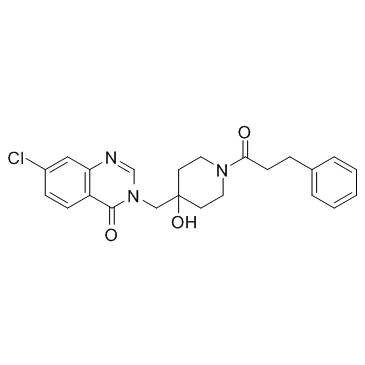
Cas No.: 1381291-36-6
Sample solution is provided at 25 µL, 10mM.
_1-3.$$$39978408@51.jpg');)
_1-9.$$$38538795@65.jpg');)
_1-9.$$$39112701@51.jpg');)
_1-7.$$$37316672@70.jpg');)
_366-372.$$$36198801@70.jpg');)
.$$$38565142@65.jpg');)
_1867-1883.$$$33248023@67.jpg');)
_eads6055.$$$39977546@45.jpg');)
_eadm9805.$$$40080571@45.jpg');)
_eadj3020.$$$39666821@45.jpg');)
_1-20.$$$39757301@28.jpg');)
_1-24.$$$38898113@28.jpg');)
_273-287.$$$36806353@46.jpg');)
_1-16.$$$37156877@44.jpg');)
_1-19.$$$37460805@44.jpg');)
_1291-1307.$$$34518654@46.jpg');)
USP7-IN-1 is a selective and reversible inhibitor of ubiquitin-specific protease 7 (USP7), with an IC50 of 77 μM, and can be used for the research of cancer. IC50: 77 μM (USP7)[1]
USP7-IN-1 (Example 2) is a selective and reversible inhibitor of USP7, with an IC50 of 77 μM, and shows no inhibition of USP8, USP5, Uch-L1, Uch-L3 or caspase 3. USP7-IN-1 inhibits the proliferation of HCT116 cells, with a GI50 of 67 μM[1].
[1]. SELECTIVE AND REVERSIBLE INHIBITORS OF UBIQUITIN SPECIFIC PROTEASE 7. WO 2013030218 A1
Kinase experiment: | USP7 is diluted in USP buffer (50 mM Tris HCl; 0.5 mM EDTA (Ethylenediaminetetraacetic acid); 5 mM DTT; 0.01 % Triton X-100; Bovine Serum Albumin 0.05 mg/mL pH7.6). Compounds stocks (10 mM) are stored at -20°C in DMSO. Compounds (including USP7-IN-1) are tested at different concentrations: from 200 μM to 91 nM. Reactions are performed as duplicates in Black 384 well plates (10 μL final reaction volume). The substrate concentration for USP7 is 300 nM Ub-AMC. The concentrations of the enzyme (USP7) in specificity assays is 100 pM. The concentrations are determined in order to perform specificity assays under initial velocities at fixed substrate concentration. Compounds are pre-incubated with enzymes for 30 minutes at 25°C. Reactions are initiated by addition of substrate to the plates containing the enzymes (+/- compounds) diluted in assay buffer. Reactions are incubated for 60 minutes at 37°C. Reactions are stopped by adding acetic acid (100 mM final). Readings are performed on a Pherastar Fluorescent Reader. λ Emission 380 nm; λ Excitation = 460 nm. Data (mean values +/- standard deviation) are analyzed as % of control (no compound) and plotted as percentage versus the Log of the compound concentration using GraphPad. Data are fitted to a sigmoidal model (variable slope)[1]. |
Cell experiment: | HCT116 colon cancer cells are maintained in Mc Coy's 5A medium containing 10% FBS, 3 mM glutamine and 1 % penicillin/streptomycin. Cells are incubated at 37°C in a humidified atmosphere containing 5% CO2. Cell viability is assayed using the MTS technique in 96-well culture plates. MTS (3-(4,5-dimethyl-thiazol-2-yl)-5-(3-carboxy- methoxyphenyl)-2-(4-sulfophenyl)-2H-tetra-zolium) is a MTT-derived tetrazolium that is reduced in metabolically active cells into a soluble, cell-permeant formazan. The amount of formazan, detected by its absorbance at 492 nm is proportional to the number of living, metabolically active cells. 103 HCT116 cells are seeded per well. 24 hours later, the medium is changed and the cells treated in triplicate with the concentrations of each compound from 100 μM to 50 nM. The compounds (including USP7-IN-1) are diluted in 100% DMSO, whose final concentration on cells is kept at 0.5%. Cells are incubated with the compounds for 72 hours, and their viability then assayed by the addition of MTS for 2 hours. Absorbance at 492 nm is measured directly from the 96-well culture plates. GI50 (Growth Inhibition 50) concentrations for each compound are calculated using a sigmoidal variable slope fit. Values represent mean of three independent experiments[1]. |
References: [1]. SELECTIVE AND REVERSIBLE INHIBITORS OF UBIQUITIN SPECIFIC PROTEASE 7. WO 2013030218 A1 | |
| Cas No. | 1381291-36-6 | SDF | |
| Canonical SMILES | O=C1N(CC2(O)CCN(C(CCC3=CC=CC=C3)=O)CC2)C=NC4=C1C=CC(Cl)=C4 | ||
| Formula | C23H24ClN3O3 | M.Wt | 425.91 |
| Solubility | DMSO: ≥ 40 mg/mL (93.92 mM) | Storage | Store at -20°C |
| General tips | Please select the appropriate solvent to prepare the stock solution according to the
solubility of the product in different solvents; once the solution is prepared, please store it in
separate packages to avoid product failure caused by repeated freezing and thawing.Storage method
and period of the stock solution: When stored at -80°C, please use it within 6 months; when stored
at -20°C, please use it within 1 month. To increase solubility, heat the tube to 37°C and then oscillate in an ultrasonic bath for some time. |
||
| Shipping Condition | Evaluation sample solution: shipped with blue ice. All other sizes available: with RT, or with Blue Ice upon request. | ||
| Prepare stock solution | |||

|
1 mg | 5 mg | 10 mg |
| 1 mM | 2.3479 mL | 11.7396 mL | 23.4791 mL |
| 5 mM | 469.6 μL | 2.3479 mL | 4.6958 mL |
| 10 mM | 234.8 μL | 1.174 mL | 2.3479 mL |
Step 1: Enter information below (Recommended: An additional animal making an allowance for loss during the experiment)
 g
μL
g
μL
Step 2: Enter the in vivo formulation (This is only the calculator, not formulation. Please contact us first if there is no in vivo formulation at the solubility Section.)
Calculation results:
Working concentration: mg/ml;
Method for preparing DMSO master liquid: mg drug pre-dissolved in μL DMSO ( Master liquid concentration mg/mL, Please contact us first if the concentration exceeds the DMSO solubility of the batch of drug. )
Method for preparing in vivo formulation: Take μL DMSO master liquid, next addμL PEG300, mix and clarify, next addμL Tween 80, mix and clarify, next add μL saline, mix and clarify.
Method for preparing in vivo formulation: Take μL DMSO master liquid, next add μL Corn oil, mix and clarify.
Note: 1. Please make sure the liquid is clear before adding the next solvent.
2. Be sure to add the solvent(s) in order. You must ensure that the solution obtained, in the previous addition, is a clear solution before proceeding to add the next solvent. Physical methods such as vortex, ultrasound or hot water bath can be used to aid dissolving.
3. All of the above co-solvents are available for purchase on the GlpBio website.
Quality Control & SDS
- View current batch:
- Purity: >98.50% Appearance: A solid
- COA (Certificate of Analysis)
- SDS (Safety Data Sheet)
- Datasheet
Average Rating: 5 (Based on Reviews and 19 reference(s) in Google Scholar.)