

Sildenafil |
Catalog No.GC11369
 One-Click Copy Product Info
|

Sildenafil is a selective inhibitor of phosphodiesterase type 5 (PDE5) with an IC50 value of 5.22nM.
Products are for research use only. Not for human use. We do not sell to patients.
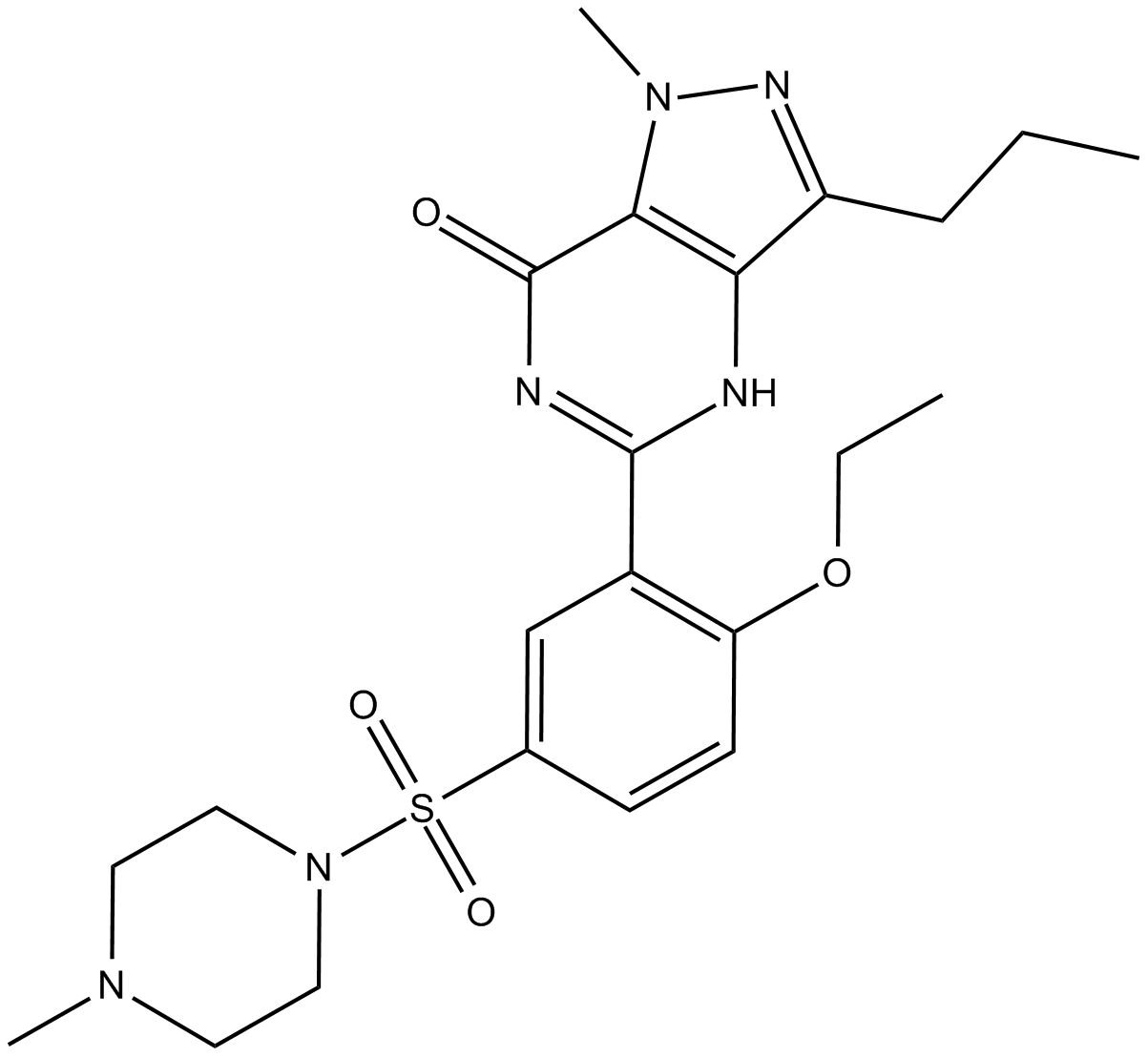
Cas No.: 139755-83-2
Sample solution is provided at 25 µL, 10mM.
Sildenafil is a selective inhibitor of phosphodiesterase type 5 (PDE5) with an IC50 value of 5.22nM[1]. By inhibiting PDE5, Sildenafil regulates the NO-cGMP pathway, increasing the cGMP level in the penile corpus cavernosum, causing relaxation of the penile arteries and the smooth muscles of the penile corpus cavernosum, thereby improving the erectile function of patients with erectile dysfunction[2]. Sildenafil has been widely used to regulate hemodynamic balance, reduce arterial resistance and increase venous compliance[3].
In vitro, Sildenafil treatment for 72 hours significantly inhibited the proliferation of HT-29, SW480 and SW620 cells, with IC50 values of 190μM, 217μM and 205μM, respectively[4]. Treatment with 50μM Sildenafil for 72 hours significantly inhibited the proliferation of MDA-MB-231 cells and induced cell apoptosis[5]. Treatment with 100nM sildenafil for 72 hours significantly inhibited the proliferation of hypoxia-induced human pulmonary artery smooth muscle cells (PASMCs), and prevented the upregulation of TRPC1 expression as well as the nuclear translocation of NFATc3[6].
In vivo, Sildenafil treatment via intraperitoneal injection at a dose of 15mg/kg/day for 5 days significantly restored the cognitive function of the Alzheimer's disease mouse model without affecting the β-amyloid protein load[7]. Oral administration of 5.7mg/kg dose of Sildenafil daily for 12 weeks significantly inhibited the formation of intestinal polyps and inflammation in mice induced by azoxymethane/dextran sulfate sodium (AOM/DSS) [8].
References:
[1] Wang Z, Zhu D, Yang X, et al. The selectivity and potency of the new PDE5 inhibitor TPN729MA[J]. The journal of sexual medicine, 2013, 10(11): 2790-2797.
[2] Zusman R M, Morales A, Glasser D B, et al. Overall cardiovascular profile of sildenafil citrate[J]. The American journal of cardiology, 1999, 83(5): 35-44.
[3] Jackson G, Benjamin N, Jackson N, et al. Effects of sildenafil citrate on human hemodynamics[J]. The American journal of cardiology, 1999, 83(5): 13-20.
[4] Mei X L, Yang Y, Zhang Y J, et al. Sildenafil inhibits the growth of human colorectal cancer in vitro and in vivo[J]. American journal of cancer research, 2015, 5(11): 3311.
[5] Chen L, Liu Y, Becher A, et al. Sildenafil triggers tumor lethality through altered expression of HSP90 and degradation of PKD2[J]. Carcinogenesis, 2020, 41(10): 1421-1431.
[6] Wang C, Li J F, Zhao L, et al. Inhibition of SOC/Ca2+/NFAT pathway is involved in the anti-proliferative effect of sildenafil on pulmonary artery smooth muscle cells[J]. Respiratory research, 2009, 10(1): 123.
[7] Cuadrado‐Tejedor M, Hervias I, Ricobaraza A, et al. Sildenafil restores cognitive function without affecting β‐amyloid burden in a mouse model of Alzheimer's disease[J]. British journal of pharmacology, 2011, 164(8): 2029-2041.
[8] Islam B N, Sharman S K, Hou Y, et al. Sildenafil suppresses inflammation-driven colorectal cancer in mice[J]. Cancer Prevention Research, 2017, 10(7): 377-388.
| Cell experiment [1]: | |
|
Cell lines |
MDA-MB-231 cells |
|
Preparation Method |
MDA-MB-231 cells were cultured in RPMI-1640 medium supplemented with 10% fetal bovine serum, 2% glutamine, 100U/ml penicillin, and 100μg/ml streptomycin at 37°C with 5% CO2 and 95% saturated atmospheric humidity. Cells were seeded into 96-well microplates at a density of 2×10⁴ cells/ml for 24h. Various concentrations of Sildenafil (0, 5, 10, 20, 30, 40 and 50μM) were added to each well. After 72h of incubation, cell viability was analyzed. |
|
Reaction Conditions |
0, 5, 10, 20, 30, 40 and 50μM; 72h |
|
Applications |
Sildenafil treatment significantly reduced the cell viability of MDA-MB-231 cells in a dose-dependent manner. |
| Animal experiment [2]: | |
|
Animal models |
Balb/c nude mice |
|
Preparation Method |
Balb/c nude mice (5 weeks old; 18-20g) were housed under standard laboratory conditions on a 12-hour light/dark cycle (lights on at 7:00 am), constant temperature (23±2°C), and constant humidity. Each mouse was injected subcutaneously with HCT116 cells (3×10⁶ in 200μl of medium) under the shoulder. When the subcutaneous tumors were approximately 0.4×0.4cm2 in size, mice were randomized into two groups and were given orally a vehicle alone (0.9% saline) or Sildenafil (150mg/kg) every two days for 4 weeks. The body weights of mice and the tumor volume were recorded. |
|
Dosage form |
150mg/kg; every two days; 4 weeks; i.p. |
|
Applications |
Sildenafil treatment significantly inhibited tumor growth in mouse models with HCT116 xenografts without affecting body weight. |
|
References: |
|
| Cas No. | 139755-83-2 | SDF | |
| Chemical Name | 5-[2-ethoxy-5-(4-methylpiperazin-1-yl)sulfonylphenyl]-1-methyl-3-propyl-4H-pyrazolo[4,3-d]pyrimidin-7-one | ||
| Canonical SMILES | CCCC1=NN(C2=C1NC(=NC2=O)C3=C(C=CC(=C3)S(=O)(=O)N4CCN(CC4)C)OCC)C | ||
| Formula | C22H30N6O4S | M.Wt | 474.58 |
| Solubility | ≥ 46.3 mg/mL in DMSO with ultrasonic | Storage | Store at -20°C |
| General tips | Please select the appropriate solvent to prepare the stock solution according to the
solubility of the product in different solvents; once the solution is prepared, please store it in
separate packages to avoid product failure caused by repeated freezing and thawing.Storage method
and period of the stock solution: When stored at -80°C, please use it within 6 months; when stored
at -20°C, please use it within 1 month. To increase solubility, heat the tube to 37°C and then oscillate in an ultrasonic bath for some time. |
||
| Shipping Condition | Evaluation sample solution: shipped with blue ice. All other sizes available: with RT, or with Blue Ice upon request. | ||
| Prepare stock solution | |||

|
1 mg | 5 mg | 10 mg |
| 1 mM | 2.1071 mL | 10.5356 mL | 21.0713 mL |
| 5 mM | 421.4 μL | 2.1071 mL | 4.2143 mL |
| 10 mM | 210.7 μL | 1.0536 mL | 2.1071 mL |
Step 1: Enter information below (Recommended: An additional animal making an allowance for loss during the experiment)
 g
μL
g
μL
Step 2: Enter the in vivo formulation (This is only the calculator, not formulation. Please contact us first if there is no in vivo formulation at the solubility Section.)
Calculation results:
Working concentration: mg/ml;
Method for preparing DMSO master liquid: mg drug pre-dissolved in μL DMSO ( Master liquid concentration mg/mL, Please contact us first if the concentration exceeds the DMSO solubility of the batch of drug. )
Method for preparing in vivo formulation: Take μL DMSO master liquid, next addμL PEG300, mix and clarify, next addμL Tween 80, mix and clarify, next add μL saline, mix and clarify.
Method for preparing in vivo formulation: Take μL DMSO master liquid, next add μL Corn oil, mix and clarify.
Note: 1. Please make sure the liquid is clear before adding the next solvent.
2. Be sure to add the solvent(s) in order. You must ensure that the solution obtained, in the previous addition, is a clear solution before proceeding to add the next solvent. Physical methods such as vortex, ultrasound or hot water bath can be used to aid dissolving.
3. All of the above co-solvents are available for purchase on the GlpBio website.
Quality Control & SDS
- View current batch:
- Purity: >98.00% Appearance: A solid
- COA (Certificate of Analysis)
- SDS (Safety Data Sheet)
- Datasheet
Average Rating: 5 (Based on Reviews and 30 reference(s) in Google Scholar.)